
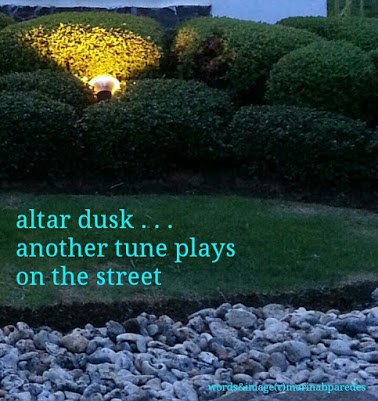
Just the right pacing and the right words. We begin with “altar dusk,” suggesting that this haiku is about a religious or spiritual activity. With dusk, that activity is ending, but we have the ellipses (…) telling us something else might happen, or that the dusk is slowly carrying on.
The second line comes as a pleasant surprise. It suggests that there was music during the religious or spiritual event, but now another form of music is being played. But where?
The third line gives us the answer. The music is coming from outside. In a sense, the poet is implying that the religious or spiritual music is being playing on through street music. This concept bridges the spiritual world with the human world, and makes it one, though the poet skillfully does not say this directly. Oneness is an often-used concept in haiku–usually from surprising counterparts.
I like the sound of the haiku as well. “altar” and “another” have a nice tune, and “dusk” and “tune” make good use of the “u” sound, which sounds musical.
The photo adds to the imagery already in our mind. We see a street lamp, which can be seen as an extension of the alter lamp, but in a suburban setting.
I enjoy how the haiku and accompanying image portrays the thought that spiritual and religious activity need not be stuffed in a box, but can be expressed in many different forms, even street music.
– Nicholas Klacsanzky (Ukraine)
 Haiku Commentary