
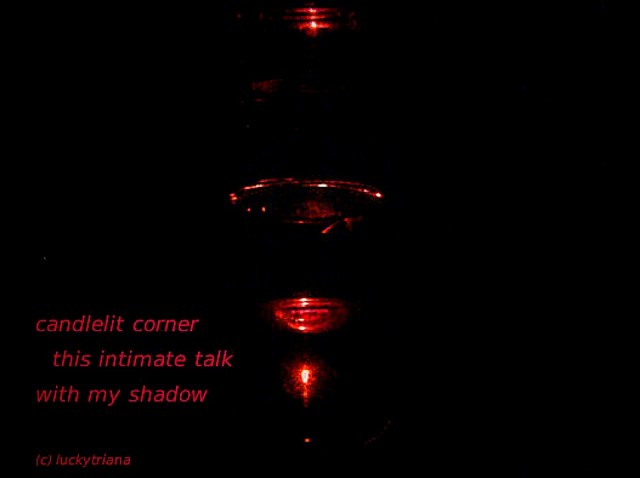
To me, the power of this haiku is the surprise ending. The first two lines set up a scene and atmosphere, and then the third line hits us with the reality of the moment.
After the surprise is made, readers might think, “Why is the poet talking to her shadow?” It could be a mental problem, it could be a sign of desperation, it could be a sign of an epiphany, or it could be even a sign of joy. The poet did not tell us which one it is, but from the tone of the poem, I would guess it is more tending towards melancholy and somberness.
What is interesting about the haiku and the “aha” moment is that despite the poet being alone, the candle itself has created a shadow for the poet to be comforted with and to even converse with. So basically, the poet is saying that we are truly never alone.
What this intimate talk entails is anyone’s guess, but I consider it to be an introspection about the direction of the poet’s life.
I like the alliteration of “candle corner,” the “t” sounds in “intimate talk” and the “l” sounds in “candlelit” and “talk.” The sound of the haiku is appealing and makes the reading of it more stark.
In addition, I like the mysteriousness of the photo. Its ambiguousness lends us to thinking that it could be a sunset, abstract art, or something otherworldly. This mood heightens the mood of the haiku.
The haiku (or shahai, because it is a photo-haiku) comes across naturally, but I am sure Lucky spent more time on it than what is perceived. But well-written haiku should across as effortless, and this one is a fine example.
– Nicholas Klacsanzky (Ukraine)
 Haiku Commentary