
closed casket kin gather after a long time
© Panagiotis Kentikelenis (Greece)
A heartfelt senryu that reflects human miseries and departures. “closed casket” may symbolize death, annihilation, and endless miseries where a person exists but does not live life fully. In this case, I can see the departure of a lone person who was abandoned by his family and/or having prolonged illness. The only misery here is that people wait for the death of such relatives, who become a hassle for the family—especially when one has to visit them every day. These days, people rarely visit their relatives because of busy lives. So, only the departure of someone makes an extended family come together in order to attend the funeral, and that visit is just a formality in most cases. So, the closed casket also symbolizes the death of values, sympathy, and the human factor that is missing these days.
– Hifsa Ashraf (Pakistan)
I was impressed by this strong juxtaposition around the topic of accepting death. By reading this poem, i tumbled into one of the myths i most love: Orpheus and Eurydice. Famous is the unforgivable mistake the lover commits by coming back from the realm of the dead, the Persephone’s, the underworld. According to Phaedrus in Plato’s Symposium, the infernal deities only “presented an apparition” of Eurydice to him. Plato’s representation of Orpheus is in fact that of a coward; instead of choosing to die in order to be with his love, he mocked the deities in an attempt to visit Hades, to get her back alive. As his love was not “true”—meaning that he was not willing to die for it—he was punished by the deities, first by giving him only the apparition of his former wife in the underworld and then by having him killed.
Coming back to the words of the poem, “kin gather after a long time” gives the idea of escapement and a sad reason to meet each other. It is the consequence of the increasing loss of family bounds in contemporary society, no more interested in developing emotional ties among blood relatives as in the past….
This poem is a chilling warning to live life generously by sharing our emotions and experiences rather than to be lonely and self centered.
– Lucia Fontana (Italy)
Senryu often exhibit a dark irony, and this poem is a fine example of this case. A family comes together to see a loved one at a funeral that has not seen each other for an extended period of time, but they do not even have a chance to see this relative due to the closed casket. It reminds me of when certain relatives at a particular funeral I attended gave many flowers, but they rarely gave flowers to this person during the time she was alive. As Hifsa said, family gatherings, even funerals, are now becoming increasingly detached from emotion and connection. The irony in this senryu points to this societal conundrum well without stating it.
I also enjoyed the economy of this senryu, as in only eight words, it carries a lot of meaning and implications. This is even more evident in the fact that it is a one-liner. By being a monoku, it can be read in several ways: “closed casket/kin gather after a long time,” “closed casket kin/ gather after a long time,” and “closed casket kin gather after a long time.” This allows the reader to find more nuances in this seemingly simple verse.
Sonically, the first three words begin with a “k” sound. This lends to the starkness of the moment. In addition, the long “o”s of “closed” and “long” adds to the melancholy.
A succinct one-line senryu that creates pointed commentary on the nature of our modern familial relationships—especially its disconnection.
– Nicholas Klacsanzky (Ukraine)
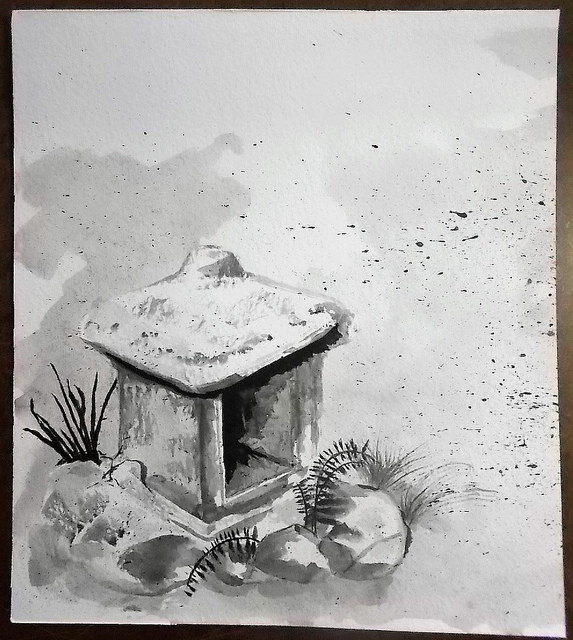
– Art by Ron Frazier
Did you enjoy this poem and commentary? Let us know in the comments.
 Haiku Commentary
Reblogged this on Frank J. Tassone and commented:
#Haiku Happenings #6: Nicholas Klacsansky presents a haiku ( with commentary) by PANAGIOTIS KENTIKELENIS!
LikeLiked by 1 person