Paul Reps’ Green Tea

50565309_309250386372128_8422852160798064640_n

Paul Reps (1895 – 1990) (USA)

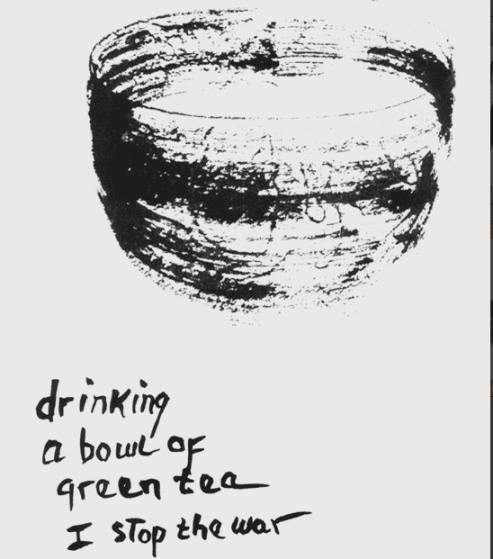
First, some background on this haiga:

“In the early ‘50s, Reps, who was in his forties, had traveled to Japan en route to visit a respected Zen master in Korea. He went to the passport office to apply for his visa and was politely informed that his request was denied due to the conflict that had just broken out. Reps walked away, and sat down quietly in the waiting area. He reached into his bag, pulled out his thermos and poured a cup of tea. Finishing his tea, he pulled out a brush and paper upon which he wrote a picture poem. The clerk read the poem and it brought tears to his eyes. He smiled, bowed with respect, and stamped Reps’ passport for passage to Korea.”

– Excerpt from Living in Balance, by Joel & Michelle Levey

Commentary

This short, intense poem has two aspects that make it interesting and deep in many ways. One aspect is related to our desire to calm our head after fatigue or mental stress. The green tea acts as a pacifier that brings the poet’s chaotic mind to peace. I believe in “tea meditation,” as it helps us to change our intense feelings that are usually a result of our shallow thoughts.

Keeping the background of this poem in mind, I think it is about fatigue due to the person feeling irritated or frustrated. It may be due to his long journey to another country, where he is not getting proper assistance. The tea brought soothing effects to his mind and he started thinking rationally about the situation.

Another deep aspect of this poem is spiritual, where a drink is the central part of the meditation practice. It is said that drinking green/herbal tea not only changes our biochemistry, but also helps us to filter/purify certain thoughts/feelings that are toxic in our nature. Every single sip of a drink works to simmer down our intense emotions and eventually facilitates us to clear our mind.

Besides these two aspects, I also see a deep connection between the person and nature, where green tea acts as fresh air in the chaotic life of a person, and helps him to get rid of the war that usually takes place in his mind.

Hifsa Ashraf (Pakistan)

From the time we are little babies, we learn to simmer down by drinking milk. To drink is a way to get in touch with our mother, and in the beginning, our mother is all of our world, so we begin to make experiences of the world by sipping. Soon, we learn also that tensions can be released by sipping milk from our mother’s breasts, and the link is that we need to sip to settle down mental or physical pain.

Later on, we can lose this habit. Usually, we find a substitute with our favorite drink and take a pause from the world, and quite often from its bitterness, by drinking it… many people unfortunately make use of alcohol, trying to relax themselves … in Italy we have the “coffee break,” which i would rather call the “tea break”… Seriously talking, a tea, even if we focus only on the water by which it is made, it has electrolytes which help the nervous system to calm down and to work in its best way.

The “cha no yu” or tea ceremony in Japanese culture has its sovereignty in the green powder melted in hot water with elegance, calm gestures, and clean movements, which add magic to the rite. There’s no doubt the monks can meditate at their best after a cup of it.

The poet uses a four-line structure, reproducing the interruptions caused by sipping, opening the second line with “of” as if he is talking and suddenly he has to stop and sip before going ahead with the poem…

To accept a conflict and not to let it steal our energies means to have the third chakra, in the area of the stomach, well balanced. People who practice meditation know that wars are probably started by people with problems with the third chakra…. Furthermore, we can move on from bad experiences if we can “digest” them, and a hot cup of tea in our hands, or better, a bowl, can really make the difference for this chakra, helping to relieve any difficulty in the process of metabolism of difficult feelings we need to cross, accept, and also let go of …

I’m amazed by the spirituality very well conveyed by Reps in his ink drawing. The perfection of the lines recalls an ensō in my mind, and reminds me of how important it is to stop and look inside, in the circle of our inner world, to find a clean, simple but powerful thought of purity and peace. The meditation of the author sounds like it is activated by the green tea’s molecules, which could set forth a chemical change soon perceived by his neurons, and felt as the strong inner movement of stopping something dangerous, a war. If only we could all do this, and together, there would be no more wars in the world… A very touching poem, with a wise and powerful message.

Lucia Fontana (Italy)

This Zenku is beloved for its simplicity. The pacing of the poem, the starkness of the painting, and the surprising last line creates many feelings and interpretations. We often forget that the commonplace can solve world problems. Moments of peace can add up to world peace.

The sense of sound works effectively too. The “o”s in “bowl,” “of,” and “stop” give a sense of vastness, in my opinion. Also, the “r”s in “drinking,” “green,” and “war” provide a feeling of roundness, like a whirring.

Sometimes things are inexplicable, but not, at the same time. I think this applies to this haiga.

Nicholas Klacsanzky (Ukraine)

Did you enjoy this haiga and commentary? Please let us know in the comments section below. 
 

Lucia Fontana’s Sakura

40914358_904528076423327_7907422073432047616_n

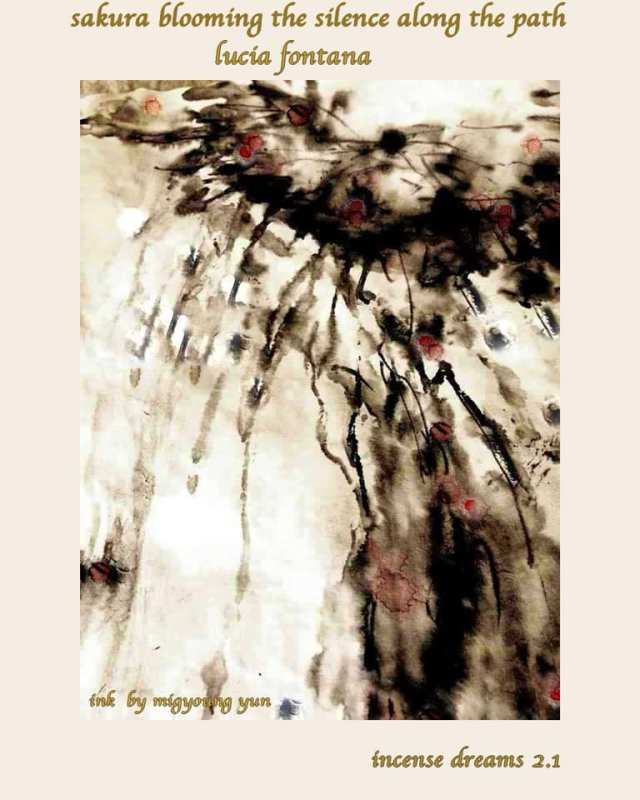
A beautiful haiga that is well conceived. In Japan, the sakura symbolizes spring or renewal, which means it also brings hope in life when it blooms. In this haiga, the sakura reflects the awakening of meditative thoughts that a person yearns for whilst strolling or walking on a path. It also means the person is contemplating about his/her deep thoughts and is taking some inspiration/motivation from nature.

On the contrary, the feelings may be opposite to what is described above. Maybe fallen or wilted sakura are present, which suggests hopelessness or a change in mood. Maybe a person is oversensitive towards some deep realities of life and relate them to nature.

Overall, the haiga indicates our approach towards different realities of life that can be either positive or negative. However, our deep understanding of those realities makes a lot of difference.

Hifsa Ashraf (Pakistan)

A very traditional haiga. The image brings us into the spring, when the weather is changing. To me, it brings a change of mood: a beautiful festival, the blooming of  sakura, people finding time in their busy lives to take a breath to admire nature.

I was surprised by the second part of the poem. I would say it brings a more modern feel to it, or a nice twist. It brings us back to the sakura, like a reminder.

Maybe there is a touch of sadness, but the second part says, “Hey, its okay to look at the sakura… it’s still blooming, and it will bloom each spring like many years before.” So, this image keeps us moving forward, and is inspiring.

Laughing Waters (USA)

I like that there are two ways of reading the content of this haiga: “sakura blooming/the silence along the path” or straight through as “sakura blooming the silence along the path.” This is one of the reasons why one-line haiku are ideal for suggesting various interpretations.

In relation to the first interpretation, the silence might be created by the beauty of the sakura, and people viewing them in awe. Also, such elements of nature are often silence-inducing, as they make us witness instead of analyzing. “The path” could pertain to a physical path, or one’s spiritual path. I think the poet is referring to both in this haiku. There is always the harbor of silence along one’s spiritual path that one can tap into through meditation and being one with the present.

If one reads the poem in a straightforward manner, it appears as the sakura are physical manifestations of silence. In fact, most things bloom without us even paying to them. We often take the growth of plants and natural life in general for granted.

I noticed the musicality of the content as well. With prominent “o” and “s” sounds, the reader can feel the relaxing nature of the stroll. And at 7 words, the monoku is quite efficient in conveying its mood and scene.

Yun, the artist, has complemented this haiku with a fine abstract sense. With the surrealistic portrayal of blossoming sakura, the meditative and spiritual haiku is expanded upon. In my opinion, the art might even bring a touch of melancholy to the overall impression.

Lucia is an expert in haiga, and it is no surprise that this haiga works so well. I look forward to see more collections of her haiga online.

Nicholas Klacsanzky (Ukraine)

Let us know what you think about the haiga and commentary below.

Sydell Rosenberg’s Feather

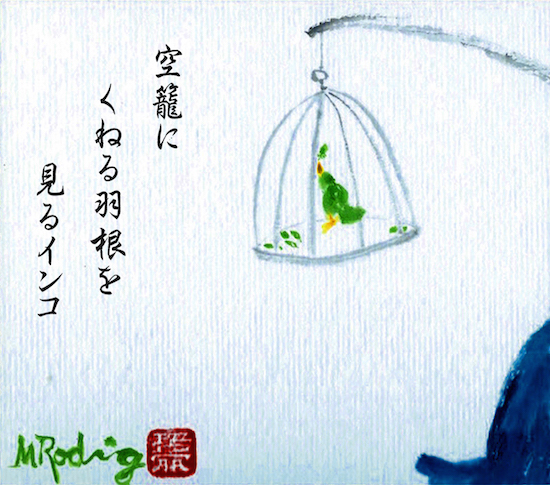
in a toyless cage
the parakeet discovers
a feather to twirl

02

Haiku by Sydell Rosenberg (USA) (1929-1996), art by Mary E. Rodning (USA), and translation into Japanese and calligraphy by Hiromi Inoue (Japan).

A nice collaboration (I do not know or read Japanese, so I don’t know about it, other than the looks of the writing is aesthetically pleasing). The crueltyI suppose it is unintentionalof a captive spirit is stated matter of factly. It is a powerful piece. The three elements work well together, but the haiku easily stands alone.

– Dana Grover (USA)

This is powerfully sad and shows how pathetic it is to capture a free spirit (wild bird) and keep it prisoner in a cage. I find that objectionable. The feather seems to symbolise the loneliness of the bird.

– Martha Magenta (UK)

To me, it shows desperation with ingenuity and intelligence of a captured being, but do animals have emotions such as being bored? This is a debate that’s been going on for a long time. I noticed that this was written in the 5-7-5 format and I can imagine the difficulty of writing the first line without telling too much, which to me it does.

Since the image already shows a cage why not emphasize it and not repeat what’s already shown?

Ex:

toyless prisoner
the parakeet discovers
a feather to twirl

Just thinking of the possibilities, where I could be wrong as well. My 2 cents disclaimer.

– Fractled (USA)

Wow. I think it’s very potent. To me, it speaks clear of how horribly sad and senseless it is to confine another being created to be wild and free. I can only hope it conveys the message to others on how very wrong and inhumane imprisoning a fellow earthling is, along with the selfishness and cruelty of it.

– Michelle Hyatt (Canada)

L1 might work better without “in a” since “parakeet” and
“cage” suggest being within.

– Edwin Lomere (USA)

I think the poem is quite strong. It oscillates nicely between a theme of making the most of what you’ve got (“a feather to twirl”), and one of being trapped with little available to you (“a toyless cage”).

– Dave Read (Canada)

Wow… I have mixed feelings regarding this particular haiku, but the intention to convey loneliness is stark and well-taken. First, it saddens me that the little fellow doesn’t have any material/objects to keep itself occupied and happy while being confined.

You see, I have an African Grey that never knew of being in the wild, (I spoon-fed her during infancy) but she escaped twiceonce in Maryland and another time in Georgia. One of her phrases is, ‘Help me.” In her last escape, she stayed away for about a week (I forgot the exact time frame).

She ( Lilo) ended up flying onto a gentleman’s lap as he and his brother were chatting in an open garage. Because of posting Lilo’s description/markings and behaviour patterns in a nearby pet store, I was blessed to have her returned to me. She has a 6-foot cage, several toys, eats fresh fruit and seeds daily (she growls at vegetables) and is rarely confined. At this time in my life, I can’t imagine not having her as my companion (she can live up to 60 years+).

I have spoken with many people, including friends, who believe birds should be free. Well, I must say horses should be free too. :)

Many animals can be domesticated. More importantly, to me, they should be treated with as much kindness as the next person. I have to admit most of my friends have 4-legged pets. It just so happened a little bird who truly talks to me became my best friend. That is not to say I’m not fond of felines & canines as well.

– Lovette Carter (traveler)

Since the haiku portion of the haiga has been commented on at length, I will do my best to discuss the art.

The white between the words and the cage, to me, portrays the loneliness the parakeet is feeling.

Most of the color is used on the bird itself, while the cage and the cage’s stand is painted lightly. This allows the viewer to focus on the bird as the main subject and see that with the play with the feather, the bird is perhaps drawn away from its loneliness. Even the poet’s name is written in green, which could point to the parakeet being a metaphor for the poet’s life.

At the bottom right, there is what appears to be a dark blue chair, which is an appropriate color for sadness.

Though simple, the emotions of the haiku runs through the art, and perhaps gives a glimpse into the true feelings of the poet.

– Nicholas Klacsanzky (Ukraine)

What do you think or feel about this haiga? Let us know in the comments.