Martha Magenta’s Stars

SAVE_20160518_192817

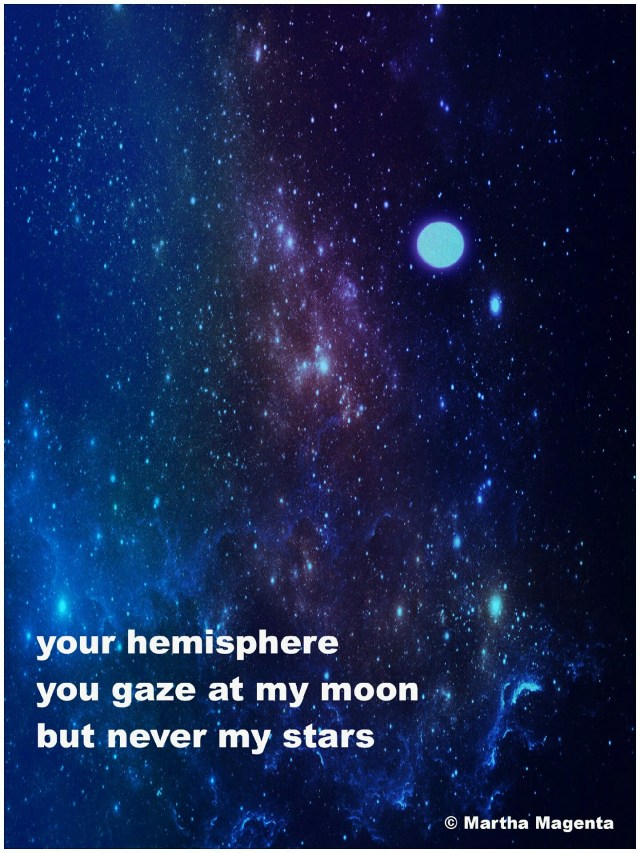
Each word in this shahai (haiku with a photo) is significant and carries many dimensions. Though the haiku can be taken literally, as two lovers far away from each other, and them gazing at different night skies, the metaphorical quality of the haiku easily comes through.

The tone of the haiku is almost argumentative. It is quite personal, like the reader is listening in on a couple’s heated conversation. “hemisphere” can mean literally the hemisphere one is in, or the hemisphere of the loved one’s brain, or in a more abstract sense, the perspective of the loved one.

“gaze” is not a light word here. From the tone of the haiku, it seems be used in a negative manner.

What I got from this haiku is that the poet does not like how a certain loved one perceives or notices only the exterior or holistic points in the poet, while the loved one is missing the “stars,” the small things that create the larger picture of who she is.

And what a large entity we have in the photo, of which appears to be a panorama of a galaxy or two (or maybe infinity itself, because we are infinite, right?). I believe this shows the wideness the poet wished the loved one saw in her.

Though there seems to be more than enough pronouns, the haiku is so engaging that I didn’t even consider it a problem.

The wording is concise and it is well-phrased. I would move this to being a senryu rather than a haiku based on its tone. But ultimately, the feeling behind the poem is more important than the categorization.

– Nicholas Klacsanzky (Ukraine)
Edwin Lomere’s Moonlight

cat

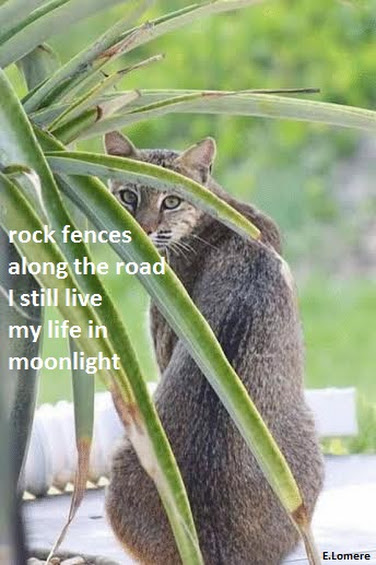
I enjoy the pacing of the tanka, the images “rock fence” “moonlight” “road” and of course the image of the cat! This is called shahai, which combines a haiku/tanka and an image. The image usually does not directly correspond to the haiku/tanka, but connects to it subtly. And Elomere did this wonderfully.

There is a connection between the rock fences and moonlight in color, and both seem timeless. Though both seem rustic, they are still majestic and stark. The connection between the two parts, however, seems more intuitive than intellectual.

The sense of sound in the tanka is wonderful, with connecting “r” sounds and “i” sounds, which separates the two parts even further. The last line comes as a surprise and makes us want to read the tanka a few times.

The ending image can mean many things. Moonlight in Zen philosophy can mean enlightenment or oneness or the self. Moonlight in other circumstances can mean sadness or contemplation.

The connection between the two parts or two statements is subtle and a bit of a puzzle. This is something that marks a fine tanka and/or haiku.

– Nicholas Klacsanzky (Ukraine)

Yumino Aoiro’s Wisteria

12+-+1


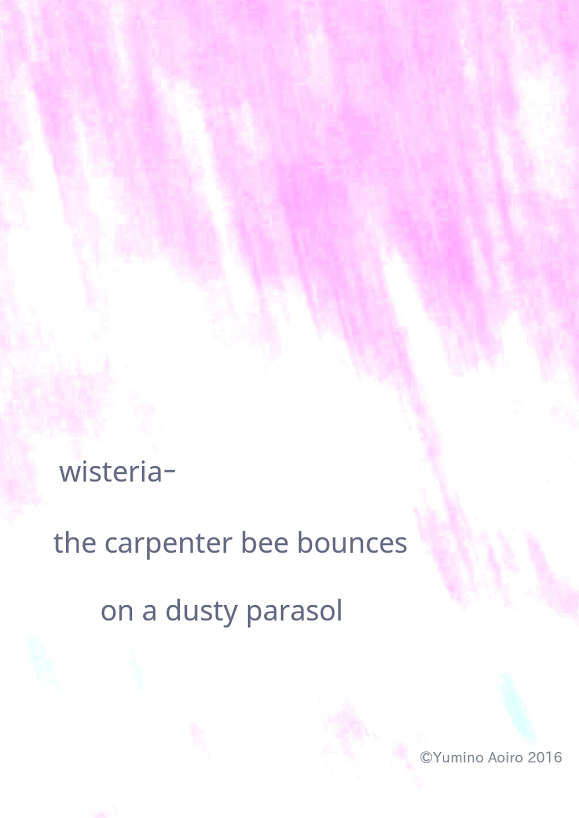
Firstly, I would like to note that this is a shahai, or a haiku accompanied by an image, or within an image. Yumino made an abstract representation of wisteria with the image, to my mind. But getting to the haiku itself, I like how each word is needed and works well. The first line begins simply with “wisteria-” which is a beautiful plant that blooms in late spring. So, the kigo, or seasonal reference points to it being about late spring. In late spring, animals are in a busy mood. And here comes the second line:

“the carpenter bee bounces”

And carpenter bees are certainly busy dudes in late spring. A bee bouncing is quite an interesting image. A nice alliteration is made with “bee bouncing.”

Bounces on what? “on a dusty parasol.” Why is the parasol dusty? Could be that the parasol has been left behind for some time, or that the dust is actually pollen (maybe wisteria pollen).

Yumino skillfully does not tell us, but shows how the pollen or dust lifts into the air from the bounce of the bee on the parasol, and how it is quite like the shape of wisteria blossoms. So, this haiku is a comparison haiku: it compares how wisteria pollen or dust looks in mid air when bounced off a parasol by a bee with how the wisteria blossom is shaped and hangs.

So, maybe Yumino is implying that wisteria blossom and pollen is one and the same. Whatever philosophical implications this means to you, you can introspect on it.

Note:

Check out how the third line is indented, giving us the space to imagine the bounce.

Also, take note of how Yumino used articles. “the” was used for the bee to give it is more importance, and “a” was used for the parasol to not steal the show from the bee.

– Nicholas Klacsanzky (Ukraine)