Jacob Salzer’s Cracked Pillars

cracked pillars
no longer stand
between us . . .
admitting all the times
I’ve been wrong

Ribbons, Spring/Summer, 2018

© Jacob Salzer (USA)

This week, we have a treat, as we have the poet himself giving commentary:

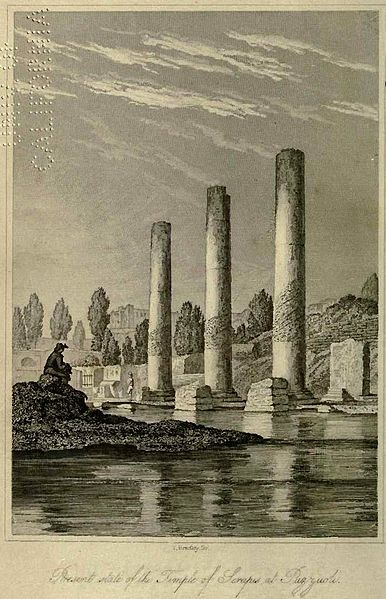
I envisioned cracked pillars from ancient Greece. As you know, a lot of the structures are now in ruins, broken down over time. Some of the pillars that once held heavy tops now stand alone, often cracked—but even those often break down, leaving only a slab of marble or perhaps a pile of stones. The pillars are actually metaphors for the sense of “I” which visually resembles a pillar. The vision was remnants of pillars in a row, and two people standing on each side of them. Basically, all that’s left of the pillars in the tanka are small piles of marble. By admitting my faults, my pillar, or sense of “I,” breaks down and I’m able to fully connect with someone else.

If you enjoyed this poem and commentary, please let us know in the comment section.

386px-Charles_Lyell_-_Pillars_of_Pozzuoli

Art by Charles Lyell

Elliot Nicely’s Small Worries

these small worries . . .
wave upon wave,
the ocean
collapsing
beneath itself

(Presence, #58, 2017)

© Elliot Nicely (USA)

A very well-crafted tanka that shows a relationship between our feelings and ocean waves. The opening line “small worries” takes us to our daily activities, where we constantly pass through a lot, and which lets our mind and heart oscillate between logic and feelings.

The ocean here symbolizes the deep feelings and thoughts that are sometimes unfathomable, and we can’t deal with them well. Waves upon waves may be our cognitive process that keeps on filtering our thoughts to find out some solutions based on logic. I can also see an element of ego here where a person’s worries can be related to his/her egoistic approach towards life. Waves upon waves in terms of the heart could be saying that feelings are blindfolded, and we can’t see that logic and thought dominates compassion, kindness, etc. In both cases, the worries or problems are not dealt with effectively, which may lead to destructive thoughts, poor relationships, and in the long run, poor mental and physical health.

Hifsa Ashraf (Pakistan)

Yes, small worries are but waves in our lives—they come and they go. In a moment, there are worries to think about and that give color to our mundane life. And then in the next moment, these are all gone and we’re back to our own silent and secure existence.

Willie Bongcaron (Philippines)

I like that this tanka points to the fact that we often get so wrapped up in the daily grind, that we often forget that our troubles are usually pretty minor. The ocean in the poem is a kind of reminder that each moment is new, and an issue of just the moment before can be washed away.

The word “collapsing” works well not only as an image, but also in its power. We commonly see ourselves as a linear story of a person. But in fact, we are always changing, and in each moment, we can choose to be a new individual.

Let’s talk about the punctuation a bit. The ellipsis reflects the continuous motion of the waves, and the comma allows the reader to pause a bit to imagine the waves. Also, take notice of the economy of language: no line is longer than three words, but each of them is strong and creates a stark image.

Sound is also important in this tanka. In my mind, the “s” and “o” sounds create the most prominent effects. The “s” letters seem to be making the “sss” of incoming waves, and the “o” letters appear to be mimicking the “ooo” of receding waves.

This tanka is written in a convincingly straightforward manner, but the last line surprises and allows us to introspect about how daily strifes are not so essential in the larger picture.

Nicholas Klacsanzky (Ukraine)

Did you enjoy this tanka and the commentary? Leave us a comment if you did.
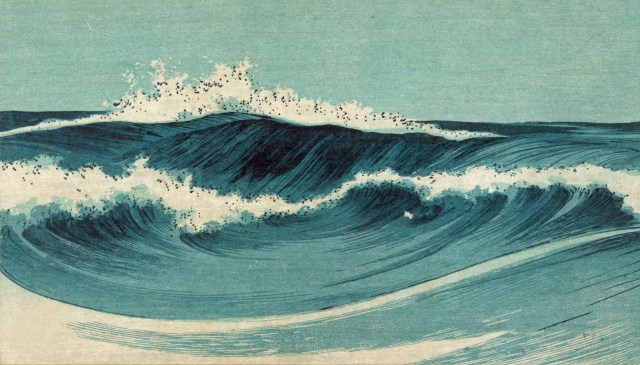
japanese-waves-painting

© Dawn Hudson

Lori Ann Minor’s Bland Tea

finding myself
as gray
as the sky
sips of bland tea
in the city winter

© Lori Ann Minor (USA)
Prune Juice, Issue 22, 2017

Ennui. I think at one time or another, we have all felt this way. Not depressed, not euphoric, just kind of blah. As we get older, become physically gray, are in a gray sky environment, those feelings do tend to come upon us. Ironically, as I began to respond to this, my wife asked if I would like some tea—she brought some to me, Earl Grey (decaffeinated). I like this tanka—it captures a human, most likely universal experience.

– Dana Grover (USA)

There’s a state called anhedonia that accompanies major depression and is indicative of that condition; sensations are muted and one can’t find pleasure in music, food, sex, or even the little things like a cup of tea. This tanka captures that muted, empty feeling quite well. In climates with long, dark winters, seasonal-affective disorder can be quite common. Here, the gray winter sky is an effective parallel to the ennui the speaker is confessing and the bland tea gives a vivid feeling of those January blues.

– Clayton Beach (USA)

To me, this feels a bit melancholic. “finding myself” plus “city winter” makes me feel that someone used to country life has to spend winter time in the city, perhaps due to an illness. Some people do develop ash-gray skin. Overall, I find this tanka a bit sad, but not overwhelming.

– Laughing Waters (Italy)

The content of this tanka has been sufficiently elaborated on, so I wanted to discuss the sound and pacing of the poem.

The most striking sound in this tanka to me is the use of “y” in “myself,” “gray,” “sky,” and “city.” The employment of “y” seems to point to the severity of the poet’s bland existence. There is also a heavy use of “i,” which slows the pace down, capturing the melancholic mood.

I feel lines 2-4, from the pacing, is the moment of “finding myself.” The last line appears to be an afterthought, as the poet introspects on her connection to her surroundings.

– Nicholas Klacsanzky (Ukraine)

What do you think or feel about this tanka? Let us know in the comments.