uprooting
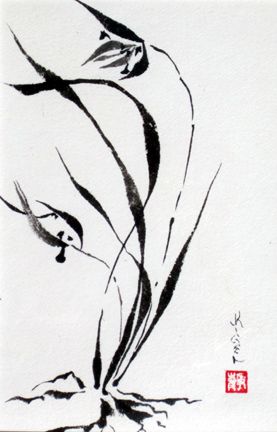
the last orchid
from its pot
I accept
my infertility
– Lori Ann Minor (USA)
First Place Winner, 2019 Mandy’s Pages Tanka Time Contest
The crisp pacing of this tanka brings out the starkness of the imagery. Succinctly, Lori zeroes in on a single act and relates that to her state of being. You can say the poet felt the Japanese aesthetic of “aware,” which relates to an object or thing conjuring emotions when perceiving it.
It seems that the poet finds a moment of connection between an orchid and herself, maybe symbolically. This kind of sentiment is expressed in Japanese poetry often and is a highly effective way of conveying a state of being. Instead of elaborating about oneself or others, poets of Japanese forms allow plants and animals to embody who they are.
Maybe the poet looked at the uprooted orchid, in all its beauty and frailty, and spontaneously had a sense of acceptance about her infertility. Or, maybe this acceptance came well after the fact. It does not matter so much about the time frame. What is significant is that readers can instantly feel the power of the words while reading this tanka. The emotion with which the poem was written is effectively conveyed, and that is the most a poet can wish for. A piece of themselves is passed onto the reader and so, the poet lives on in those who read their work.
I enjoy the humbleness of this poem. It gives the feeling that a plant and a person are not so far apart. In a way, the orchid becomes a conduit through which Lori can find acceptance. In this sense, the orchid is a martyr without even knowing it is.
The main sound I hear in the tanka is the repetition of “t.” It might mimic the “tick” or “thud” of an orchid being uprooted. Also prevalent is the use of “o,” which slows down the pace to allow the reader to take in the tanka to a greater extent.
The first line standing as “uprooting” makes the experience of imagining the poem more intense. From there on, the line breaks are more standard but well done.
A poignant tanka that uses excellent pacing, sound, and imagery to deliver a feeling straight from the poet to the reader.
– Nicholas Klacsanzky (USA)
Did you enjoy this tanka and commentary? If so, please leave a comment.
 Haiku Commentary