Lucky Triana’s Intimate Talk

84-tsMX2oY9FJ5zeMCyKpyjXRQL8cf7S3C5T9D_1QPmBWAYxjBh1ksM6b6a-_-DbdwhDPER07Q=w2095-h1179-no

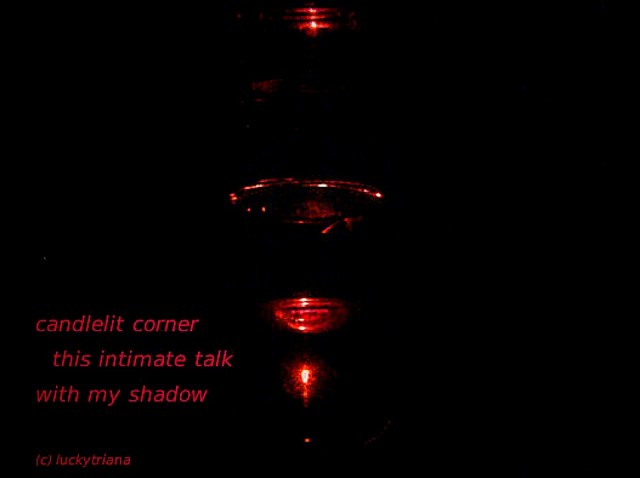
To me, the power of this haiku is the surprise ending. The first two lines set up a scene and atmosphere, and then the third line hits us with the reality of the moment.

After the surprise is made, readers might think, “Why is the poet talking to her shadow?” It could be a mental problem, it could be a sign of desperation, it could be a sign of an epiphany, or it could be even a sign of joy. The poet did not tell us which one it is, but from the tone of the poem, I would guess it is more tending towards melancholy and somberness.

What is interesting about the haiku and the “aha” moment is that despite the poet being alone, the candle itself has created a shadow for the poet to be comforted with and to even converse with. So basically, the poet is saying that we are truly never alone.

What this intimate talk entails is anyone’s guess, but I consider it to be an introspection about the direction of the poet’s life.

I like the alliteration of “candle corner,” the “t” sounds in “intimate talk” and the “l” sounds in “candlelit” and “talk.” The sound of the haiku is appealing and makes the reading of it more stark.

In addition, I like the mysteriousness of the photo. Its ambiguousness lends us to thinking that it could be a sunset, abstract art, or something otherworldly. This mood heightens the mood of the haiku.

The haiku (or shahai, because it is a photo-haiku) comes across naturally, but I am sure Lucky spent more time on it than what is perceived. But well-written haiku should across as effortless, and this one is a fine example.

– Nicholas Klacsanzky (Ukraine)

Dave Read’s Moose

Banff Trail
he shoots a moose
with his iPhone

failed haiku v.1 i.1

© Dave Read (Canada)

“Banff Trail” refers to a trail in Banff National Park–the oldest national park in Canada. Then we get this rather intense image of a moose being shot. But wait… when the third line comes, we realize the moose is only being shot by an iPhone camera. But this surprise is more than just wit.

Dave, I believe, is contrasting the old and new–a prominent theme in haiku/senryu. Banff National Park, as I said, is the oldest national park in Canada, and this is being contrasted with the freshness of an iPhone. And in this new generation, we shoot moose with our iPhone cameras rather than our guns.

I think this poem is a remembrance, however witty it seems on the surface, of how our old generation hunted such beautiful and epic creatures without remorse. Though we may chuckle at the poem, beneath its humor is a long history of making the moose almost extinct.

The “o” sound is prominent, with “shoots” “moose” and iPhone.” It gives a sense of distance and maybe the range of shooting either a camera or gun.

Though simple and humorous, Dave has given us a reminder of our past and how we have progressed as a race.

– Nicholas Klacsanzky (Ukraine)

Eric Loman’s Window

an old man 
at an empty window, kissing
only he remembers who

© Eric Lohman (USA)

I think this senryu or haiku (though I would lean more towards a senryu) is multifaceted. It seems sad, funny, and delirious at the same time. This is due to the mystery that Eric leaves the reader with. If Eric simply told us who the old man is kissing, then the poem would have less impact on a reader.

One of the key words in this poem is “empty.” Maybe the old man is in a senior housing building and the mundaneness of the housing grounds can be seen. And such simplicity can drive some people crazy. The old man might be all alone–his family not visiting him regularly, and he is indulging in a memory of a kiss.

When we imagine him kissing the air, puckering up, we get a sense that the old man feels a mix of emotions. This mix of emotions sharply contrast the boring senior housing or empty house he lives in.

I like how Eric put a comma in the second line and made the third line come as a surprise. This is a key element in haiku: surprising the reader. After the surprise, the reader can get a moment of spiritual or philosophical insight.

In the case of this poem, I think it is the insight that the life of an old person is much more complex than we usually imagine. They might stop speaking, but memories rush through their minds, and they contemplate a life lived, with all its consequences and blessings.

– Nicholas Klacsanzky (Ukraine)