Marilyn Ward’s Rainfall

2016 - 1

I believe this photo-haiku brings out the humility of animals and the no-mind state that spirituality expounds on.

In the first line, we get the pleasant image of spring rain, which is a sign of nourishment and kindness, you could say.

The second line presents a mystery. Who is drinking out of the gutter? And from such a pretty scene as a “spring rainfall” we get the contrast of a gutter.

In the last line, we learn that a goldcrest, a lovely, small bird, is drinking out of the gutter. I think it is called a goldcrest because of its royal appearance of a gold streak on its head and wings.

This royal bird is drinking from a gutter, and just accepts life as it is. It doesn’t have thoughts like, “I am above drinking out of a gutter–I am a magnificent bird.” It just drinks because it is thirsty and the water happened to be there. The use of “a goldcrest” instead of “the goldcrest” further shows the humility of the bird. The freshness of the spring rain is compared to the fresh mind or beginner’s mind of the bird.

The isness of this haiku is much in line with Zen philosophy. In Zen, there is a philosophy that having awareness without thought is a state of meditation. If you have thoughts, you are not truly meditating. You are adding your own shades to reality when you have thoughts. Reality, as it is, is something different than what we think or feel about it. It just is, and this haiku, in my mind, champions this philosophy.

The sound of the haiku is quite nice with “r” going through “spring” “rainfall” “drinking” “gutter” and “goldcrest.” The “r” sounds, coincidentally, like rain.

The photo shows the beauty of the spring rain and the lettering adds further to the mood of the haiku.

A fine photo-haiku that just is.

– Nicholas Klacsanzky (Ukraine)

Lucky Triana’s Intimate Talk

84-tsMX2oY9FJ5zeMCyKpyjXRQL8cf7S3C5T9D_1QPmBWAYxjBh1ksM6b6a-_-DbdwhDPER07Q=w2095-h1179-no

To me, the power of this haiku is the surprise ending. The first two lines set up a scene and atmosphere, and then the third line hits us with the reality of the moment.

After the surprise is made, readers might think, “Why is the poet talking to her shadow?” It could be a mental problem, it could be a sign of desperation, it could be a sign of an epiphany, or it could be even a sign of joy. The poet did not tell us which one it is, but from the tone of the poem, I would guess it is more tending towards melancholy and somberness.

What is interesting about the haiku and the “aha” moment is that despite the poet being alone, the candle itself has created a shadow for the poet to be comforted with and to even converse with. So basically, the poet is saying that we are truly never alone.

What this intimate talk entails is anyone’s guess, but I consider it to be an introspection about the direction of the poet’s life.

I like the alliteration of “candle corner,” the “t” sounds in “intimate talk” and the “l” sounds in “candlelit” and “talk.” The sound of the haiku is appealing and makes the reading of it more stark.

In addition, I like the mysteriousness of the photo. Its ambiguousness lends us to thinking that it could be a sunset, abstract art, or something otherworldly. This mood heightens the mood of the haiku.

The haiku (or shahai, because it is a photo-haiku) comes across naturally, but I am sure Lucky spent more time on it than what is perceived. But well-written haiku should across as effortless, and this one is a fine example.

– Nicholas Klacsanzky (Ukraine)

Marina Balmaceda Paredes’ Breath

16+-+1

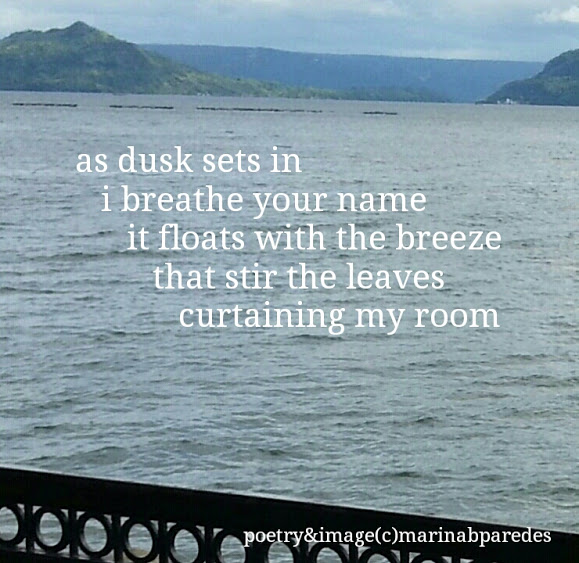
I love the journey of this tanka. It shows how our actions, like a simple breath, can be integrated with the nature and return back to affect our lives later on. The photo adds to the atmosphere, and maybe makes the breeze a sea breeze.

Names are kind of like leaves. They grow out from a being and are reminders of who we are. The poet is probably speaking the name of a loved one and has an insight about how her breath is carried throughout the natural world and returns to her own place of residence, throwing up leaves in her window to make a curtain in order for her to sleep better. The last line comes as a surprise and makes one peaceful simultaneously.

The sound of the tanka is resonant. The “i” sound flows through it with “i” “it” “stir” and “curtaining.” This sound gives off a starkness. Also, “breeze” “leaves” and “curtaining” have a sort of internal rhyme that makes me feel the wafting of the breeze more.

I also enjoy how the poet sets the lines, like a breeze carrying on. Marina has worked on this tanka thoughtfully and with great intention.

– Nicholas Klacsanzky (Ukraine)