
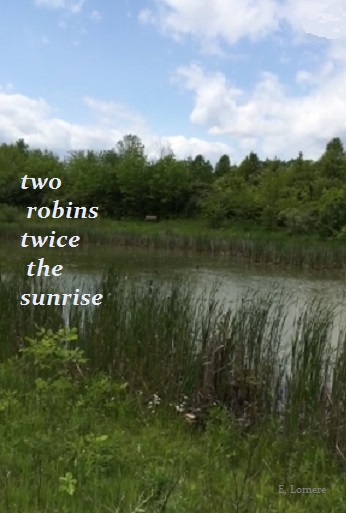
Words and image © Edwin Lomere (USA)
It is so simple, only one word per line, but it is pregnant with meaning and implication. The photo is taken after sunrise, and appears to be the aftermath of the sunrise. The photo shows two sides of a river or pond, which coincides with “two robins.” As with most shahai, or photo haiku, the photo does not directly reflect the haiku, but adds to it or creates more implications.
The red breast of the robin compliments the red of the sunrise. Also, the song of robin is at once majestic and cheerful, like a sunrise. But with the two robins, the haiku could be implying the sunrise has not happened yet, but the sunrise has been represented twice in the robin’s look and song.
Another reading of it is “two robins twice/the sunrise” which is saying that the sunrise is like seeing or hearing two robins twice. It brings in an aesthetic of fullness that is dear to haiku.
I think this is a spring haiku, not only from the view of the photo, but from the cheerful atmosphere created by the poet.
The sound of the haiku is quite pleasant, with the “o” sound running through “robins” and “two,” and “two” and “twice” having a play with the “t” sound. The “i” sound is in “twice” “robin” and “sunrise, all of which gives a musical quality to the haiku–maybe imitating the song of the robin.
I think the poet slowing the poem down to one word per line makes us not only appreciate each word more, but saves us from having it like:
two robins
twice
the sunrise
…which would afford us less chances to read it differently.
– Nicholas Klacsanzky (Ukraine)

 Haiku Commentary