
Yumino Aoiro’s Cicada

05 - 1

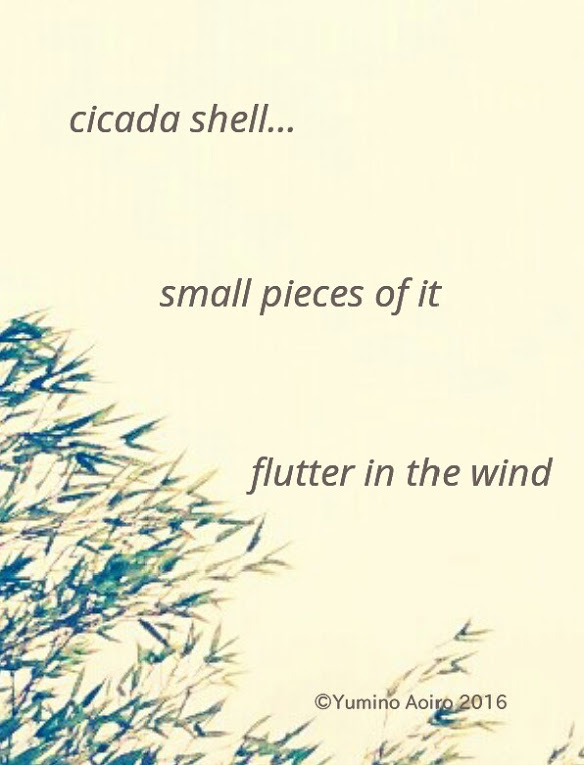
In this haiku, we have a classic aesthetic showcased: continuance. With the first line, we understand that the cicada has moved out of its larva shell, but what happens after…

Its shell flutters in the wind, almost like its real self, now flying through the air–only for a short time though. The short-lived nature of both the fluttering shell and the cicada itself is poignantly shown in one’s imagination. Though the shell is living a new, “full” life of a cicada by flying in the air (even fluttering like wings), that life will end too soon.

The ellipses is used well to show the continuation of the shell and to make the two parts in the haiku clear. The lines are short and the words are not complicated, which is important in haiku. Also, both parts are easy to understand.

This haiku is a sketch from life, of which master haiku poet Shiki championed. Something simple, objective, and in the moment is celebrated and focused on with a sense of awe.

The alliteration of “shell” and “small” emphasize the importance of these words, and the “i” sound carried through the poem in “cicada” “pieces” “it” “in” and “wind” gives this haiku a sense of sharpness.

The art, what I presume to be bamboo leaves, resemble the shape of the fluttering wings of a cicada well and create a definite mood. How the lines are laid out on the page show a continuation as well.

Yumino seemed to put a lot of thought behind the words and image of this haiku. A great haiku with much to think about and to feel.

– Nicholas Klacsanzky (Ukraine)
 

Yumino Aoiro’s Sincerity

18 - 1

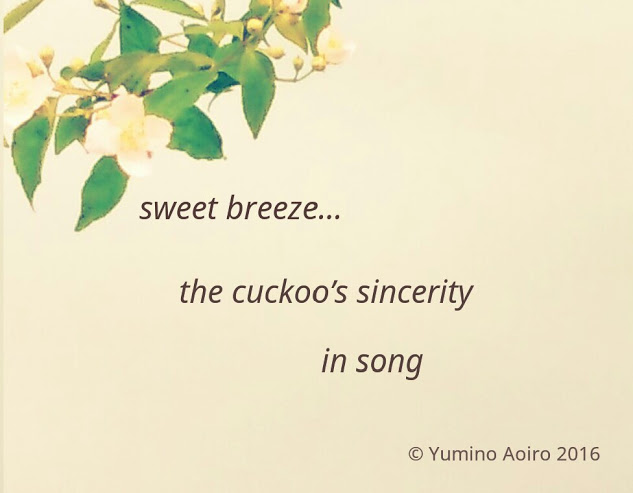
A precise haiku written Yumino Aoiro, who is also an artist and usually accompanies his haiku with a visual of simple elegance. He has been producing beautiful work for as long as I have known him and I have to keep in mind that “English” is not his native language.

I like the idea of using “sincerity” in the song of the cuckoo as a descriptor in the haiku. “Sincere” means open and not deceitful, and this captures the beauty of all nature. It simply is what it is. The beautiful part is that the cuckoo doesn’t know that we see her as “sincere.” She exists somewhere in her song. She flies in whatever routes or courses that come to her in that moment; hopefully, a safe one, but, maybe not.

We benefit from that song in gaining some clarity for ourselves. Regardless of our ego and “intelligence” we can only be what we are.
I think  Yumino indirectly tells us this in his haiku. It is there for the taking.

He also gives us a “sweet” (warm) “breeze.” It is gentle and we can feel it if we pause at the ellipsis that he provides; we pause and feel the breeze: sweet breeze… We share the breeze with all things and we are held for a moment in the haiku to realize this.

Of the cuckoo sounds that I have heard, there seem to be two musical intervals: the darker minor third, and the brighter major third. Either way, we know those two famous tones around the world. It is only the cuckoo calling. “Singing,” as we think of it, in its own musical birdly world.

Yumino san takes us into that little, yet expansive world and we rest for a moment in the interval. He has given us a haiku of simple elegance and balance. Something classical has formed like the human mind desires. Something we can access and have sought out for generations: it is simplicity, a slower world, earth-time.

– Edwin Lomere (USA)