
Yumino Aoiro’s Sincerity

18 - 1

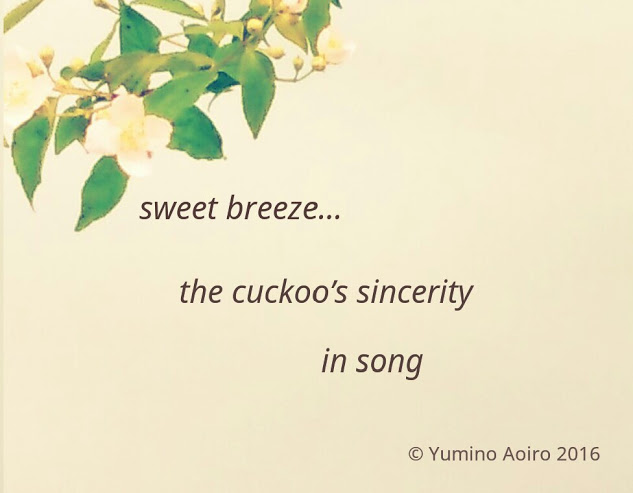
A precise haiku written Yumino Aoiro, who is also an artist and usually accompanies his haiku with a visual of simple elegance. He has been producing beautiful work for as long as I have known him and I have to keep in mind that “English” is not his native language.

I like the idea of using “sincerity” in the song of the cuckoo as a descriptor in the haiku. “Sincere” means open and not deceitful, and this captures the beauty of all nature. It simply is what it is. The beautiful part is that the cuckoo doesn’t know that we see her as “sincere.” She exists somewhere in her song. She flies in whatever routes or courses that come to her in that moment; hopefully, a safe one, but, maybe not.

We benefit from that song in gaining some clarity for ourselves. Regardless of our ego and “intelligence” we can only be what we are.
I think  Yumino indirectly tells us this in his haiku. It is there for the taking.

He also gives us a “sweet” (warm) “breeze.” It is gentle and we can feel it if we pause at the ellipsis that he provides; we pause and feel the breeze: sweet breeze… We share the breeze with all things and we are held for a moment in the haiku to realize this.

Of the cuckoo sounds that I have heard, there seem to be two musical intervals: the darker minor third, and the brighter major third. Either way, we know those two famous tones around the world. It is only the cuckoo calling. “Singing,” as we think of it, in its own musical birdly world.

Yumino san takes us into that little, yet expansive world and we rest for a moment in the interval. He has given us a haiku of simple elegance and balance. Something classical has formed like the human mind desires. Something we can access and have sought out for generations: it is simplicity, a slower world, earth-time.

– Edwin Lomere (USA)

Isabella Kramer’s Sleeping Crows

sleeping crows
under the milky way
nightingale’s echo

© Isabella Kramer (Germany)

I enjoy the subtlety and epicness of this one. The crows are sleeping, and their various calls cannot be heard any longer, but the nightingale’s echo (not song, but echo of it, which is important to note) still resounds. The nightingale exhibits many sounds while singing, like whistles, trills, and gurgles. And this echo of its song is underneath the expanse of the milky way.

Firstly, as a reader, I can say it is simply an exquisite image. But beyond that, we have a continuation of sound in the nightingale–and at night, when dangerous things are supposed to happen. The nightingale’s song is loud and immensely beautiful, and is a common subject for poetry because of its enamoring song.

Why is it important that it is an echo of the song rather than the song itself? I think because when we look up at the milky way, its distance is clear, but its beauty is still mesmerizing. The same could be said about the echo of a nightingale’s song.

The nightingale as a kigo or seasonal reference is for all seasons. Comparing that reference with the seeming eternity of the Milky Way is poignant.

The colors are also important to mention. The milky way could be said to be white and the crows are black. Though we would associate the night with darkness, the bright milky way and the bright song of the nightingale fill it with a brilliant atmosphere. Readers might ask the question, “Is night really night?” And for that matter, “Is anything really as it is?”

I think Isabella used the “o” sound effectively with the ends of line 1 and line 3 being “crows” and “echo.” Also notice the use of “l” with “sleeping” “milky” and “nightingale” which makes the haiku more musical.

A succinct, but grand haiku.

– Nicholas Klacsanzky (Ukraine)