Haiku by Quamrul Hassan, Tom Bierovic, and Martina Matijević

all her feelings for him coming back first snow

Quamrul Hassan (USA) 
published in the Wales Haiku Journal, Winter ’25/26 edition

Commentary by Jacob D. Salzer:

An interesting haiku about a past relationship that has not fully faded away.  The many qualities of snow really come alive in this one-line haiku (monoku) in relation to the complexity of a past relationship, partly because the poet has used very few words. Perhaps the poet met a previous partner in late spring or early winter as the first snow was falling. Perhaps the man in this poem is relatively quiet and soft-spoken with a kind heart. Perhaps there is also something that was suppressed or hidden beneath the layers of snow in the man’s and/or woman’s mind.

Snow is soft, quiet, and often magical, yet it can also carry connotations of melancholy, distance, danger, and emotional coldness. In places that experience all four seasons, the snow comes and goes, and then melts away.  However, even when the snow melts, the scent of snow remains in our memory, just as the memories of this man seem to remain in the woman’s heart and mind, even if it’s only traces of him. It seems the woman in this poem could be feeling a combination of feelings all at once. Whether the breakup was last year or several years ago, it seems it was complex and not an easy decision.

In addition, the common phrase, “falling in love,” could be implied in this monoku as the first snow is falling. Why did this couple go their separate ways? How often do couples reunite? What brings people together? What tears people apart? The cycles of the seasons create a complex dynamic in this poem, as the memory of this man returns. In the end, how long will our memories remain in a personal and collective sphere? Does the snow itself also carry memories as it melts into rivers and streams? This is a powerful monoku that juxtaposes human relationships with the many qualities of snow.

her goodbye
too soft to hear
autumn rain


Tom Bierovic (USA)
published in The Heron’s Nest, Volume XXVII, Number 1: March 2026

Commentary by Hifsa Ashraf:

The haiku begins with the pronoun ‘her’, which immediately personalizes the experience. The phrase ‘her goodbye’ carries a particular emotional weight. Had the poet written simply goodbye, the effect would have been more general, but the addition of her suggests someone who has a special place in someone’s life. It conveys a sense of disbelief, as though the speaker cannot quite accept that this particular person is leaving.

The line ‘too soft to hear ‘is especially striking because goodbyes are often associated with sadness, bitterness, or rage. However, in this haiku, the goodbye is soft, suggesting tenderness. Perhaps the separation has been discussed and mutually accepted, making the departure gentler, though no less painful. The repetition of the long o sound in too and to subtly deepens the emotional intensity of the moment.

The word ‘hear’ is equally important. It may imply that the speaker does not fully register the goodbye, either because it is spoken so softly or because the reality of the parting is too difficult to accept. There is something intriguing here; who heard it? The intended person, or perhaps others who witnessed the scene?

The ending image, ‘autumn rain’, beautifully anchors the poem. Autumn is normally associated with decline, endings, and melancholy, while rain often evokes quiet sorrow and introspection. The seasonal image deepens the emotional resonance of the farewell, allowing readers to connect their experiences of loss and separation to the poem.

What I particularly appreciate is the mystery of this haiku. The word ‘her’ remains open-ended. She could be a beloved, a family member, or a friend. Likewise, the goodbye may signify a breakup, a departure, an illness, or even death. This openness invites readers to enter the poem with their own memories and emotions, giving the haiku a universal and enduring quality.

remaining snow —
my eulogy rests
in the closet

Martina Matijević (Croatia)

Commentary by Nicholas Klacsanzky:

The poem opens with a seasonal reference (kigo) that indicates late winter, when the snow has refused to melt. The em dash (cut marker or kireji) at the end of the first line allows readers to pause and consider the image presented. The run of “n” sounds in this line also brings a sense of heaviness.

The second line, “my eulogy rests,” creates a turn in the haiku. However, the word “remaining” relates well to “rests.” It makes a connection between the snow and the eulogy. As a written tribute to someone who has passed, it is intriguing that the poet’s eulogy is already composed—either by the poet herself or by someone else. The word “rests” also personifies the eulogy, or the piece of paper it is written on. It gives the eulogy a life of its own. There is a mix of soft and hard sounds in this line, with “o” and “r” continued from the first line. These letters reflect the mixture of emotion someone might have when writing a eulogy.

“in the closet” as a third line brings the haiku back to the mundane from the flight of the previous line. The expression “in the closet” has many connotations and interpretations. A closet is often a repository of postponed things, our winter coats, our old lives, the objects we can’t quite throw away and can’t quite use. Having one’s eulogy in the closet could mean you were close to death once and have now recovered. Furthermore, it could be interpreted as the eulogy being less important than previously thought from the poet’s perspective. Perhaps the poet feels that words cannot adequately describe a life. Finally, “in the closet” can mean keeping a key aspect of your identity, such as sexual orientation or gender identity, a secret from others. It stems from the phrase “skeleton in the closet,” highlighting a time when hiding your true self was seen as a shameful secret. Leaving these mysteries in the haiku provides space (ma) for the reader to find meaning that is their own.

There are a lot of soft sounds in the last line, with “o,” “l,” and ‘i.” But the “t” at the end subtly closes the matter and makes us feel that perhaps the eulogy will remain in the closet for some time more.

The resonance from “remaining snow” deepens after reading the whole haiku. Both the snow and the eulogy belong to a colder season, a season of dying, and yet both persist.

In form, the haiku hits the sweet spot with only eight words. The diction is simple, though poetic enough to have flavor. Each word is needed and adds to the sentiments and scene. This haiku is a grand, layered association between nature and human mortality.

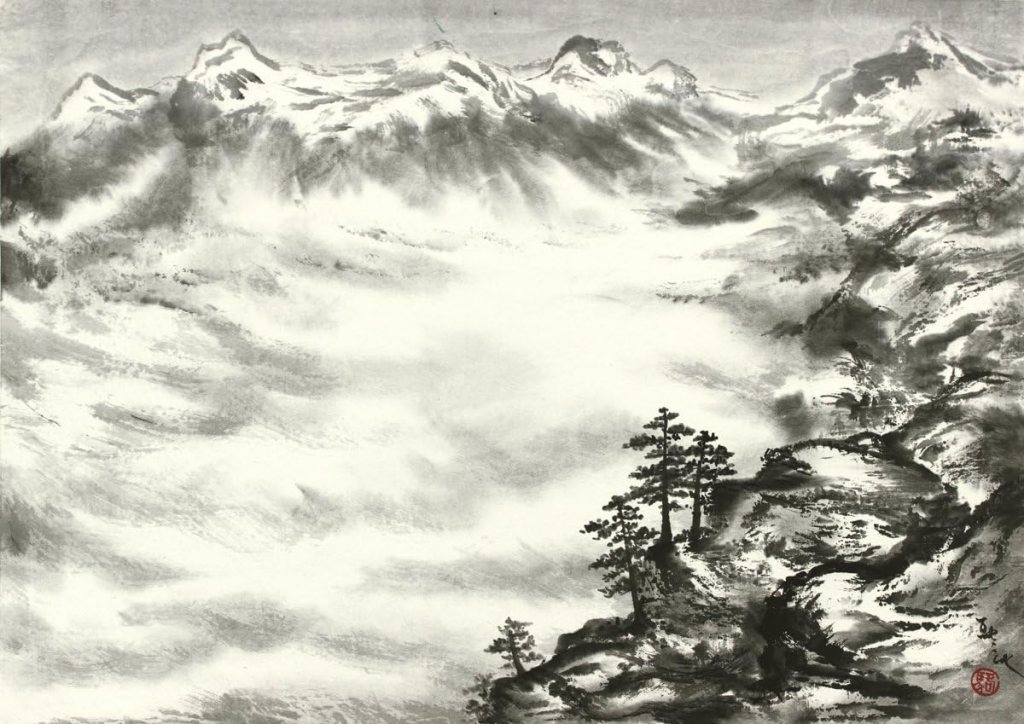
 Painting by Hiroaki Takahashi

Several one-line haiku by Alan Summers

We have a special feature this time around. Here are several commentaries on one-line haiku from Alan Summers’ new book, modŏ – new & selected.

the robin and the snow and the robin’s song again underscored


Commentary by Hifsa Ashraf:

When I read this poem in one go, I feel as if an old vinyl record is playing on a loop, with slight pauses between the music that are almost imperceptible. It is a profound monoku in which the poet sketches a winter scene for us—a season of deep silence, where snow and cold weather often keep people indoors. Yet, winter is also a season of reflection, allowing us to connect more deeply with our inner selves and with nature. Since snow is a familiar part of winter in many regions of the world, connecting one’s emotions with it feels both natural and profound.

The opening word, ‘the’, makes me think of a particular robin. It may be a bird enjoying itself in the snow, or perhaps its song carries a note of sadness or loneliness. Symbolically, I also see the robin as a person seeking solace in nature in whatever way they can. Is the robin connected to deeply personal feelings that resurface each winter? Is it an old longing or desire that has quietly endured over the years and now emerges again in this season? The snow in the background plays an important role in highlighting these thoughts, emotions, moods, and desires. It also evokes a sense of nostalgia—something that keeps returning with the arrival of winter.

‘The snow’, likewise, may represent the familiar qualities associated with winter: silence, loneliness, emptiness, and stillness. Yet, I also see it as a kind of white noise, something vast and difficult to fully grasp. In this sense, the robin and the snow create a yin-yang relationship, complementing and defining one another.

The repetition of and in italics, though less emphasized, together with the recurring presence of the robin and the snow, creates an interesting rhythmic effect in the background. It emphasizes both elements and encourages readers to view them not as separate images but as parts of a unified experience.

The real cut, for me, occurs at ‘again’. The word suggests continuity—something returning time and again, whether through the cycle of the seasons or through recurring personal memories. It is as though the robin’s song repeatedly resurfaces within the snowy landscape. Perhaps it is something a solitary person longs for in winter: a sound that breaks the silence and resonates with their feelings. The song inspires one to join nature’s chorus and find comfort within it. It becomes something impossible to ignore amid the quiet fall of snow.

The haiku concludes with the word ‘underscored’, which shifts our attention from the surface imagery to the deeper music beneath it. Besides the robin’s song and the silence of the snow, there is a hidden harmony created by their interaction. The robin gives voice to the snow, while the snow, in turn, amplifies the robin’s song. The ending carries a subtle melancholy that invites us to reflect on our relationship with nature regardless of the season. At the same time, it offers hope, showing us how silence itself can become a symphony, even when no one else is there to hear it.

The repeated sounds of r, s, o, and n further enhance the musical quality of the monoku, creating a melody that readers can almost hear as they move through the poem.


wintergreen that time spent as Christmas alone


Commentary by Jacob D. Salzer:

It is remarkable how certain scents can transport us back in time to a specific memory (or a collection of memories), in a specific place and circumstance.  In this monoku, the word “alone” could have at least two different interpretations: 1) it could mean that the wintergreen scent is only smelled on Christmas Day with family and/or friends, or 2) Christmas Day was spent alone without the company of family and/or friends. This monoku makes me think of elderly people who live in assisted living homes, memory care facilities, or hospice facilities who may not have family nearby. Although the person referenced in this monoku could also be young and alone for many different reasons. Did the person get stranded in a snowstorm?  Did they experience a tragedy or a flight delay? Did they want to spend Christmas with family but their family members passed away? Does this scent bring back memories when the person celebrated Christmas with family but can no longer do this anymore?  

I also think of a beautiful forest. Perhaps the person spent Christmas in the woods for the first time.

I also appreciate how this monoku shows a disruption in our day-to-day lives, where the Christmas holiday is celebrated (hopefully beyond the capitalist mindset of gifts and money exchange), and where actual relationships are made and nourished beyond the idea of money.

Regardless of our interpretations, it is the wintergreen scent that is remembered, viscerally felt, and re-experienced in this monoku. Perhaps this scent brings a mix of emotions all at once (melancholy, joy, nostalgia, etc.). The wintergreen scent is also strong and powerful (and therefore hard to forget), which (in my mind) translates to strong emotional correlations. What other scents do we recognize, and where do they take us? What mental impressions (samskaras) remain in the subconscious mind from this lifetime (and even past lives) that are associated with various scents? This is a powerful monoku to experience and contemplate.


a single gate faces the forest snow-hinting sky


Commentary by Ron Scully:

Why “a single gate” rather than a double, or another, open or closed? Alan Summers shows deftly the doors, read gate, are one way, one off, and we are stopped by the stand of thick forest, rather than forest bathing, we are on the brink of snow bathing. Quite the piquant piece by a master. Several readings would yield richer reactions.


self-penned obituary again the snow


Commentary by Nicholas Klacsanzky:

Though this monoku is extremely concise, there are at least three ways of reading it. My first interpretation was that the poet, or another person in the poet’s life, is writing an obituary for themselves again, and this act is represented in, or connected to, the snow falling outside. The second look made me think that snow itself might be the obituary that is penned, and that the poet feels (or felt) one with snow; the snow could be falling after the obituary has been read, signifying that nature continues without indifference or reverence. Finally, on the third reading, I saw that a self-penned obituary is perhaps being compared to snowflakes, where variety is present at a focused level, but from far away, it might appear the same.

In any way you read this one-line haiku, the kigo, or seasonal reference, of snow is important. It expresses the mood, the cold, and sometimes the beauty of impending death. Snow can also be a metaphor for the blank page, or erasure. It also adds a layer of sound with “s” that matches the beginning with “self.” Perhaps it is representative of the cycle of life and death. In addition, the “o” sounds in “obituary” and “snow” provide an open feeling as if the person in the poem is welcoming death and ready for it.

The cut to form the two parts of the haiku is felt naturally after either “obituary” or “again.” The word “again” acts as a pivot that can give meaning to both the first and second parts of the haiku.

There is a lot of feeling behind the words and phrasing in this monoku. Not a word or image is out of place. An impactful haiku that calls us to pause and introspect about our relationship with nature, death, and identity.

Publications:

“the robin” previously published in whiptail: journal of the single-line poem, ed. Kat Lehmann & Robin Smith (November 2025)

“a single gate” previously published in haikuKATHA 52 (January 2026) Founder/Managing Editor: Kala Ramesh

“self-penned obituary” previously published in whiptail: journal of the single-line poem, ed. Kat Lehmann & Robin Smith (November 2025)

Roodborstje op besneeuwde boomtak (1878–1910) print in high resolution by Theo van Hoytema. Original from The Rijksmuseum. Digitally enhanced by rawpixel.

Haiku by Urszula Marciniak, Tuyet Van Do, and Elliot Nicely

plans for the New Year
my list is turning into 
origami


Urszula Marciniak (Poland)
published in ESUJ-H: English Haiku, December, 2025

Commentary by Nicholas Klacsanzky:

This haiku opens with the common New Year’s ritual of making a list of resolutions. The seasonal reference (kigo) of New Year is extremely traditional in Japanese haiku. Each Japanese haiku master of old has written perhaps hundreds, and even thousands, of New Year haiku. So, the poet leans into this tradition.

The word plans carries weight, as wishes is usually used. This seriousness is undermined or transformed in the second line, though. Turning suggests a shift, and origami being used on its own allows the reader to imagine the infinite possibilities of this artform.

The enjambment in the second line is uncommon in haiku, especially traditional haiku, but it holds readers in suspension. It is difficult to expect origami to be the third line, and the surprise helps the haiku become more endearing. Also, this haiku does not have punctuation but most likely does not need it. If there were a punctuation mark in the first line, it would make that line super long. There is a clear line break between the first and second lines.

The final image in this haiku suggests a mixture of things. It could be showing frustration at the act of creating a list to adhere to. It could also be a sense of whimsy, viewing resolutions as play rather than concrete, business-like aspirations. In another way, it could be suggesting that time is relative and New Year’s rituals are not as important as people think.

Looking at the sound, the opening pl cluster gives a brisk, purposeful feel, while the long vowels in new and year give the first line a sense of expansiveness, befitting new beginnings. Frustration is felt in the short vowels in the second line with list, is, and in. In the third line, every syllable is open and soft, which is a complete contrast to the clipped sounds of line two.

Ultimately, this haiku folds meaning into itself, just as its imagery suggests. It transforms a ritual and tradition into a playful act, which I feel is needed in these harsh days.

await discharge papers 
outside the ward window 
a fleeting bird
 

Tuyet Van Do (Australia)
published in FreeXpresSion, issue 2, February 2026

Commentary by Jacob D. Salzer

This haiku has considerable psychological weight and significance. According to vocabulary.com, “A ward is a group of rooms or a section in a hospital or prison; in a hospital, different wards deal with different needs, like the psychiatric ward or maternity ward.” The discharge papers signify that the person was in the hospital or prison ward for a number of days, weeks, or even months or years, but we don’t know why.

In this haiku, we are standing at an important threshold between worlds, evident in the transition of being discharged back into society, and noticing the bird glimpsed outside the window. The last line, “a fleeting bird,” could be interpreted as a symbol of hope, that the spirit of the person will have a new kind of freedom and a better life. On the other hand, the word “fleeting” could contain connotations that this hospital or prison stay may happen again in the future. Ultimately, this haiku sparks important conversations about hospitals, prisons, and larger conversations about society in general. For example, in the U.S., there are more people in prisons than in any other country in the world. (Source: https://www.sentencingproject.org/reports/mass-incarceration-trends/)

Why is this the case? How can we prevent more crime to begin with? How can we prevent more illnesses and also give people a better chance at a better life when they are discharged from hospitals and prisons? My hope is that this haiku will encourage more people to take a closer look at healthcare systems and prisons, and take proactive steps to make life better for more people. This is an important and vulnerable haiku that shows deep wounds in society and in people, and, hopefully, also shows signs of true healing, transformation, and a better life.

memory care unit
this rippling twilight
beneath cypress trees


Elliot Nicely (USA)
published in Modern Haiku, 57.1, 2026

Commentary by Hifsa Ashraf:

The opening phrase, ‘memory care unit,’ establishes a setting most likely associated with aging, dementia, and the fragility of memory. It is a place where care, healing, and support take time, and where hope often persists despite uncertainty. The absence of punctuation leaves the phrase open, inviting readers to read it from different perspectives.

The second line, ‘this rippling twilight,’ introduces a transient and shifting moment of the day. The use of ‘this’ points to a particular twilight, making the experience immediate. The word ‘rippling’ suggests movement and transformation, whether real or imagined. It may refer to light filtering through the trees, reflections on a window, water, or another reflective surface. The poem naturally raises questions: What are the colours of this twilight? What causes the rippling effect? Is there water, a puddle, glass, or the play of light and shadow?

Cypress trees often carry associations with remembrance, longevity, and mortality. Their presence deepens the poem’s emotional and probably psychological resonance. There is a sense of yūgen here, as the poem leaves much unseen. What kind of cypress trees are these? Do they stand in a row, or do they form a canopy through which the fading light filters? The observer’s position also remains uncertain. Are they looking through a window? Standing beneath the trees? Or, is the scene partly imagined?

This uncertainty leads to another important question: Who is the observer? A resident, a caregiver, a visitor, or perhaps the poet? The haiku does not tell us, and that openness enriches the reading.

In any case, I appreciate how the poem connects imagination and nature within the setting of a memory care unit. Amid concerns about memory and aging, the natural world continues to offer moments of beauty, mystery, and reflection.

Kanō EitokuCypress Trees, Tokyo National Museum