Rika Inami’s End

when the end
comes upon me ―
sirens blowing
through the darkness
rushes to the fire
© Rika Inami (Japan)
IMG_7618

This self-eulogy is evocative in its simplicity and pacing. There is nothing difficult to understand in this tanka, but the subtle meaning behind it might be.

The end of the tanka is not about her, but about fire, an all-consuming element. I think Rika is expressing that in the end, she will become one with her surroundings, or maybe  she or her life was an illusion all along.

It also seems the author is saying that when her end comes, there will be no use in trying to pity her or get involved in feelings. But rather, the author could be pointing to the problem that made her die in the first place. “Fire” has a lot of symbolism attached to it, such as passion, anger, inspiration, and so on.

With the em dash in the second line, we feel more of her end, as she gives us time to take it in. The em dash might seem unnatural, but for poetry, it totally makes sense to have there. In tanka, we sometimes use punctuation to show two parts more clearly. So, Rika is also demarcating the parts in the tanka.

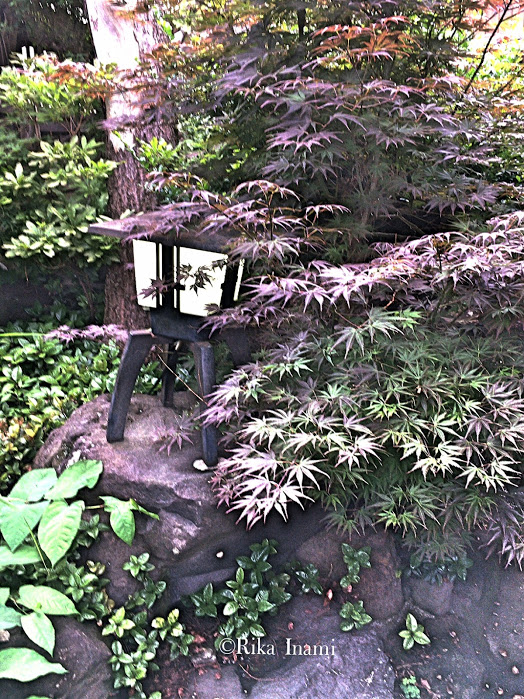
The photo connects indirectly to the tanka wonderfully. The red of the maple leaves shows the fire and the latern is similar to a siren light.

The most prominent sound to me in this tanka is the “o” sound in “comes,” “upon,” “blowing,” “through” and “to.” It gives an effect of a suspension of time and makes us read the poem slower.

A humble poem about one’s death, written in a simple style. But that is just the surface. I think this tanka brings up a lot of symbolism and thoughts about the reality/illusion of life, where we go when we die, and what we are meant for in the end.

– Nicholas Klacsanzky (Ukraine)

Adjei Agyei-Baah’s Clap

folding and unfolding
the unheard clap
of the butterfly

Brass Bell, October 2015

© Adjei Agyei-Baah (Ghana)

This points directly to the notion that haiku is a poetry of insight. The things we don’t realize are around us are brought to the surface.

With the start of the haiku, it seems we are almost going in slow motion, witnessing the butterfly as a detached observer. And in those moments of detachment, often we can experience phenomena that are seemingly hidden.

With the word “unheard,” we comprehend that the author did not actually hear the clap of the butterfly’s wings, but understood in his observation that he could not hear it. It is a metaphor for all things we don’t hear, and in a wider view, what we don’t experience.

We believe our reality to be as it is, though we cannot experience everything that is happening. Then what is truly objective? What would complete objective reality be like? Is there such a thing?

As haiku writers, we try to be objective as possible with what senses we have. However, in this haiku, I believe the author is directing our attention to the fact to just how limited we are in our ability to experience life and to understand it completely.

Getting away from philosophy for a moment, I enjoy how the lines flow. The last line comes as a eureka moment in the pacing itself, and the lines in general make the reader read slowly. This helps us to really take in the moment.

The sound works well to give a lilting feeling to it with the letter “l” in “folding,” “unfolding,” “clap,” and “butterfly.”

Now back to the act itself: the clap. What does the clap indicate? The author does not say, which is a classic haiku technique. If you over-explain in haiku, you usually are doing a disservice to your readers. They should have space to figure out and feel things for themselves.

The clap could be applause, either congratulatory or mocking. The clap could be an alert to danger. The clap could also refer to the famous Zen riddle: “What is the sound of one hand clapping?” Also in Zen, clapping is used to wake students up to the awareness of the moment. The butterfly could be a teacher of ours, and we don’t even know it.

But the clap could simply be. The clap could be just a clap. And with it being unheard, the author may have heard the unheard clap in his mind, and got immersed in that sound. By the tone of the haiku, this seems quite plausible.

Whatever we think about the clap, its unheard sound is heard in the minds of each reader of this haiku.

– Nicholas Klacsanzky (Ukraine)


Christina Sng’s Summer Comfort

summer comfort
the arthritic cat
basks in the sunlight

Honourable Mention, Neo-classical Haiku, World Haiku Review (June 2016, World)

© Christina Sng (Singapore)

This haiku, to my mind, is double-sided. It may seem like it is a simply poem about an arthritic cat enjoying a moment away from pain, but therein lies the other side. Even as the cat is enjoying its moment of peace, its pain and existence of suffering will come back momentarily or the cat is already feeling pain, but only has a peek at peace. That serenity seems bittersweet: intermixed with the joy is the mooring of pain that the cat feels continuously.

This applies to human beings as well, and it is typical in haiku to show compassion to animals and nature in general so we can reflect on ourselves. Through our compassion for the cat, we may realize that people around us feel the same, living moment by moment in pain with glimpses of peace.

The first two lines make for a strong juxtaposition. “Comfort” and “arthritic” are not two words we usually associate together. But that is what haiku does: brings together dissonant parts of life and makes us see the range that life brings, in all its contradictions. But in this haiku, and many others, the end result is the heart: through the contradiction, the melancholy, we feel compassion and care for the cat–and hopefully in turn, we care for all living beings and for ourselves.

The last line gives the impression that the cat is relaxing for a while with “basks.” But who is to know if the cat is feeling pain, if it is trying escape from pain, or in fact the cat has passed away and is simply laying in the sunlight now–a kind of heavenly light, but in a direct sense.

This haiku is made up of hints, and leads the reader to many avenues of the mind. However, this haiku has a celebratory mood, though tinged with a sense of sadness. The use of “the” in the last line gives the light more prominence and it would not be far-fetched that the cat has passed away and or the cat is in its final moments. It is not so common in haiku to have two “the” as we like to give focus to one thing. But here the cat and the sunlight has equal importance, which hints that the cat and the sunlight are a part of a larger process that we need to pay attention to.

Notice how each line ends with a definitive “t.” The strength of the sound of the “t” should not be underestimated. It is the power behind words such as “might,” “smite,” and “sight.” It is a sharp sounding letter appropriate for a sharp contrast and look into existence. Also, “cat” and “comfort,” besides the alliteration, brings in a sense of keenness.

In haiku, the last line is usually short. However, in light of the pain and possible death, the poet judiciously uses a longer line to show importance and present a tribute.

As a former cat owner, I know how hard it is to see a beloved pet suffer and die. I believe this haiku brought out the appropriate emotion without being overt, using evocative imagery instead.

– Nicholas Klacsanzky (Ukraine)