Yumino Aoiro’s Cicada

05 - 1

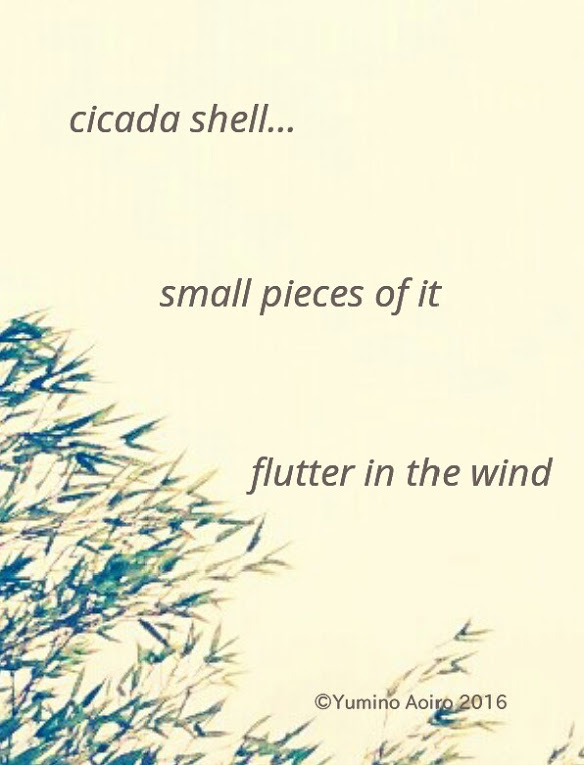
In this haiku, we have a classic aesthetic showcased: continuance. With the first line, we understand that the cicada has moved out of its larva shell, but what happens after…

Its shell flutters in the wind, almost like its real self, now flying through the air–only for a short time though. The short-lived nature of both the fluttering shell and the cicada itself is poignantly shown in one’s imagination. Though the shell is living a new, “full” life of a cicada by flying in the air (even fluttering like wings), that life will end too soon.

The ellipses is used well to show the continuation of the shell and to make the two parts in the haiku clear. The lines are short and the words are not complicated, which is important in haiku. Also, both parts are easy to understand.

This haiku is a sketch from life, of which master haiku poet Shiki championed. Something simple, objective, and in the moment is celebrated and focused on with a sense of awe.

The alliteration of “shell” and “small” emphasize the importance of these words, and the “i” sound carried through the poem in “cicada” “pieces” “it” “in” and “wind” gives this haiku a sense of sharpness.

The art, what I presume to be bamboo leaves, resemble the shape of the fluttering wings of a cicada well and create a definite mood. How the lines are laid out on the page show a continuation as well.

Yumino seemed to put a lot of thought behind the words and image of this haiku. A great haiku with much to think about and to feel.

– Nicholas Klacsanzky (Ukraine)


Olivier Schopfer’s Confession

the white lily’s
pollen-covered anthers…
time to confess

Modern Haiku 46.2, Summer, 2015

© Olivier Schopfer (Switzerland)

This haiku has strong emotional overtones. The comparison of the pollen-covered anthers of the white lily and the opportune time to confess is at once striking and natural. Just like the anthers filled with pollen, the feeling of someone who wants to confess something is similar: a new beginning is ahead, the weight of expectation is heavy, and it colors the person to a great degree in terms of personality and even appearance.

The poet could also be asking the lily to confess something. Though this interpretation is more abstract, as it is not easy to think about what you would ask the lily to confess, I think this is the point. Haiku often bring us to a point where thinking is no longer possible, and only awareness remains.

The imagery itself is compelling. There is so much to imagine in three lines: the pollen-heavy anthers, how one confesses, the petals of the white lily, the possible person hearing the confession, and maybe more. If a haiku does not allow the reader to imagine much from the haiku, then usually that haiku can be said to be not layered or detailed enough.

The punctuation is also interesting to note. The use of an ellipsis shows a waiting or carrying on of the pollen on the anthers. With the context of the last line, it seems the pollen has been on the lily’s anthers for too long.

The “i” sound runs through the first and last line, whereas the “e” sound goes through the second line and third line. Besides making the haiku more musical,  I believe the “i” sound brings more urgency to the tone, and the “e” sound shows more of the beauty of the lily.

The purity of the lily and the act of confession is also a poignant contrast. It makes readers think of the true meaning of purity. It is great when you can see both a similarity and a contrast in a haiku’s juxtaposition. Schopfer has brought us a lot to delve into within a short amount of words, while also touching on an event that nature and human beings have to live through.

– Nicholas Klacsanzky (Ukraine)