
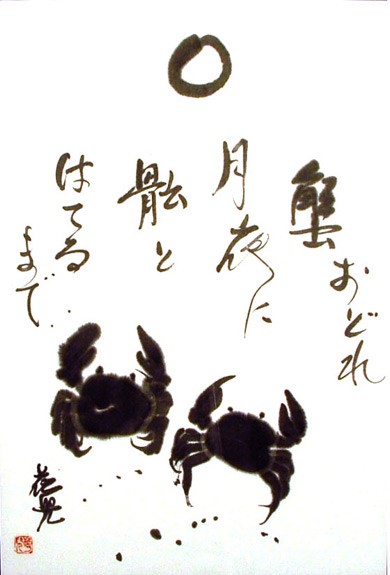
Kaji Aso’s Dancing Crabs

crabs

dance crabs
under the full moon
until you become a skeleton

© Kaji Aso (1936-2006) (Japan)

Before discussing this haiga (art plus poetry), I will supply some biographical information about the artist and poet.

Kaji Aso was born in Tokyo, Japan in 1936. He received an BFA in Painting and MFA in Printmaking at the Tokyo University of Art. But he was not only an artist; he was also a teacher, singer, adventurer, poet, and philosopher. All those who speak of Kaji Aso use the words “renaissance man” to capture his many accomplishments and his boundless spirit.

In 1972, he founded the Kaji Aso Studio Institute for the Arts in Boston, MA. Here he brought together Japanese and western culture: visual art, music, poetry, philosophy, theater, and good food. He also designed and built the first Japanese teahouse in Boston, where he presided as tea master. For thirty-three years, Kaji Aso was also a professor at the School of the Museum of Fine Arts, Boston. His art is part of the permanent collections of many museums around the world, including the Museum of Fine Arts, Boston; the National Museum of Modern Art, Tokyo;  the Museum of Modern Art, NY; National Museum of Czechoslovakia;  the State Pushkin Museum, Moscow and Padua Museum of Fine Arts, Italy. Thirteen of his works are registered as Japanese National Properties.

As a talented tenor, Kaji Aso performed opera and Italian and Japanese songs. He ran in thirty-six Boston Marathons and led kayak expeditions down some of the longest rivers in the world including the Mississippi, the Nile, and the Volga.

Although haiku was just one of his many special gifts, Kaji Aso very often expressed the wisdom of his beliefs in haiku and did a lot of haiku illustrations. He organized and took an active part in many seminars and lectures about Japanese art, haiku, sumi painting and calligraphy. With countless awards and publications attributed to him, he can be rightly called a legend. [Adapted from The Living Haiku Anthology]

Commentary

In the art, we can notice the moon at the top, with the haiku written in an accented way to take in the haiku slowly. The crabs below the haiku are shown dancing by the dots below them. This type of painting is not exacting, but rather an approach is taken to capture the spirit of what is seen. This relates to wabi-sabi, allowing imperfections to be and seeing the beauty in them. Sumi art is more of a sketch of life, rather than an exact showcasing of it.

Though the art seems simple, we can get a poignant feeling from it. I perceive joy and austerity in the blots and lines of the ink. It gives off vibrations of spirituality, but also a pure simplicity that makes one joyful when viewing it.

The feeling the art exudes compliments the mood of the haiku. Though the art does not show the crabs as skeletons, it shows their dancing and allows us to feel the mysticism of the haiku more.

In terms of the haiku, each line is striking and wakes one up to the moment. Though the haiku can be taken literally, I believe it has a spiritual mood.

Crabs are a reference to different seasons, but most commonly, they reference summer. It would make sense that they would be dancing if it is summer.

The full moon has so much symbolism in Japan that it is hard to define it in a few short lines. But the full moon can mean complete enlightenment, the absolute truth, and even specific mystical beings. In the context of this haiku, I feel the full moon is in a sense luring the crabs into a mystical experience, and that the poet suggests the crabs to give up the attachment of their bodies. The poet recognizes the crabs as seekers of truth when they dance under the full moon, and is instructing the crabs as he would students of Zen or other forms of spiritual practices. There is no sense of division of the human and natural world in the mind of the poet.

We get a contrast of the full moon and the skeleton. This juxtaposition, though it seems obvious after a few readings, does not seem apparent quickly. This is because the starkness of the moment described is so strong, that the reader does not consider the aesthetic of it at first.

A masterful haiga by an enormously talented artist and poet.

– Nicholas Klacsanzky (Ukraine)


Maria Laura Valente’s Mantra

summer wind –
in the sound of waves
an endless mantra

©  Maria Laura Valente (Italy)
The Mainichi, October 18th, 2016

We start with “summer wind,” which is soothing in enduring heat. The poet also makes a note of the season, and allows readers to unload all their notions of summer into their reading of the haiku. Seasonal references in haiku act this way: they allow our personal histories with a certain period of time and ideas of culture associated with it to pour out. That is one of the reasons haiku can be so small: the amount of associations poets can infer through seasonal references and selective words can produce much more than what is written.

The poet then uses a dash, which is a good choice in order to not bleed the first line into the second one. In addition, it allows the reader to pause, and imagine summer wind and maybe remember his or her memories of it. Some haiku benefit from lines bleeding into each other, while others do not. And it is often up to the poet whether they want more of an open interpretation or a more closed one through punctuation.

In the next two lines, the poet focuses on the sound of the waves and compares them to a mantra. In haiku, we usually use our sense perceptions to not only portray the moment, but to show meaning and feeling. In this haiku, sound is the chosen sense perception.

I think a mantra is an appropriate description of the sound of waves, as usually mantras don’t have so much inherit meaning, but its meditative sound is of more importance. We don’t usually interpret what waves are saying with their sound, but we just listen to them, and the sound soothes us.

Since there is a juxtaposition in this haiku (and in most haiku) it is good to think about how the two parts interact. Summer wind and the sound of waves both are calming, and both might sing a high-pitched song. Also, summer is a time we wish we could go on forever, and this sentiment is reflected in the endless mantra of the waves. The poet could also be saying that summer wind is going through the waves and making a sound, and causing it to sound like a mantra. It is an interesting contrast of having a carefree time like summer being situated alongside a mantra, which is of a more serious nature. It is kind of a yin and yang of the mundane joy of life and the peace of the inner self.

The “s” letter features strongly, and seems to make the sound of wind. Also, the letter “w” is prominent and gives a wispy sound to the haiku. The lines are paced naturally and pleasantly, in the common short line, long line, short line format. The way the second line is set, it allows readers to have suspense for the third line.

Overall, this haiku is soothing like an endless mantra. It makes one feel calm and have a mystical sense for nature.

– Nicholas Klacsanzky (Ukraine)


Kay F. Anderson’s Pine Trees

what else
do I need to know . . .
pine trees growing from stone

© Kay F. Anderson (1934-2007) (USA)

Before I discuss this haiku, let’s take a look into the life of the author of the poem. Kay F. Anderson was a freelance writer, a painter, counselor, motivational speaker, educator, and a certified Transactional Analyst. Kay’s attention shifted to haiku in 1990. Her work, which included haiku, haiga, and tanka, was published in all the major English-language haiku journals. She was featured twice in the HPNC Two Autumns Reading Series (in 1993 and 2002), and served as an editor for the 1997 Two Autumns anthology, Beneath Cherry Blossoms. She was a long-time member of the Haiku Poets of Northern California and served as its President in 1996. Kay served as a judge for the 1994 Gerald M. Brady Memorial Senryu Awards (by the Haiku Society of America) and for the 2001 International Haiku Contest (by the Palomar Branch of the National League of American Pen Women).

Kay’s use of haiku in working with other cancer patients was featured, along with her haiku, in Emiko Miyashita’s The New Pond. Although weakened by metastatic malignant melanoma and the effects of treatment, Kay continued to write, paint, and participate in haiku activities. After a seven-year battle, she is survived by her husband, two daughters, four grandchildren, one great grandchild, and countless haiku friends.

Awards and Other Honors:

Many of Kay’s poems were honored in national contests and published in major anthologies, including William J. Higginson’s Haiku World. Some of her awards include:

First Place, Haiku Poets of Northern California (HPNC) International Tanka Contest (1995); Second Place, Harold G. Henderson Haiku Awards (1996);                                                   Second Place, National League of American Pen Women contest (1996).

Her tanka awards include three Tanka Splendor Awards (1993), First Place, HPNC San Francisco International Tanka Contest (1995), and Editor’s Choice Award, Brussels Sprout (1995). A tanka was included in the anthology Wind Five Folded (1995) and in the Acorn Tanka Supplement (2001). Three of her tanka were selected for The Tanka Anthology. Her work also appeared in the premier edition of Reeds, published by Jeanne Emrich.

Books Published:

The First Book of Philosophy (for gifted 6th grade students) and I and thou in the here and now (named Word Books, Inc. Book of the Month). She edited the 1997 Two Autumns anthology, Beneath Cherry Blossoms, and was working on a book to help a new generation find and travel the Haiku Path to Joy. [Adapted from The Living Haiku Anthology]

Commentary

This is one of those haiku you immediately agree with, but you don’t know exactly why. Searching for that “why” can take a few minutes, or maybe a lifetime.

I get a Zen feeling from this haiku, as it seems a bit like a koan, or spiritual riddle. Though the first two lines are not followed by a question mark, I see them as a question. But they could also be phrased as a searching statement, as if the poet wants to know how she can improve herself or gain a new level of consciousness.

Pine trees are definitely sturdy, growing in mountainous areas. I have seen many times how pine trees can be surrounded by stone and they grow like nothing is blocking them. In this sense, they seem almost supernatural. But the determination of nature is so strong that it can grow against all odds. Also, the pine tree does not have any negative thoughts about the rocks. It simply grows.

Maybe the poet is reflecting on this and feels like, “Hey, why can’t I just be myself, and  not think so much.” And it is not just one pine tree, but many pine trees in the haiku. The poet has got all the proof she needs to be strong-willed and confident in herself. Also, the pine trees growing from stone could be proof of the mystical power of the universe.

But pine trees do not try to be inspiring to others, nor they do something for praise. The haiku could also be indicating that we should expect nothing from our actions, no matter how saintly or inspiring they could be perceived. In reality, everything is as we perceive them, and nothing more. Beyond perception, everything is the same, anyways.

Lines in haiku, especially in English, do not need to follow a restrained form, but are mostly arbitrary in length. In this haiku, Anderson lays out the lines in succession, almost like reaching a moment of enlightenment or coming to a point of discovery.

The diction in this haiku is casual and natural. But from this earthy tone comes a starkness that a reader feels immediately. Like a Zen koan, this haiku turns our consciousness to the center and allows us to focus on a truth beyond thoughts.

– Nicholas Klacsanzky (Ukraine)