
golden grapes —
if only each word
were so sweet
Ephemerae, volume 1, 2018
© Stefano d’Andrea (Italy)
The protagonist in this haiku probably refers to the type of sweet, small tomato known as “golden grapes.” They are loved as snacks in the summer and spring. The poet is from Italy, and I can imagine these in salads, and various other dishes.
Possibly, while eating one of these delicious tomatoes, the poet had a yearning for our words to be just as sweet. Maybe, recently he was engaged in an argument with friends or loved ones, or he saw the banter of politics in the news. Either way, it is a contemplation on the almost-perfection of nature, with each golden grape being consistently pleasing to the taste in the right season. In a way, it recalls a sense of innocence, when we see the world in a more simple and magical way. It could also be an introspection for us to think about what we can change in our behavior, especially in our current political climate.
Getting into the technical stuff like punctuation, layout, and sound, I like the pause given with the em dash in the first line. It gives reader’s time to imagine the golden grapes. In terms of the layout, we have a standard English-language format of a short first line, a longer second line, and a short last line. The pacing of the lines are natural and it reads easily. When looking at the sounds, one cannot skip over the multiple usage of “o.” It is reflective of the shape of the golden grapes. The haiku becomes musical with the repetition of “g” in the first line, and “s” in the third line.
A charming haiku that makes us introspect about human behavior and its relation to nature.
– Nicholas Klacsanzky (Ukraine)
Grapes are golden when it’s the beginning of autumn, after the fructose in them has increased at the height of the summer sun’s exposure.
When the poet says “if only each word were so sweet,” it suggests that maybe somebody has talked in a not-so-kind way to him… There is a sort of subtle sorrow, in which the sadness of a farewell can be perceived… golden grapes, golden times, golden words… Gold has always dealt with the divine, and indeed a divine dimension can be experienced through a sweet dialogue, maybe with a missed love… a regret? A loss? A grief?
Mead, the most ancient alcoholic drink men started to produce, or the nectar of the Gods, is also made from a golden and sweet substance: honey. It was cherished by the Egyptians and ancient Aegean Sea cultures, and something divine is findable in that attribute of grapes too. So, grapes are golden when ready for harvest, ready for making first the must, then to become wine. “In vino veritas” is a Latin phrase that means “in wine there’s the truth.” The poet, an Italian, is probably fond of this extraordinary drink, and maybe he is a sommelier and vine grower. In the haiku, he seems to recall wine and its properties… Maybe words should be always full of truth and sweetness before being pronounced… And probably words should be always chosen after having reached a gentle state of mind before being written or told, especially in a poetic path such as the writer’s.
Anyways, words have a very deep and magical power, and we should prefer silence, which is also golden if words cannot be as golden as Stefano’s grapes in his poem….
A haiku that leads the reader from the sensual dimension (visual, taste) to the comprehension and acceptance of human imperfections through the divine beauty of nature….
Well done, d’Andrea!
– Lucia Fontana (Italy)
Did you like this haiku and commentary? If so, please leave us a comment.
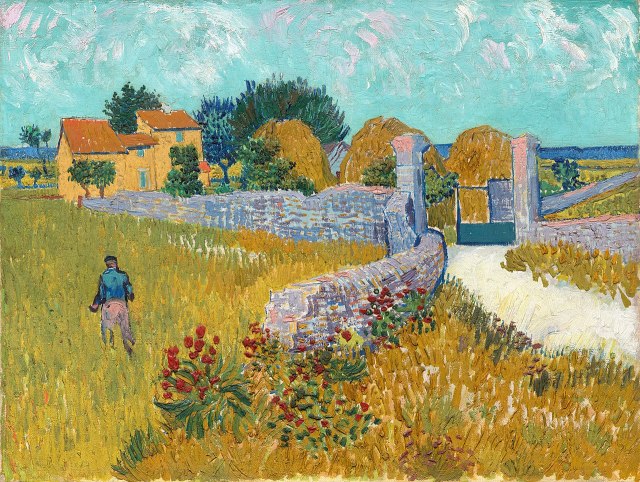
– Vincent van Gogh
 Haiku Commentary
Lovely haiku.
LikeLiked by 1 person