
chrysanthemums
the thread slips from
granny’s needle
© Srinivasa Rao Sambangi (India)
Modern Haiku, Issue 49:3, 2018
This haiku is very intelligently crafted. “Chrysanthemum” is a late autumn kigo, hence the fragment itself sets a mood of decay and destruction. The slipping of the thread is poignant in the sensitive portrayal of the loss of abilities which we take for granted in our youth.
The fragment and phrase nicely use the technique of association. There is a struggle against the natural course of things, and in between the lines, we find a glimpse of grace.
One of the deepest haiku I’ve read.
– Pragya Vishnoi (India)
I have an old sewing machine from my mother in my possession, and every time I use the needle for sewing work, I can think of her presbyopic goggles and that thread that avoided the eye of the needle as if it were equipped with its own life…
In this way, this haiku of Srinivasa Rao becomes something that belongs to me, generating correspondence and the widening of perception—the qualities of a good haiku.
Melancholy, impermanence, and the sense of loss are linked to chrysanthemums. Fleeting humor is a classic element that enriches this very touching text. The rhythm of the verses leads from the slow murmur of line 1 to the fluidity of line 2, then almost pausing to savor a memory on line 3.
– Margherita Petriccione (Italy)
The overall theme of this haiku is based on ageing with loneliness and melancholic feelings. I can see a very deep connection between the chrysanthemums and the sewing. The chrysanthemums symbolises grief, sadness, or pain in some parts of the world, but it is also considered as a symbol of joy and optimism. That is why in certain countries, women used to embroider chrysanthemums on skirts, shirts, and tablecloths.
In this case, maybe the granny needs to embroider a chrysanthemum not just to kill time but also to bring back memories of her past. The thread slipping may show the ‘cultural annihilation’ or ‘change of time’ where no one follows old traditions. Being nostalgic, she wants to revive that tradition to overcome her loneliness and melancholy but ageing drains her energy to do so.
It also shows the transformation of time, culture, and traditions where different phases of life are replaced with something new with a little or more acceptance. In granny’s case, she still misses her past life that was full of festivity and traditional activities that are now fading away with time.
– Hifsa Ashraf (Pakistan)
In this haiku, I wondered if it could be a one-liner. But to me, line 1 has a stronger break in three lines even without the use of kireji, which is important because as a reader, it makes me contemplate the kigo word (how it is a fragment in this particular haiku and how it ties to the phrase in the two last lines), which is an all autumn/winter seasonal word in Japan and also its imperial seal.
Chrysanthemums are used as a health benefit for various ailments in its tea form, especially in Asia. To me, the juxtaposition between the words harmonizes rather than contrasts between the words “chrysanthemums” and “granny” because in China the plant represents longevity. What’s interesting to me is that the phrase “the thread slips from granny’s needle” to me can be interpreted in two ways, which can be tragic but if combined with the fragment and the history of the word “chrysanthemum,” there’s also the possibility that there’s nothing wrong with granny and the thread slipped from the needle from daily distractions of life.
In conclusion, this haiku is highly dependent on readers to create context from their own personal experiences, which I believe the author does a great job expressing by telling little.
– Fractled (USA)
The poets above have done a great job discussing the content and technical aspects of this haiku. However, I want to point out how the shape of chrysanthemum petals are akin to a sewing thread. In a way, the chrysanthemums take over the scene as the thread slips from the needle. This creates a continual sense of completeness.
In terms of sound, the “th” sounds in the first and second line make a sound similar to manual sewing. Also, I appreciate the musicality of “slips” and “needle.”
A strong image and powerful juxtaposition that takes a keen look to fully appreciate its beauty.
– Nicholas Klacsanzky (Ukraine)
Did you enjoy the poem and commentary? Let us know in the comments.
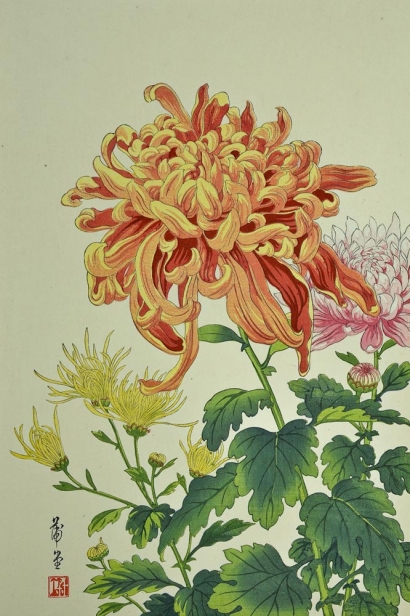
– Art by Nishimura Hodo
 Haiku Commentary