Isabel Caves’ setting sun

setting sun
a child learns to say
“imaginary”

Isabel Caves (New Zealand)
(Previously published in Poetry Pea – Haiku Pea Podcast Series 2 Episode 2

The way I see the setting sun in this haiku is more about the transformation from day to night which also means the transformation of one’s focus from the outer world to the inner one. I loved the way the writer cleverly used the word ‘sunset’ positively where all energies converge into darkness but also enlighten the mind.

The second part of this haiku is about the transformation of learning where a child learns in the daylight most probably from nature and dreams or creates through imagination based on that learning. The word ‘imaginary’ here means the abstract thinking of a child which is chiseled by the daily life experiences before that reaches the stage where they start uniquely perceiving the world. It’s about the transformation from one stage of life to another, from light to darkness, or vice-a-versa. I liked the quotation marks around ‘imaginary’ which make it more significant and unique.

Hifsa Ashraf (Pakistan)

The setting sun in the context of this haiku seems to have two moods:

1) Sad, in that the child learns what imagination is and what it is not. Before, the child had no mental concept of it.

2) The beauty and epicness of a sunset can be compared to one’s imagination.

As a reader, I seem to follow the first interpretation. As soon as we have words for things, we ruin them, in a sense. The mystery, the grandeur, the innocence is lost. Nature is no longer filled with spirits and magic, but are given scientific names and explanations. They become mental concepts rather than something to witness as is. Through mental obstruction, we can lose the child within.

In terms of the sound in the haiku, it seems that the letter “s” is the most prominent. The string of “s” sounds in the first two lines and the absence of it in the last line makes the ending more striking. I’m glad the poet did not add a dash or an ellipsis in the first line as a kireji, or cut word or phrase, which is traditionally seen in haiku. With the quotation marks, it was already enough punctuation, and more punctuation would make it too busy. The format is standard for English-language haiku, although one tries to avoid having one word in the last line in order to not be either too sentimental or pointed. However, it works well here with the quotation marks and as a surprise.

A haiku that touches upon innocence and the loss of it, it’s a powerful tribute to our imagination.

Nicholas Klacsanzky (USA)

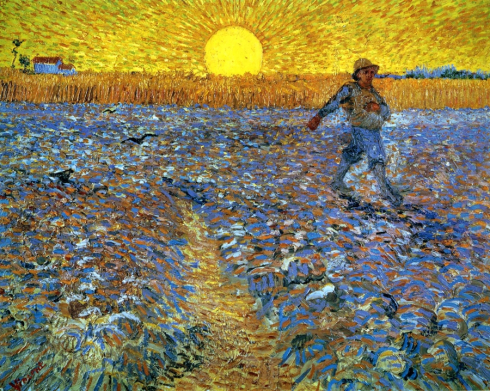
1888-vincent-van-gogh-the-sower

Painting by Vincent van Gogh, The Sower, 1888

Carmela Marino’s dream

moon flower…
the rest of a dream
on the windowsill

Carmela Marino (Italy)

This haiku beautifully covers the deep feelings of both day and night. A dream that starts at the night gradually enters into the daylight as a daydream. I loved the analogy of a night dream with a moon flower that reflects the fresh start of a day. The star-shaped structure of this flower brings hope in one’s life that there’s nothing to worry about as this flower blooms at night, so it looks surreal like a dream that also blooms and makes one’s life worth living.

I loved the twist in this haiku where the writer takes us from a moon flower to a morning scene in continuation of the night dream. A windowsill is a place that is used for pondering and daydreaming. So, the night dream is not over yet and the dreamer is still in a state of dreaming that now shifts from darkness to light. This means the follow up of the dream even in the daylight.

I loved the mystery behind this haiku which takes us on an ethereal journey of dreaming which is an essential part of our life in terms of hope and purpose. I loved the way the writer used both ‘moon flower’ and ‘windowsill’ as metaphors where there is no disconnection of dreams and/or a journey that starts from within and then connects us with the outer world. The ellipsis after moon flower gives a beautiful break to stop and enjoy the glory of the night and the gradually blooming process of a dream.

Hifsa Ashraf (Pakistan)

We got a kigo, or a seasonal reference, for spring with “moon flower.” But more importantly, we are given a flower that only blossoms at night. This connects strongly to dreams, where our imagination and subconscious “blossoms” at night. With the ellipsis, the silence of that time can be felt.

In the next two lines, much can be implied. My initial thought is that the poet wakes up and sees the moon flower on her windowsill. It’s possible that the poet was dreaming of something that related to the flower in question.

The other interpretation is that the content of the dream is a mystery to the reader, and that mystery corresponds to the intriguing flower that blooms at night.

Finally, the dream (either physical or abstract) could be represented by an ornament or an object that rests on the windowsill. This continuation lends to the idea that nature still is active and even blooms at night, as with the moon flower.

I get an ethereal feeling from this haiku. In a way, it brings me into a dream world. We can discuss interpretations of haiku, but I think the feeling we get from haiku is most important.

In terms of its structure, we have a classic format that mirrors traditional Japanese haiku and which is most common in English-language haiku. If we look at the sound, we immediately catch wind of the usage of “o” to slow down the pace and to make the poem more dreamlike.

With the aesthetic of yugen, or deep mystery, this haiku puts readers in a powerful state and makes them see nature with more abstraction and imagination.

Nicholas Klacsanzky (USA)

Moonflower

– Painting by Elaine Haxton(Australian, 1909-1999)Moon, Moths and Moonflowers, 1976


Florin Golban’s Storm

after the storm—
playing hopscotch
among the blossoms

Florin Golban (România)
International Honourable mention, Vancouver Cherry Blossom Festival 2019

In general, storms cause chaos. There’s no specification of storm in this haiku, which makes it more open for discussion. But, every storm interrupts our daily routine, especially the recreational. The same goes for a difficult time, which puts all activities on halt.

Hopscotch is the resumption of a happy or carefree time that one has after a difficult time, where they enjoy playing it among nature. The blossoms indicate that life is in full bloom where there’s no tension or chaos. It’s more like back to normal where a person enjoys all their favourite activities, especially outdoor ones.

It also depicts resilience that one develops over a period of time.

Hifsa Ashraf (Pakistan)

The em dash in the first line allows us as readers to take in what happened from the devastation by the storm. In this case, the poet focuses on the blossoms strewn on the street or sidewalk. Fallen blossoms, especially of the cherry variety, are highly beautiful and evocative.

The act of playing hopscotch among the blossoms can represent several things:

1. Playing in the midst of destruction or the loss of something beautiful.
2. That we should not pay attention to the chaos around us and remain positive.
3. We should be connected to nature. Nature is a part of our everyday life.
4. And more…

The feeling this haiku gives me is mixed: happiness and sorrow. Happiness for the play and sorrow for the destruction. But great haiku often have layered and/or complex feelings behind them.

In terms of the sound, the prominent letter is “o.” It slows down the reading and makes the moment being portrayed seem longer. The use of “o” is balanced enough to not be intrusive and gives music to the poem.

The length of each line is relatively the same, which is fine. Usually, the second line is the longest in a haiku, but no harm done. Besides, there are no hard and fast rules for haiku.

I think this spring haiku brings out a sense of joy and melancholy simultaneously with great effectiveness.

Nicholas Klacsanzky (USA)

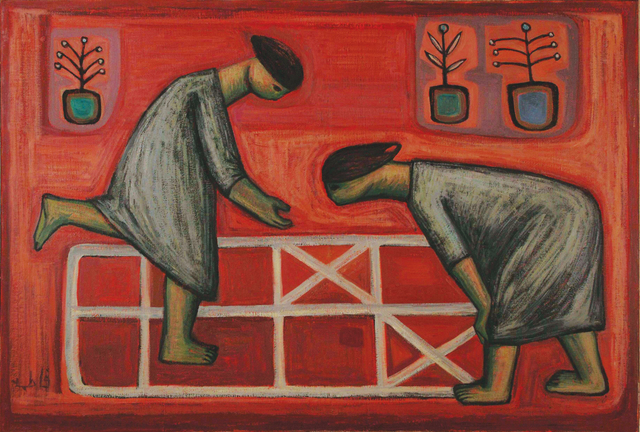
large

Painting by Fatma Arargi (1954)