
what remains
after the river is gone
this empty bed
– Kat Lehmann (USA)
Published in Mayfly 68, 2020
I always wonder how to express my deepest feelings about certain themes of life that are well connected with the most essential element of nature: ‘water’. I love it when someone challenges me to write about topics that really cover annihilation.
In this haiku, Kat beautifully expressed her feelings in a simple but most elegant way without letting go of the flavours of the right metaphor that is the beauty of a well-crafted haiku.
What remains is a question mark that we all need to address at the end of this temporary life for which we spend a lifetime to solve the mystery of what we get in the end. The ‘river’ is well placed in this haiku that reflects our thoughts, feelings, and constant learning and building up of a momentum in our lives. I think the flow of the river may be interpreted in two ways: 1) physical life 2) mental or spiritual life. Both goes on until we stop breathing and/or stop thinking about what is necessary for survival.
The empty bed both of the river and our life indicates nothingness and or annihilation where only a deep silence prevails. This haiku also depicts the process of evolution and revolution that both start and end in nothing. This is the ultimate meaning of life.
– Hifsa Ashraf (Pakistan)
At first glance, this poem might seem like a matter-of-fact statement, which a lot of fine haiku do. But then, we get an “aha” moment. The empty bed is both positive and negative. The empty bed could be a representation of the emptiness and harshness of the dry season, but it could also mean a place where new life can flourish without hindrance. Plus, the author could be referring not to a riverbed but to the bed in her house—thus making it a double entendre.
The empty bed is also a sight to behold. The way the river carved into the earth is now fully visible and we can witness what the river did to the soil and rock. It may be empty, but it’s full of memories etched into the earth.
I think the poet did right by not including punctuation, as it would have made the second line too long, in my opinion. The poet retains the traditional Japanese rhythm of haiku.
In terms of sound, the most striking letter is “r,” which gives the haiku added power and weight. The sound of “e” in the last line with “empty bed” has long syllables, which creates a sense of melancholy and starkness.
A fine haiku that gives many introspective associations to readers.
– Nicholas Klacsanzky (USA)
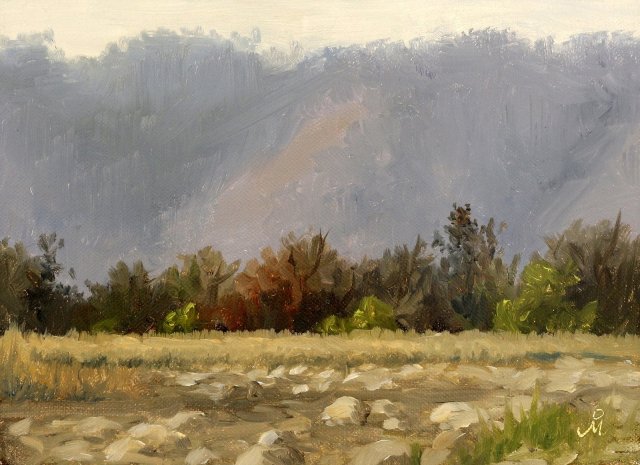
– Painting by Mandar Marathe
 Haiku Commentary
Pingback: Books read: haiku and the like – Pearl Pirie