Pravat Kumar Padhy’s zero

the zero-shadow moment I am with myself

Pravat Kumar Padhy (India)
Published previously in The Heron’s Nest Vol. XXI, Number 3, 2019

There are many monoku about shadows that pull at my heartstrings but this one is more intriguing in terms of the theme, where one doesn’t have to feel the sense of the moment but rather dig deeper to know how to relate it to one’s own life experiences.

A zero-shadow, in my opinion, indicates the complete absence of the shadow in one’s life. The word ‘zero’ itself reflects the degree of nothingness in this haiku where the writer feels it’s more like the temperature which is cold at zero. A zero-shadow also depicts a lack of connectivity or loneliness due to various reasons.

When you feel that you have a zero-shadow that represents your existence means you’re all alone without having a single ray of hope in your life. It also means the detachment of worldly relationships that act more like shadows and get lost when a person is having trouble or is in the dark.

In terms of sound, the letter ‘m’ in this haiku can relate to the echoes from the heart that are remorseful due to this miserable time.

Hifsa Ashraf (Pakistan)

As with most fine one-line haiku, this poem can be read in several ways:

the zero-shadow
moment I am with myself

or:

the zero-shadow moment
I am with myself

or:

the zero-shadow moment I am with myself

…which all have different available interpretations. However, as a reader, I’m naturally inclined to read it as the second version. In this version, we have a clear break in subjects.

This poem is like a realization that one is truly alone and with oneself. I don’t get a sense that this haiku is about loneliness, though. It’s more about observing who you are fully without any impediment.

I can’t say that this monoku has a kigo, though it’s indicative of noon. In my imagination, I see this haiku taking place in either summer or spring.

Looking at this haiku technically, I enjoy the originality of “zero-shadow,” the length and rhythm of the line, and the sound, which was aptly mentioned by Hifsa.

Overall, I enjoy this one-line haiku for its ability to put the reader in the state expressed, which is the state of the total observation of the self.

Nicholas Klacsanzky (USA)

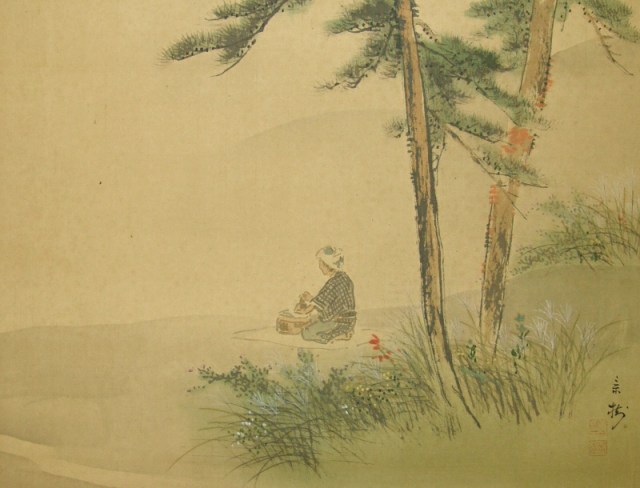
farmer at noon

Painting by Imai Kageki (1891 – 1960)
Jane Williams’ low tide

low tide
in the gull’s footprints
echoes of flight

Jane Williams (Australia)

First of all, I would like to discuss my immediate thought about this haiku that struck my senses and that’s the letter ‘o’ which dominates this haiku. This indicates the life cycle where we strive to fulfill our needs or dreams and to move to the next level or phase to do the same.

When there’s low tide, the waves are not as charged as they are during high tide, which means there is a calm situation on the seashore. So, low tide is equivalent to our positive or constructive thinking that helps us to make our life more meaningful by planning and managing our goals.

The gull’s footprints are a subtle expression of things that may not be very strong but can create a huge impact on our lives. The webbed feet of a gull is commonly prominent on seashores and are a sign of life, freedom, free will, mindfulness, and positivity.

To me, “echoes of flight” is about the destiny that is calling someone to take a flight, to strive and achieve the purpose of life. Echoes are the personal experiences that resonate in one’s mind about one’s forthcoming life. In other words, it’s the clarity of purpose that comes with maturity and a peaceful mind.

Hifsa Ashraf (Pakistan)

The thing that intrigued me initially about this haiku is the pivot line: “in the gull’s footprints.” This allows the poem to be read in at least two ways: “low tide in the gull’s footprints/echoes of flight” or “low tide/in the gull’s footprints echoes of flight.”

In the first reading, you can see water fill the footprint, and this act being said to be echoes of flight. In contrast, in the second reading, we get a juxtaposition of low tide with the echoes of flight in the gull’s footprints.

“echoes of flight” can be seen as metaphorical or physical. It could be about memories of flight, or it could be about the sound of wings reverberating (or even the shadow of wings). This phrase gives this haiku a special touch of originality.

Personally, the way I read it is that within our beginnings, we can see what we can achieve. Though this haiku is mostly objective, it’s probably a metaphor for how our trajectory as a person can be perceived from the very outset.

Hifsa rightly admired the usage of the letter “o” in this poem. I want to point out the letter “l” in this haiku as well. With its prevalence, it gives the reading of the poem a lilting feeling, like the flight of a gull.

The structure of the poem is the standard for English-language haiku that mirrors the traditional Japanese rhythm of haiku. The lack of punctuation is a benefit as it allows the pivot line to work its wonders. In terms of the kigo, or seasonal reference, gulls can be either a kigo for spring or autumn, traditionally. I think in this haiku, it most likely is a seasonal reference to spring.

With its substance, pivot line, musicality, and imagery, this is a must-read haiku.

Nicholas Klacsanzky (USA)

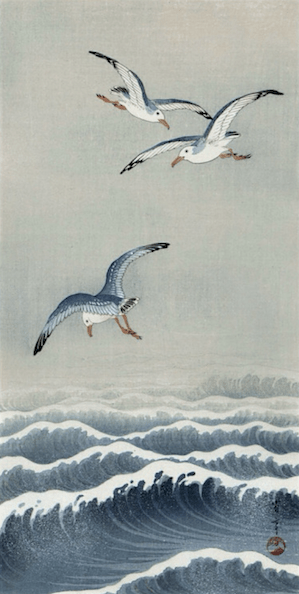
450e90c4d19d0c40c944c316d69ef3b0

Painting by Seitei (Shotei) Watanabe

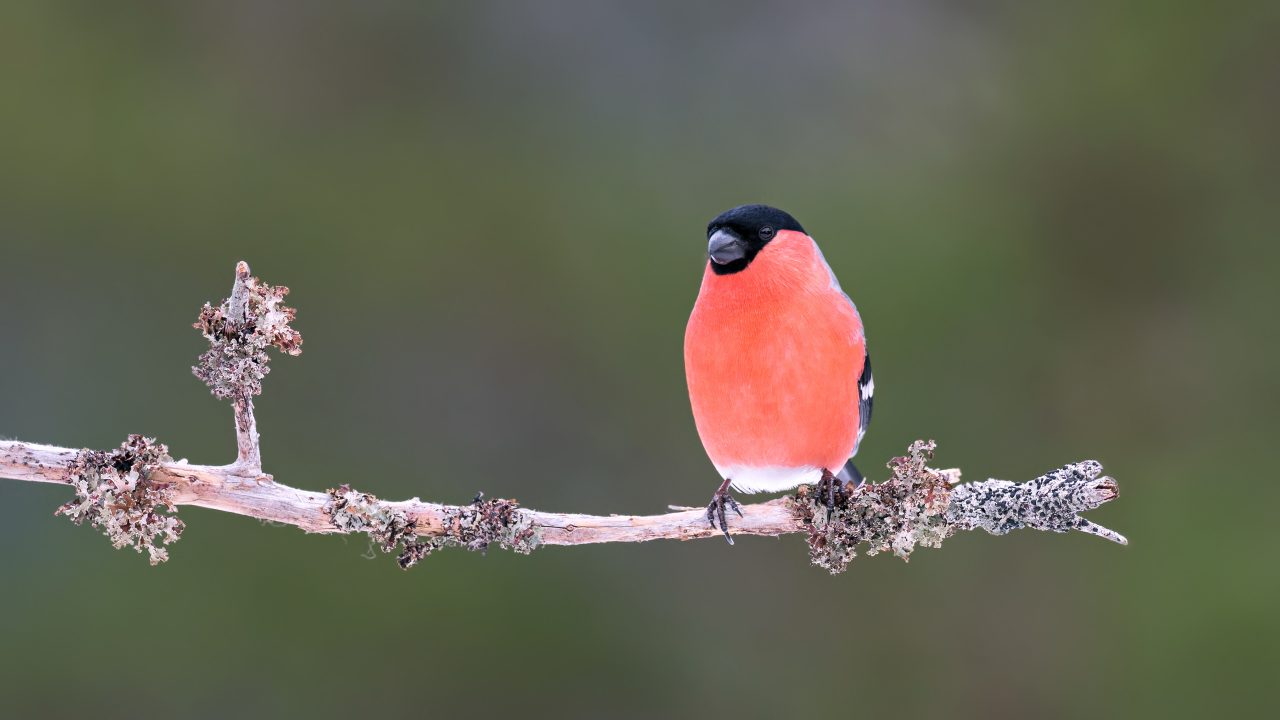
Muskaan Ahuja’s Robin

winter dusk
the robin’s last chirp
before hiding into a tree

Muskaan Ahuja (India)

Winter dusk is a time of converging all the thoughts of the day where one focuses on the inner state of mind—in other words, the locus of control is one’s own self. The mysterious magic of the forces at dusk creates a great impact on the psyche of a person where they are attracted by the invisible pull of the inner self.

The last chirp of a robin may indicate the departure or annihilation of life that comes before one has possibly enjoyed life fully and then ends up in deep silence.

The hiding into a tree is more like an occultation where there is no more left to say or do. A life full of mysteries and chaos let us go through experiences where we enjoy positivity, happiness, and blessings but when all is over, we have nothing except silence and loneliness.

Another aspect of this haiku can be a deep understanding of life after passing through various experiences that enrich our intellect and bring maturity. This is the stage where people enjoy their solitude and silence more than words.

It’s the focus of life from outside where worldly life builds up a dwelling for our end, which is annihilation and mortality.

From chirp to deep silence, from dawn to dusk, from interaction to solitude, all these stages of life show a momentum towards our ultimate destiny, which is nothingness.

Hifsa Ashraf (Pakistan)

We have the kigo, or the seasonal reference, right in the first line. As you probably know, haiku are traditionally seasonal poems, and starting a haiku with a kigo is a safe bet and a fine idea.

With “winter dusk,” we can get the picture of cold solitude and maybe melancholy. This tinge of the solitary is continued on the second line with a robin’s last chirp of the day (or perhaps of its life, for any number of circumstances).

Haiku often focus on one thing at a time to allow readers to dive into that moment more readily and to gain a sense of mindfulness. You can say it’s a tradition to focus on one thing at a time in the spirit of Zen, which is popular in Japan (ichigyo-zammai). Haiku is not a Zen art, but its history is intertwined with it. So, having this philosophy on display in the craft of this haiku is well-founded.

In the last line, we see the robin taking refuge within a tree cavity or deep within the labyrinth of its branches. The robin is essentially going through the process of its own dusk. Its chirp is colorful like the sunset and then recedes like the dying colors of the sky. In this way, you can say dusk and the robin are both manifestations of each other.

Looking at the haiku in a technical sense, we might first notice the unusually long last line. It’s common practice to have a shorter last line than the middle line. However, it’s not only difficult to format the lines differently without creating an issue but also it’s not long enough to be of concern. Like most great arts, haiku writing doesn’t have strict rules and allows for plenty of exceptions.

I think the first line could have benefited from a dash to add to the serious mood of the haiku. But, the poem is fine without it and no problem is created with the absence of punctuation in this haiku. For the sound, I felt the letter “r” was particularly important. It gave the haiku more weight.

This haiku captured the mood of winter dusk through a strong visual and sensory sense and brings readers to stillness and introspection.

Nicholas Klacsanzky (USA)

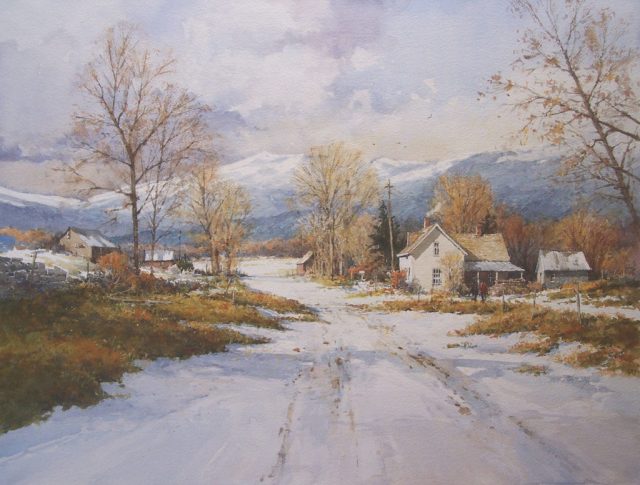
winter dusk

– “Winter Road” by Ian Ramsey