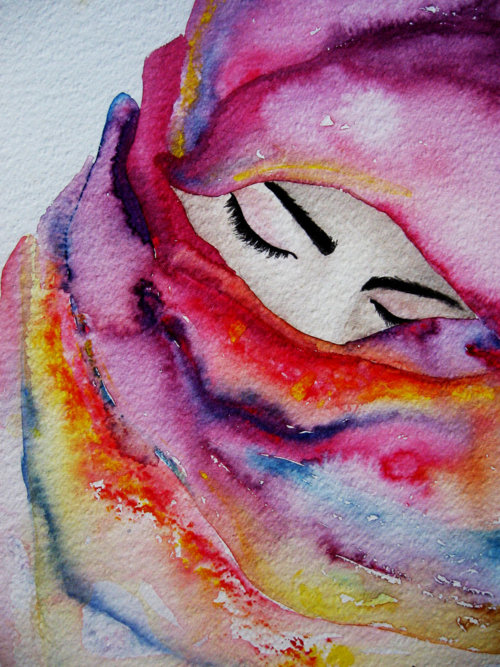
Praniti Gulyani’s first hijab

my first hijab . . .
a shadow
on the flower

Praniti Gulyani (India)

(Previously published in Old Song: Red Moon Anthology, 2017)

The opening line of this haiku indicates the first experience of a person wearing a hijab (veil) which is significant in terms of its religious, cultural, and social value. A first hijab also means that a girl has entered into puberty where she has to cover herself up as a means of her protection when she is interacting with a world full of strangers and experiencing a different perspective of life that is more mature.

A shadow, in my opinion, means the self-reflection of one’s thoughts about drawing a line to protect herself from the outer world. A new self-image that is more careful and thoughtful. This shadow can also be the fears that a woman holds in her youth regarding her body, beauty, and self. Through a hijab, she is trying to keep herself away from the darkness of the outer world.

It is like a flower that unfurls and reaches the stage of blossom where many insects and seasons ruin its beauty and loses the charm of life.

The use of an ellipsis after ‘hijab’ indicates the deepest feelings of a person, which is more than merely a piece of cloth.

Hifsa Ashraf (Pakistan)

What drew me to this haiku was the topic of “hijab” which is not a common theme in this art form, and that the second part of the poem is open to many powerful associations. 

As Hifsa mentioned, donning a hijab is part of the process of coming of age for a Muslim girl. Going through puberty as a girl is not something I’m familiar with as a man, but I can see the possible mixed emotions that it would bring. You are at once excited and scared for what becoming a young woman can entail. Perhaps the second part of the haiku is speaking about a more universal experience of one’s innocence being tainted. The poet, it seems, is expressing this through the lens of her religious and cultural experience. 

I feel each word and line break in this haiku is deliberate and potent. It has a serious tone and is not celebratory. In my opinion, the pacing of the poem is telling the reader “take this seriously” as the weight of the words can be felt palpably. 

In haiku, we speak of kigo, or seasonal references. “First hijab” can be said to be a kigo as it refers to a certain period of time. We can also say that wearing one’s first hijab could signify the spring of one’s life.

What is also interesting to note is the relation between the shadow and a hijab’s color, which is traditionally black. The correlation between the two parts of the haiku becomes even more apparent when considering this. 

I like that Gulyani did not explain what kind of flower she was referring to. That would detract from the power of mentioning her first hijab. It would also make the haiku too heavy with three distinct subjects to consider. “Flower” has many references, spiritually, physically, and metaphorically. I will leave it to the reader to puzzle over them in the context of this haiku.

Finally, I want to take note of its technicalities. Though the first line is the longest, which is traditionally short, I believe having “my” in the poem is important. Without it, the haiku would not be perceived as so personal. The brevity of the poem is commendable and no word is wasted. The poem seems to have been written effortlessly, but I doubt it. The best poems seem natural on the page, but behind them, there are sometimes hours and days of work. In terms of the sound, the “i”s in the first line make it stark and the “o” sounds in the last two lines slow down the pace, which is effective with such a short poem. 

Gulyani has written a unique and personal haiku that needs to be heard. It has resonance, brevity, and flow. Not only that, but she has also written about a substantial subject with the weight it deserves.

Nicholas Klacsanzky (USA) 

d5jlxvu-1a018e82-d370-45ca-9d0f-e16333eebc95

– Painting by nysahanny  


Alan Summers’ duskfall

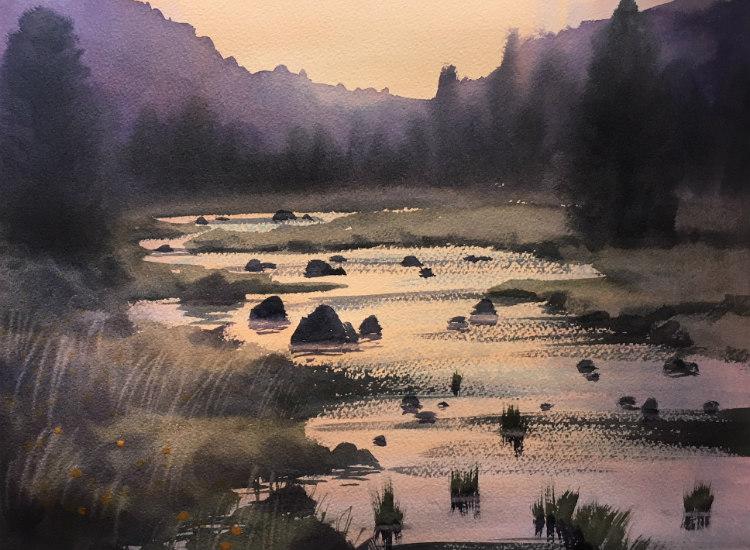
duskfall…
the moon bumps
into a paperboat

Alan Summers (UK)
(Published previously in The Heron’s Nest vol. XXI no. 4, 2019)

It’s difficult sometimes to summarize a whole story into the shortest possible amount of words, but when someone does it, it becomes a masterpiece. This haiku is one of those masterpieces that shows why haiku is considered as one of the finest forms of creative writing.

‘Duskfall’ with an ellipsis gives the imagery of a silent yet sad evening where there are no activities. The word itself shows the ending of life when dusk has fallen and is followed by darkness. But, the ending of life can also mean a new beginning that is deeper in nature. It looks like the locus of control is shifting from the outer world to the inner one where subtle aspects of nature get active and replace worldly life.

In this haiku, I can see both outer and inner aspects of life where outer life activities gradually enter into the night and let night complete the rest of the story. The moon bumping into a paper boat shows how things delicately work out of realities, especially when they enter into the night where a moon gradually comes close to Earth and touches the temporary or fragile part of life, which is a paper boat in this case.

Hifsa Ashraf (Pakistan)

Mr. Summers is often experimental and inventive in his choice of words and phrasing. In this haiku, “duskfall” is one such example. It is not a recognized word by the majority of dictionaries but it is intuitively understood. It has a potent imagistic sense to it, with the motion of dusk falling either into place or dropping away. I prefer to think it is the former. As Hifsa pointed out, the ellipsis helps to create movement as well.

The next two lines provide a startling but calming image of the moon bumping into a paper boat. However, we can discern that the moon is not actually hitting the paper boat, but its reflection is.

A fun part of reading this haiku is figuring out the connection between the first line and the next two lines. The haiku seems to say: “the coming of dusk is like the moon’s reflection bumping into a paper boat.” A lot could be interpreted from this, but I feel that the image gives rise to mystery and magic.

What is also curious is that Mr. Summers plays with color with the two parts: dusk being black and the moon and paper boat being white. In a way, the coming of the blackness accentuates the white. I get a sense that the poem could be speaking of yin and yang: the sky and the earth, the night and day, are intertwined and balance each out.

Besides all this thought, witnessing the moment described would be joyous and spectacular, especially in the quiet of dusk. Like in any poetry, haiku have a layer of mental interpretation and a layer of mood/atmosphere. Understanding both can give us a comprehensive picture of a poem.

Another feeling I get from this haiku is the beauty of the “o” sounds in “moon,” “into,” and “paperboat.” These long syllables slow down the poem and create the scene of dusk potently.

It’s difficult to write an original haiku about the moon after 100s of years of tradition of doing so. Mr. Summers has done it through his unique juxtaposition, word choice, and imagery.

Nicholas Klacsanzky (USA)

rhoucfpca7r01

– Painting by Gareth Naylor.

Réka Nyitrai’s pinned butterfly

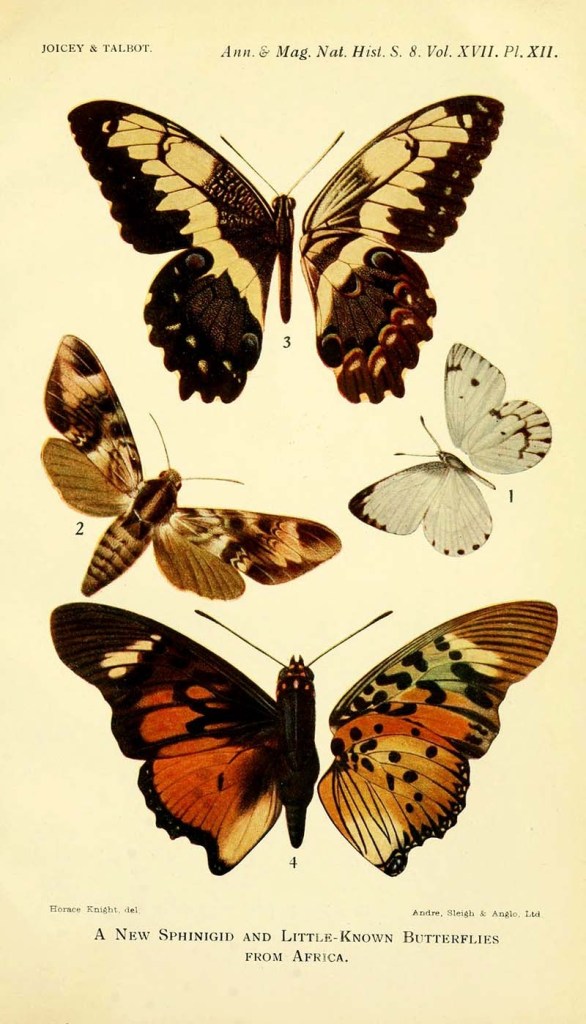
pinned butterfly –
even in death
beautiful

Réka Nyitrai (Romania)

(published previously in Scryptic issue 2.4 December 2018)

I liked the simplicity of this haiku that straight away touched me deeply. We mostly mention living creatures in our poems as a source of inspiration but this unique haiku took another unique dimension of life which itself is full of life.

‘pinned butterfly’, if I imagine, means the transformation of life into death but still finds its way to get the attention of the masses. When we pin something, we try to highlight it on a wall or board or any other place where it can be seen by many people. It also shows how things become important after death, and especially how death carves their beauty and makes them immortal.

Yes, this happens only through imaginative and creative thoughts that never die. Our thoughts and creativity make things immortal no matter what stage of life they are at and whether they are alive or dead—whether they are dynamic or static. The only thing that matters in the imaginative world is how we make things alive and immortal through our creative thinking. This haiku is the epitome of the imagination that takes us to a static stage of life where butterflies don’t flutter, don’t leave trails, don’t fly high, and don’t spread fragrance. It is a meditative stage of life where one finds existence in stillness and in deep silence. The en dash after ‘butterfly’ means a short pause which also reflects the stillness of life both during the creative and/or meditative process.

Hifsa Ashraf (Pakistan)

This haiku brings to mind how beautiful endings are at times. Sunsets. Outros in songs. A person’s last words. A pinned butterfly.

The beauty that the poet sees in the pinned butterfly brings it back to life in a symbolic sense. It is alive with color and elegance, albeit in stillness. But by pinning the butterfly, we can relish it’s beauty forever in a certain moment. That moment happens to be its death.

Getting technical, we can say this haiku displays muga (a Japanese aesthetic), or spiritual selflessness. The poet does not discuss herself and focuses solely on the beauty of the butterfly, in its new transformation.

The dash is useful to make a clear split between the parts. Also, it could visually represent a pin. The economy with which the poem is written is admirable. With only six words, it carries a powerful message. The sharp “i” sounds in the haiku also direct one’s attention to the image of a pin.

Simple yet poignant, this haiku allows readers to contemplate the beauty of the afterlife in its physical sense. It also brings about an introspection on what it means to be alive.

Nicholas Klacsanzky (USA)

Sphingid-and-little-known-butterflies-from-Africa-1916-s