
first buds—
I dust the head
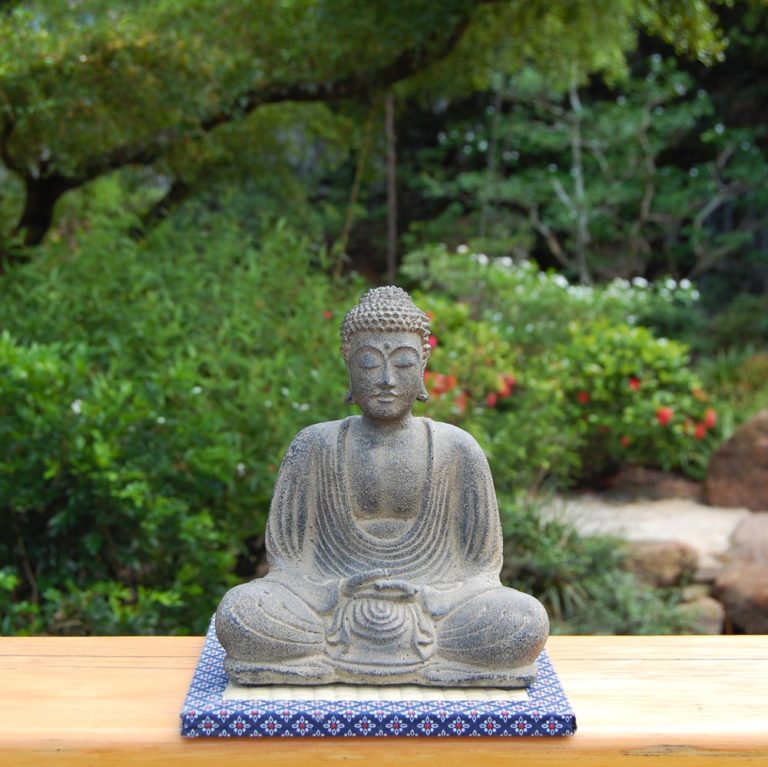
of a stone Buddha
— Carmela Marino (Italy)
(previously published at the Golden Triangle Contest March 2022)
Commentary
This is an interesting haiku that touches both the hard and soft sides of life deeply and perhaps spiritually. The opening line ‘first buds’ gives some hope of spring—the season of new beginnings, or rejuvenation. The plural form of ‘buds’ makes it a bit mysterious where it looks like there is an abundance of buds on a branch, falling, or stuck on the head of a stone Buddha. But, when I take this haiku as a whole, I find it more intrinsic, more towards ‘self-enlightenment’ and/or ‘wisdom’ where buds can be the lessons of wisdom or Buddha’s philosophy unfurling in different phases of life as a sign of hope, progress, learning, and change.
It only needs some clarity, mindfulness, or crystallization of thoughts which is signified in the second line ‘I dust the head’ where the emphasis is beyond seeing i.e. introspection or meditation. I liked the way the poet blends both the delicate side of nature (buds) with the hard and concrete side of nurture (head) by masterfully using the technique of ekphrasis and yugen which may catch the eyes of many haiku lovers.
— Hifsa Ashraf (Pakistan)
I appreciate the contrasts in the juxtaposition. The flowers are soft: the Buddha statue is not. The first buds symbolize birth, while dust symbolizes death. The flowers are full of color, while the stone Buddha is not (unless he’s wearing a green moss robe). After Enlightenment, it’s been said the Buddha escaped the wheel of samsara: the endless cycles of birth and death. Actually, in a way, it seems this haiku succinctly expresses the essence of Buddhism by showing the nature of impermanence (symbolized by dust). The Buddha shows us that the mind’s attachment to what is fleeting and temporary creates suffering (while nonattachment reveals peace and ends suffering).
This haiku also brings to mind a quote by my favorite Estonian composer Arvo Pärt: “Time and timelessness are connected. This moment and eternity are struggling within us.”
It seems impossible for the human mind to experience life that is timeless because the measurement of time seems to be hardwired into conditioned thoughts. Yet the timeless ever-flowing “now” is the only time we are ever alive. It seems the present moment is actually something the mind can never identify with because when it tries to describe the moment, it’s already describing a past event. Thus, it seems the experience of living in the timeless ever-flowing “now” is not a mental concept or idea, but rather seems to originate from the spirit without any words or thoughts. Of course, our measurement of time has its place in modern society. We frequently measure our lives in years, months, weeks, minutes, and seconds. We have work schedules, meetings to attend, and appointments to keep. In the world of jobs and making a living, time is money. However, this haiku puts our small human lives into perspective. One day, we will all physically become dust on the stone Buddha. Therefore, who am I?
Interestingly, the fact there is any dust to begin with made me initially envision a Buddha statue indoors somewhere. At first, I only saw human dust. However, on the second read, I see pollen and the poet is dusting the pollen off the Buddha statue in a garden or park somewhere. This also could be true.
In regards to the first line, the flower buds could be symbols of hope for new generations. It’s also been said the Buddha gave his disciples a flower without speaking a word. This was a transmission of Enlightenment: a wordless unity that is devoid of thoughts. It’s also true that not all flowers bloom at the same time, but they naturally open to sunlight when the time is ripe. In a way, it seems the same could be said regarding our spiritual unfoldment. I also appreciate the saying: “When the student is ready, the master always appears.” For me, this haiku speaks to this quote as well, where the new buds are students. Perhaps most powerfully, without a single word, the stone Buddha guides us to look within, to become still and quiet. It seems only in those silent depths can I begin to realize his Spirit is not separate from my own Spirit. Perhaps eventually, ultimately, the master vs. disciple duality will seem to disappear.
In short, this is a powerful haiku that expresses impermanence, the timeless flow of the present, and the teachings of the Buddha.
— Jacob D. Salzer (USA)
Hifsa and Jacob wrote extensively on the meaning and interpretations of this haiku. I will in turn dive a bit into the technical world of this poem.
In the first line, we have a traditional kigo, or seasonal reference, for spring. “Buds” is fairly general, but I think the poet may have wanted to shy away from putting too much attention on the flower itself in order to focus more on the Buddha. Also in the first line, we see a dash used to separate the two parts of the haiku, which is the fragment and the phrase. This is another classical element of this haiku.
The second line brings in the action. Commonly, haiku only have one verb so that we can concentrate on one movement. Here, the “head” could be the head of a flower without reading the third line.
In the third line, we discover that the head is not of a flower but of a stone Buddha. I think it is important that the poet capitalized “Buddha” as she is not referring to not just any buddha but the Buddha in the form of a statue. She is treating this stone as the actual Buddha and giving it proper reverence. Dusting the statue’s head might signify cleaning or clearing the way to enlightenment, as with a clear mind, one can be in nirvana.
Looking at how the lines are arranged, we have a non-standard length of lines according to English-language haiku. The longest line is usually the second, but here it is the last. There is nothing wrong with this, especially since syllables and Japanese sound units don’t match up well. As long as the rhythm flows well and brings about a potent mood, which I think this haiku does. The rhythm present makes “Buddha” stand out more, which is not a bad thing at all.
We have some interesting usage of sound in this poem, too. The “u”s in “buds,” “dust,” and “Buddha” seem to provide a sense of reverence to me. The “b” sounds pop and make the haiku reading more powerful.
In terms of aesthetics, this haiku might show ba. According to Jim Kacian, “If you look up ba in any Japanese-English Dictionary you’ll find it means “place” or “site” or “occasion”. And these are all true in the most general sense—ba is a pointer to a kind of awareness that something of importance is happening in time and space.” I feel this haiku demonstrates a spiritual importance to the moment of dusting a stone Buddha’s head, where it plays with spirituality, physical objects, and manifestation.
An enjoyable haiku with multiple layers of spiritual and religious meaning.
— Nicholas Klacsanzky (USA)
 Haiku Commentary
Really enjoy Carmela’s verse! And thank you for the enlightening commentary. The contrasts are lovely, and I appreciate the sense of reverence.
I also wanted to share a related verse I selected as a community judge for the Poetry Pea last year, by Anna Yin. There are some similar themes and contrasts in the juxtaposition.
stone Buddha
in newly formed puddle
melting snow
LikeLiked by 2 people
Nice verse yourself! Thank you for the feedback. I hope you enjoy more of our posts.
LikeLike
Pingback: il fiore di luna