
fossil galaxy
headlights speed
from dark to dark
— John Pappas (USA)
Commentary
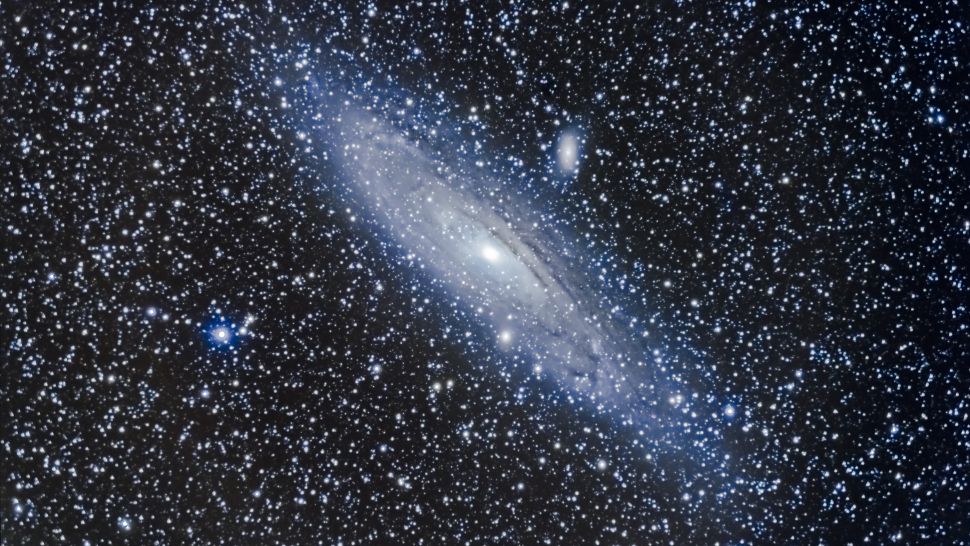
A common understanding of a fossil galaxy is that it’s a remnant of an older galaxy that existed within a current galaxy. It’s something left behind after many years for us to think over, get some lessons from, and see how things are temporary and worthless over time.
When I see a fossil, my thoughts go back to a time when that fossil had a life—maybe even an integral part of life or the environment at that time. A question comes to my mind: “why does nature preserve fossils for us?” There is a simple logical answer: “so that we can remember our history or past.” A fossil galaxy shows us the marvel and perhaps the waste of this universe that discards many elements with time but doesn’t abandon them—estrange its parts but allow them to be present.
Life is like that for us: we discard many things that were once the most valuable part of our lives but they keep circling our minds. Certain things get preserved in our memories like a fossil. We may not give attention to them, but they may elate or haunt us in the later part of life. So, I take ‘headlights speed’ as flashback memories that come to remind us of what’s in our past and how we reach this point after passing through, dark to dark. The word ‘dark’ may depict dreams (particularly nightmares) that remind us of the remnants of difficult times we try to push back in our heads.
However, the connection between our mind and space is so deep as can be observed in this haiku, where we try to connect with the galaxies outside and the galaxies within through our thoughts, memories, reasoning, logic, and analysis being an integral part of this universe. The dark is a background, whether it is our life or space that brings our history to light.
It seems there are galaxies within galaxies—both inside of us and beyond us. This idea is poignantly brought down to earth, quite literally, in this haiku but also (pun intended) leaves space for our imagination and dreams.
The fragment of this haiku “fossil galaxy” is intriguing, as it marks traces of an ancient galaxy. I also interpret “fossil galaxy” as the Milky Way Galaxy when the dinosaurs roamed Earth. In both interpretations, I appreciate the time-warp perspective in this haiku.
The phrase “headlights speed from dark to dark” brings to mind a time-lapse of a highway, with cars moving at night and I see stars rotating above. “from dark to dark” could relate to the pollution caused by cars and other motor vehicles, unfortunately contributing to carbon in Earth’s atmosphere and climate change. If we look at the lifetime of a car, it originates from the darkness of Earth via raw materials; then factories produce pollution under the hum of electricity; then some parts of the motor vehicle are buried back into Earth. The good news is most parts of cars are recycled.
According to popularmechanics.com: “Fed by annual new-car sales that hover around 17 million, the U.S. automotive recycling industry reclaims some 750 million pounds of scrap each and every month…The automobile is the most recycled consumer product in the world — 95 percent of all vehicles are reclaimed. The rate far exceeds the numbers for recycling giants such as newspaper (74 percent), aluminum cans (51 percent) and glass (22 percent). And much of the reclaimed material winds up back in new cars: Coffee-stained carpeting becomes air-cleaner assemblies and chewed-up tires morph into brake pedals and floor mats…Still, as much as 25 percent of each car ends up in landfills. That’s largely because landfill space is still relatively cheap and the technologies to recover nonferrous material are still expensive.” Source: Where Your Car Goes to Die (popularmechanics.com)
“from dark to dark” could also be interpreted as returning to The Great Mystery or the Unknown. It shows just how brief our human lives truly are in the grand scheme of things. From one perspective, even a billion years is equivalent to a microsecond. For some, there could perhaps be a divine comedy in this view.
In terms of “headlights speed,” I thought of all the devices we use that operate at close to the speed of light, such as sending text messages with our phones or sending an email. “It’s the electromagnetic wave rippling through the electrons that propagates at close to the speed of light…This makes the observable speed of electricity about the same as the speed of light: 186,000 miles per second.” Source: Quick Answer: Does Electricity Travel At The Speed Of Light – BikeHike (cyclinghikes.com)
It’s interesting to note that some stars have actually burnt out, but because they are so far away, their light still travels and appears to our human eyes on Mother Earth.
Interestingly, it seems galaxies are not just “out there” but also internal in our subconscious and our dreams. Just as a single seed gives birth to an entire forest with innumerable trees, it’s been said that the subtle samskaras or mental impressions give birth to innumerable worlds. This offers a different perspective because instead of the world and galaxies solely being seen as “out there,” they could also be seen as an internal/eternal phenomenon.
Regardless of our interpretation(s), this is a haiku with depth, modern implications, and mystery.
— Jacob D. Salzer
With the desolation shown in this haiku, I would place the kigo or seasonal reference in either winter or fall. That being said, I’m not sure the implied kigo is that important to the quality of this haiku. In Japan and around the world, many haiku have been composed as kigoless.
Though there is no punctuation used, the line break in the first line could be said to represent a kireji or cutting word (though more accurately stated as a cutting character or sound) that shows the delineation between the two parts of the poem.
The two sections of this haiku are not too closely or too loosely connected, which illustrates the art of toriawase. The dark of the night connects with the dark of the universe. “Speed” can fit well with the idea of the speed of light. It is up to the reader, though, to see these connections and to see how they resonate with them. Well-written haiku like this one allow the reader to fill in their own gaps, though the poet leads them on certain paths of discovery.
Pacing in this haiku is pretty much standard for English-language haiku: a short first line, a longer second line, and a short third line. However, as we can see, the third line is a tiny bit longer than the second in this haiku. That’s fine because the traditional rhythm is kept with the elongated syllables in the second line.
In terms of sound, the most prominent letters are “l” and “d.” The “l” sounds provide a lightness to the reading as if to illustrate the ephemeral nature of the universe. On the flip side, the “d” sounds give a punch that brings about a sense of seriousness.
This is a unique and relevant haiku with potent imagery that drills deep into our imagination and search for meaning.
 Haiku Commentary