
pottery class
i embrace the broken
pieces of me
— Mona Bedi (India)
First Place, Indian Kukai, #38, 2022
Commentary
The overall imagery of this haiku is apparent as there is little mystery involved here. But, it gives us deep feelings about the self, often known as the inner self. It’s an introspection where the poet has created an analogy between her feelings about herself with pottery. Clay is the element that binds us to this haiku in many ways. If it is introspection, the poet may try to share her broken self, flaws, past experiences, hardship, etc. Taking a pottery class can be taken as catharsis where the focus is not only giving venting feelings and emotions but also reshaping or remoulding the self that is still suffering or dissatisfied and trying to find peace. There is a glimpse of wabi-sabi in this haiku where you accept yourself the way you are as the word ‘embrace’ indicates and focuses on self-healing by practicing optimism and positivity.
The mystic element in this haiku is also obvious in this haiku where the words ‘pottery’ (clay), ‘broken pieces’, ‘I’, and ‘me’ depict how silently one passes through the process of transformation and goes beyond nothingness gracefully. According to Sufism, the connection between the self and clay is quite subtle and deep. It shows the humility and modesty of being, where deep understanding takes us on the journey of ‘knowing thyself’.
The sounds of ‘p’ and ‘m’ in this haiku may depict the rhythm of the thoughts and feelings that are still not on the surface. The letter ‘i’ may show how humbly and keenly a person makes themselves ready to pass through the journey within, which can take them from unknown to known.
This is a powerful haiku that expresses psychological healing and recovery. I feel acceptance and self-love in the phrase “i embrace the broken pieces of me.” In this haiku, “broken pieces” seem to be symbols for past psychological trauma that carry a heavy connotation. However, the word “embrace” gives me a vision of all the broken pieces coming together, while still honoring each piece as a unique place in our being. Furthermore, in a pottery class, there is a sense of community with the students and teacher. It seems this inclusiveness brings psychological cohesion and unity where the poet is no longer alone on her path of healing.
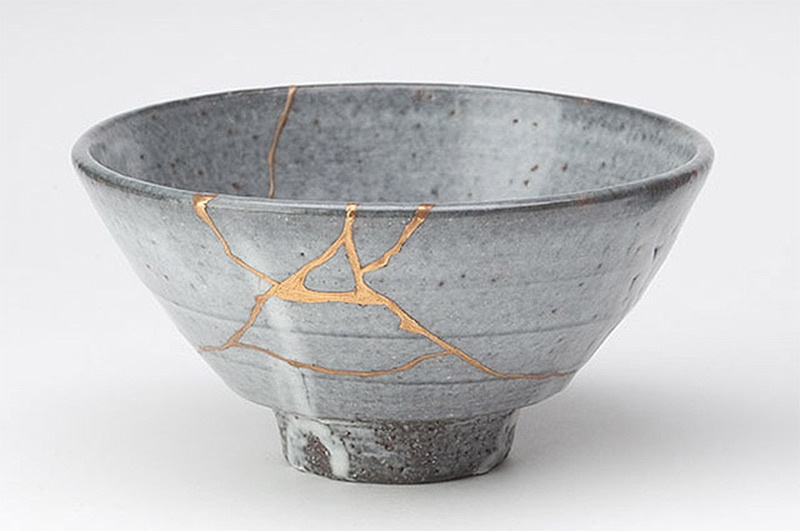
Along these lines, this haiku immediately brings to mind the ancient Japanese art of kintsugi. Here are some quotes that demonstrate how powerfully kintsugi relates to this haiku:
“Kintsugi (golden joinery) is the Japanese art of repairing broken pottery with lacquer dusted or mixed with powdered gold, silver, or platinum, a method similar to the maki-e technique. As a philosophy, it treats breakage and repair as part of the history of an object, rather than something to disguise.” “Kintsugi became closely associated with ceramic vessels used for chanoyu (Japanese tea ceremony). As a philosophy, kintsugi can be seen to have similarities to the Japanese philosophy of wabi-sabi, an embracing of the flawed or imperfect. Japanese aesthetics values marks of wear by the use of an object. This can be seen as a rationale for keeping an object around even after it has broken and as a justification of kintsugi itself, highlighting the cracks and repairs as simply an event in the life of an object rather than allowing its service to end at the time of its damage or breakage. Kintsugi can relate to the Japanese philosophy of “no mind” (mushin), which encompasses the concepts of non-attachment, acceptance of change and fate as aspects of human life.” “Not only is there no attempt to hide the damage, but the repair is literally illuminated… a kind of physical expression of the spirit of mushin….Mushin is often literally translated as “no mind,” but carries connotations of fully existing within the moment, of non-attachment, of equanimity amid changing conditions. …The vicissitudes of existence over time, to which all humans are susceptible, could not be clearer than in the breaks, the knocks, and the shattering to which ceramic ware too is subject. This poignancy or aesthetic of existence has been known in Japan as mono no aware, a compassionate sensitivity, or perhaps identification with, [things] outside oneself.
— Christy Bartlett, Flickwerk: The Aesthetics of Mended Japanese Ceramics”
Source: Kintsugi – Art of Repair | Traditional Kyoto
With kintsugi in mind, it seems traces of past trauma may never be fully erased from our individual and collective memory. However, by joining the fragmented parts of our self, I feel the broken pieces can become transformed or transmuted into a larger sense of purpose and unity. In this haiku, it seems the sharp edges that once defined each piece have now blended into a deeper compassion. Perhaps by mending the pieces together, we can also recognize the lessons our past has given us to help protect ourselves and prevent future harm. Interestingly, while this haiku is personal, I think the healing theme of this haiku could apply to families and larger communities that appear to be fragmented or broken. As one example, in some areas of life, I see the United States of America as a divided nation because so many subjects seem to divide people. With this in mind, if we consider thinking of this haiku with the phrase: “i embrace the broken pieces of my family,” “i embrace the broken pieces of my community,” or “i embrace the broken pieces of my country,” perhaps these could be healing phrases for a larger community context because it seems the first step to healing is acceptance—recognizing the broken pieces as they are.
Along these lines, it seems fragmented communities start with fragmented individuals. If peace and unity are felt within individuals (if their broken pieces are mended together within their own self), then it seems that fragmented unity will be reflected in the world. In short, it seems larger community healing starts from within each individual. Fortunately, according to quantum mechanics and several philosophies, we are not alone and the sense of being an isolated, separate person or individual is not as concrete as it appears to be. Rather than supporting rigid individuality, science and several philosophies—including indigenous ways of life—tell us that all of life is connected.
In regard to quantum mechanics, here is a powerful quote that resonates with this haiku: “When quantum systems interact, the result can be the creation of quantum entanglement: their properties become so intertwined that a description of the whole solely in terms of the individual parts is no longer possible.” Source: Quantum mechanics – Wikipedia
Along these lines, it seems by embracing the broken pieces within us, eventually, even the very sense of “me and mine” as a mental concept may ultimately dissolve into a spiritual energy that is universal.
In short, this is a powerful haiku that speaks of acceptance, compassion, and healing. I feel it also symbolizes the gifts of our individuality in the context of a universal consciousness.
— Jacob Salzer
I have little to add after such excellent and deep commentary from Hifsa and Jacob. I would like to comment on how this haiku is kigoless, or without a seasonal reference. This is definitely fine, since haiku written without kigo goes back all the way to Matsuo Basho and more specifically with the free verse movement of haiku in Japan. I would not say this is a senryu because it is not irreverent or cynical in nature.
Though there is kireji or punctuation acting as a “cutting word,” it is implied by the line break in line one. As Hifsa noted, there is no juxtaposition here but rather an association between the clay and our bodies or self. The length of the lines follow the standard for English-language haiku with a short first line, a longer second line, and short third line to match the traditional rhythm of Japanese haiku.
As Jacob discussed, I think it is important the poet decapitalized the “i.” It is a way to step away from the ego and to distance oneself from egoic thought.
The enjambment, or break in thought, on the second line is unique. In haiku, we don’t usually use enjambment, but I believe it works well here. The word “broken” is appropriately broken off from the rest of the phrase. Perhaps it lends to separate readings for the last two lines, respectively.
A clear haiku that strikes deep emotional and philosophical tones.
— Nicholas Klacsanzky
 Haiku Commentary