
river mist…
the faint whispers
of a lost prophet
— Jacob D. Salzer (USA)
Published in The Heron’s Nest, Volume XXIV, Number 3: September 2022
Commentary
The haiku begins with a mystery of belief or religious life. The poet may have diluted thoughts or beliefs. I see ‘river mist’ as a sign of a lack of clarity or less understanding of one’s beliefs where one’s thoughts may be covered in a mist—the discontinuity of a spiritual or religious lesson. I also see it as how directionless a person is if they have no spiritual or religious leader who can show them the path and live a modest and peaceful life. The ellipses after ‘mist’ let us pause and ponder more on things that are not clear to us, which may be misguided or misleading in many ways.
After ‘mist’, ‘faint whispers’ add more to the modification of religious practices that used to be followed by people to get inspiration and guidance for a righteous path. With time, certain voices have lost their strength, positive influence, and power which may be the cause of some worldly chaos.
I see ‘lost prophet’ here as a spiritual leader who helps us heal wounds of our soul and who inspires us as a role model to live an exemplary life full of compassion, kindness, and peace. In other words, this haiku might be implying that we don’t have much of a platform to explore and understand our spirituality currently.
The haiku begins with perhaps a spring kigo in “river mist.” Coupled with the second part of the haiku, I feel the season is early spring with the word “whispers.”
The word “mist” connects well to “whispers” and even to “lost.” It’s a strongly visual haiku in that respect. You can see the mist move about the river, like the whispers of a lost prophet. The juxtaposition shows a comparison between nature and spirituality. It could be that the mist is the whispers themselves, or that the whispers are simply present in the river mist.
The idea of a lost prophet is intriguing. It could be that a prophet has passed away, is physically lost, or that the people have stopped listening to them.
Looking at the punctuation, the ellipses act as a kireji or cutting word that as Hifsa noted, allows us to pause and imagine the mist floating over the river. The haiku is stronger because of this effect.
The sense of sound in this haiku is something to pay keen attention to as well. The letter “r” struck me as the most important. It gave me the feeling of a moving river. Overall, the haiku has a soft reading to it that is reminiscent of whispers.
In terms of pacing, the haiku follows the standard English-language format of a short first line, a longer second line, and a short third line to approximate the original rhythm of Japanese haiku.
Salzer has done a fine job to combine spirituality, nature, and human limitations.
The first interpretation I was going for is the lost prophet signifies he or she has physically passed away. As the prophet takes their last breath, all that’s left of his/her life are faint whispers, Mother Earth, the endless river, and the mist. The mist could symbolize their spirit passing away/slowly evaporating into sunlight as the river of life flows on. When I saw the river mist in my mind’s eye, I felt an ethereal quality right away, and this led to writing about faint whispers. I also saw the evaporating mist as a kind of transfiguration. I appreciate how mist is water in a more subtle form that becomes nameless and formless.
I also wrote ‘a lost prophet’ to describe how the prophet may feel lost in human civilization, i.e. he or she doesn’t truly feel like they belong in human society. As a result, he or she retreats to Nature and finds their true home there, to such an extent that even their own words and teachings have become indiscernible and are only heard now as faint whispers. In other words, their life and teachings could now be Silence itself. It could be that the person has lost all labels, including the word ‘prophet.’ The sound of the river and his or her voice is all that remains instead of words. But the whispers are so faint, we and maybe even the prophet cannot know what they are saying. I intentionally left that open for the reader to hear maybe faint words in his or her whispers, maybe to hear their final words, but in a very gentle way; but the real message I’m going for is not found in words at all, but in the silences and in the sound of the river, and the Great Mystery and a deep wordless Love.
In short, I wanted to describe a transition from someone being mentally pinned as ‘a prophet’ to the essence of the prophet’s Real teaching that is not found in words but in Nature and Silence. Now, the river’s mist is the whispers of the prophet, calling people back to Nature, to Real Spirit and Love. There is a mergence of identity when the prophet loses their mental labels. They are now unified with Mother Earth and the Divine Spirit as there are no longer any mental barriers. I was deeply inspired to show a wordless Love found in Nature in this haiku.
I also wrote ‘a lost prophet’ to possibly mean the person has become physically lost in Nature. The person perhaps has left behind city life for good, but they were maybe not really prepared, and got lost in Nature, leading to their physical death. This circles back to the first interpretation. As the prophet takes their last breath and says their last faint whispers with hardly any physical strength left, what survives is Mother Earth and Spirit. I wanted to show perspective too, that the founding of religions is actually not very old compared to the history of Mother Earth Herself, and that the human race and human history is actually not very old either. But the prophet also may not necessarily be religious at all. I was actually leaning more towards a spiritual prophet outside of religion whose teachings revolve around Mother Earth.
There is another darker interpretation I thought about when writing this. I saw “a lost prophet” as someone who is mentally lost, who has gotten so caught up in the ‘prophet’ label and has a kind of ‘cult’ following. Some people may follow this prophet into Nature and suffer the consequences. When this lost prophet finally dies, the hollowness of their life is revealed in the mist, and their faint whispers and corrupt words have disappeared for good.
In this haiku, I also wanted to show how all verbal words are transient. Words appear and disappear, just like the mist.
In the end, I feel Nature will endure, and the Great Spirit. The Great Mystery will last. And Silence and Love.
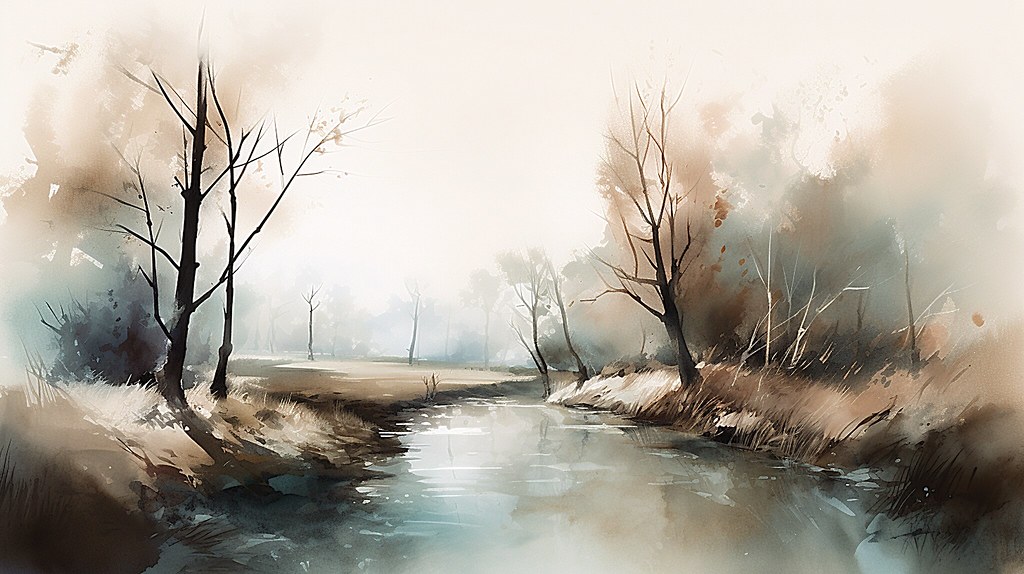
Painting by M. Martin Vicente
 Haiku Commentary
Pingback: Haiku – October 2023 – A Haiku Journey