
kid’s bed
a thousand ways
to disappear
— Samo Kreutz (Slovenia)
(previously published in THF Haiku Dialogue, December 2022)
Commentary
I greatly appreciate the imaginative space of this haiku. This haiku transports readers into books, stories, and dreams. As a child, my parents would read to my sister and I. These are wonderful memories that I cherish. It seems in our modern world, it can be easy to forget the imagination, but when we do this, I think we all pay the price. I feel our imagination is important because it opens our hearts and minds, and can lead to many different perspectives and creative ideas.
I feel “a thousand ways to disappear” is a great way to express being completely immersed in a book, story, or dream.
This is a touching haiku that shows the power of the imagination, stories, and dreams.
A lovely haiku that covers the stories of almost every person as a child. It shows the tangible and intangible aspects of life where a child’s bed is taken as a symbol of relief where one seeks solace and catharsis. The bed helps a child to become calm and have an uninterrupted environment where they can play, sleep, dream, and listen to stories. It’s a place that takes them to another world where they can freely think, feel, and do whatever they want.
It’s a domain where there are a thousand ways to see life differently when they are on their own and where all senses converge to provide a holistic perspective that is calm and content. Adults might desire to disappear into childhood memories, to feel nostalgic, or to have deep imagination/daydreaming that keeps them away from this chaotic world. I see this as an escape from reality where a person goes back to their childhood and gets lost in a time that was carefree and without responsibilities.
— Hifsa Ashraf
There is no distinct kigo or seasonal reference here. That is fine, especially since it can fit in the genre of senryu. There is a time placement of early childhood, though.
The way the two parts of the poem fit together is intriguing. Something as overlooked as a kid’s bed as an adult is given special appreciation. The word “disappear” is the most crucial, in my opinion. It connects to both adult and child selves. The juxtaposition in this haiku or senryu reminds me of the saying, “From one, comes many.”
There is no punctuation in the poem besides the needed apostrophe. This gives more of a case for fitting in the senryu genre. However, the line between haiku and senryu, especially in English, is often rather thin.
The pacing, with a short first line, a longer second line, and a short third line, is common practice in the English-language haiku world to approximate the Japanese rhythm of haiku.
The concision in which the poem is written is commendable. The poet uses just the right amount of words with the most effective phrasing. It is fitting for such a simple, yet poignant subject. The chosen diction is on point as well for the mood of the poem.
The sound of the letter “d” in this poem is key. It provides weight to the poem and a staccato rhythm, which connects to “thousands” in an abstract way.
With a mastery of simple power, the poet delivers a nostalgic and perhaps melancholic form of celebration.
— Nicholas Klacsanzky
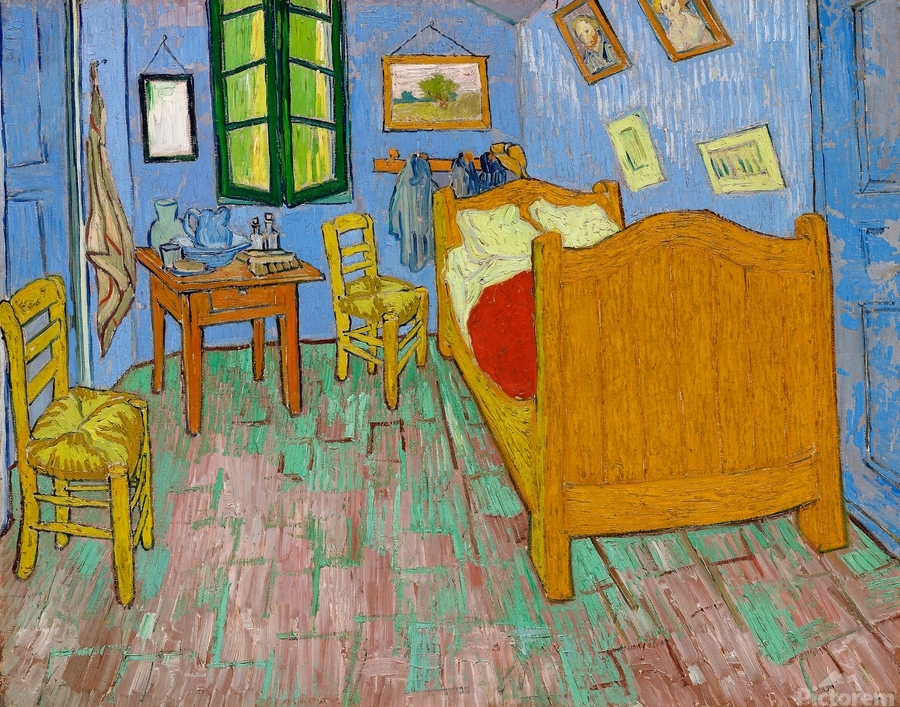
BEDROOM IN ARLES | THE BEDROOM | 1889 | VINCENT VAN GOGH
 Haiku Commentary