faceless flowers how
to mind this flesh and bone
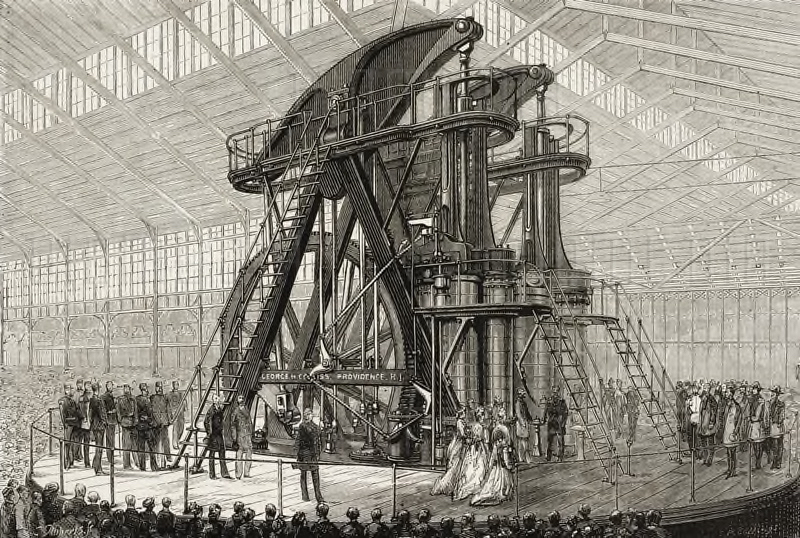
in an age of steam
— Ian Gwin (USA)
Commentary
The initial message I received in this haiku is a warning to not become another “gear in the machine” in a modern capitalistic society that seems to promote conformity and the accumulation of material objects. “Faceless flowers” seems to be a metaphor for perhaps certain workers who may, unfortunately, not feel truly valued or seen. However, I also read “faceless flowers” to perhaps mean some people are ignoring Nature. I wonder if this haiku is saying that it’s difficult to see some people’s unique individuality through the steam of modernity that can sometimes cloud our vision.
This reminds me of a chapter in the novel A Wrinkle in Time by Madeleine L’Engle where all the suburban houses look the same and all the children are bouncing balls on their driveways at the same time, much like robots. The children also all went inside their houses at the same time, on a precise schedule. Later on in the novel, it was discovered that a large brain was controlling the actions of the people on this planet. This telling symbol of mental conditioning seems to relate to this haiku. The mention of steam also brings to mind steam engines in trains and their environmental consequences.
“How to mind this flesh and bone” seems to translate as: “How can I take care of myself in mind, body, and spirit within modern society and feel a true sense of belonging?” It seems this is something many of us strive for and struggle with to some degree. This body that is made of the Earth’s elements seems to be disconnected from the Earth in a concrete city. As a result, do some people sometimes feel like “faceless flowers?” Are we being conditioned to believe modern city life is “normal?” Do the majority of people truly believe that “more is better?” Are we often blind to the origins of the products that we buy? Do we pay too much attention to marketing? Have our values largely shifted to a productivity-based model that ignores creativity? These are the questions that come to mind when I read this haiku. It’s a powerful poem that faces the subjects of identity, our values in modern society, and our connection and/or disconnection with Nature.
This haiku has some traditional phrasing we don’t see often these days. Through its phrasing, it presents streaks of modernity and dystopia, showing a world that is transforming from the traditional to the modern era with the sense and love for nature gradually degrading.
I see the faceless flowers as a lack of communication and connection with what is happening due to a fast-paced life. People are more involved in the artificiality of things and becoming akin to robots who keep on striving for success and satisfaction. In reality, they are far away from their essential nature.
The haiku’s season could be placed in spring with the reference to “flowers” as a kigo. However, flowers bloom in several seasons.
This haiku displays unique phrasing and line breaks, with “how” sticking out on the first line and no comma before it. The sound of the line works well and puts focus on the question. You can say the “cut” (kireji) is invisible before “how” but it is syntactically evident while reading.
How the two parts of the haiku combine (toriawase) creates perhaps a comparison between humanity’s loss of identity through industrialization and the faceless faces of flowers. Essentially, through technology and our actions, we have become cogs that somehow have to maintain ourselves despite dehumanization.
Like Hifsa noted, the diction of this haiku is intriguing, especially in the second line. Also, the sound made by the letter “f” manifests a sharp resonance that matches the bitter mood. The last line has softer sounds to perhaps make a somber effect.
Ian Gwin has crafted a fresh haiku with creative phrasing, diction, and symbolism.
 Haiku Commentary