
Haiku from Kelly Sargent, W. Barrett Munn, and Fatma Zohra Habis

winter sky swallows the words I can’t take back

Kelly Sargent (USA)
Cold Moon Journal, March 2024

Commentary from Hifsa Ashraf:

A winter sky stays dull and dim but remains open to wild imagination. This monoku reflects various shades of a winter sky when we read it in one go. I focused on the first three words for a while, which can be read in three ways: winter/sky swallows, winter sky/swallows, and winter sky swallows.

The repetition of ‘s’ and ‘w’ sounds makes it more interesting to read and interpret. Sky swallows usually reflect loyalty, a new beginning, hope, transformation, and more. It seems it alludes to a murmuration that is getting the poet’s attention due to its shapeshifting, shades, shadows, and sound. The use of ‘swallows’ makes this monoku more profound and dynamic. The swallows in the sky could indicate the end of the winter as well which commonly is related to positive outcomes.

The second part of this monoku takes this monoku to another aspect that is more personal and profound. It looks like a mirror reflection of the first part of the monoku. When I read it as a whole, ‘the words I can’t take back’, it gives me a feeling that the person wants to express all that follows the murmuration in the winter sky. ‘the words’ is a catch here as they may reflect personal experiences that are either positive or negative.

If I read the second part of this monoku with the central word ‘swallows’ that juxtaposed this poem, it looks like the person is still in conflict.

“winter sky” is a ground where the poet masterfully displayed profound feelings and thoughts, while allowing readers to find as many interpretations as possible. It is a good exercise for the brain and heart to solve the mystery of this haiku.

no headstones;                         
buried all across the south
remains of slave ships

W. Barrett Munn (USA)
Haikuniverse, January 9, 2024

Commentary from Jacob D. Salzer

An important haiku that shows part of the darker history of the U.S. This haiku transports us back in time, yet we can still feel the consequences of slavery today. I can feel the unbearable weight of colonialism and capitalism when I read this haiku. It is unfathomable in my eyes to imagine being a slave or a slave owner. Some people who are buried are not always remembered with a designated tomb or headstone. This haiku conjures up several questions that we can ask ourselves: What else dwells beneath the ground that we walk on every day? How much of history is skewed, buried, or not documented? How can we preserve history to the best of our abilities, so that we, collectively, can (hopefully) learn and grow and not make the same mistakes? What are examples of modern-day slavery and what are the consequences? How many consumers are conscious of where their products come from? How many people know the origins of the things they buy? How many are aware of the working conditions in various factories? How many of us are open-minded to life after death? Where does karma originate? What is the nature of the soul? Despite the horrifying history, I appreciate how this haiku shines a light into the dark and lets us attempt to see those who are not seen. 

this morning
in the shell hole
lone bud

Fatma Zohra Habis (Algeria) 

Commentary from Nicholas Klacsanzky:

I enjoy how the second line interacts with the first and third lines. It can be read as “this morning in the shell hole/lone bud” or “this morning/in the shell hole lone bud.” The phrase “shell hole” makes me imagine both an ammunition shell and a shell from the sea. Both interpretations are valid and intriguing. Perhaps, though, morning and a bud connecting with ammunition is more poetic.

“lone bud” could refer to early spring or late winter, when buds are either just coming up or leaving for the time being. With “morning,” I get the feeling it could be the start of spring. This provides the haiku with a tone of hope. Ultimately, I believe it expresses that like the morning, new beginnings arise even in the most difficult of times and that life goes on even through the passed.

Another striking element of this haiku is its sound. The strongest sound comes from the letter “o,” which could represent a hole in its own right and demonstrate a soothing atmosphere to the poem. Also, with only eight words and the traditional rhythm of a short line/longer line/short line, the poem is economical and effective. The poet, I believe, rightly did not add punctuation, as it could have detracted from the flow of the pivot line and would have stood out too much. The haiku presents a simple image but has poignant overtones that can take the reader to different symbolistic places.
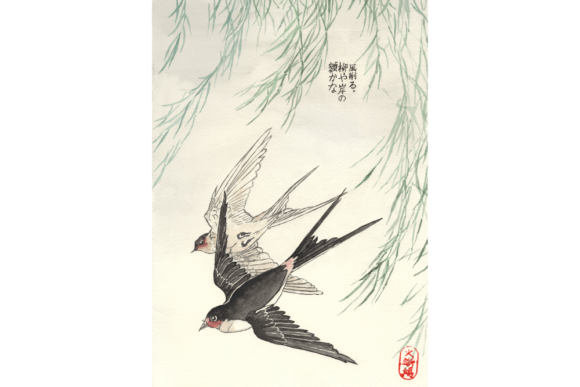
Painting by Daria Melantova

Haiku by Alan Summers, Royal Baysinger, and Nisha Raviprasad

the last one melting
in the snow-jerk’s grip 
cola float 

Alan Summers (UK)
The Pan Haiku Review Issue 2, New Year’s Eve/Winter 2023 
A Kigo Lab, Special ed. Alan Summers

Commentary from Nicholas Klacsanzky:

What initially drove my interest in this haiku is its unique kigo, or seasonal reference. In the poet’s own words: “After “Soda jerk” a term used for a person who operated the soda fountain in a drugstore, preparing/serving soda drinks & ice cream sodas. A snowjerk is a snow chaser, as the snow decreases in some geographical areas, and increases in other areas. Snow will soon be like diamond dust.” This reflects the effects of climate change.

The first two lines could be interpreted in at least two ways. It may connect to the cola float mentioned in the third line, or an unnamed iceberg or ball of snow. I believe this haiku points to the irony or sadness of a snowjerk melting ice, snow, or a float with their hands. This melancholy is contrasted with the sweetness of the cola float.

There is a fine euphony occurring in the haiku with the “l” and “o” sounds. Also, the pacing of the haiku aligns well with the original Japanese rhythm of this art form. Lastly, though the kigo is unique, the language itself is accessible. Overall, it’s a haiku you have definitely never seen before with pressing topics built in, which makes us pause and ponder.

a dog
gnawing its bone
— re-reading her letter

Royal Baysinger (Canada)
Modern Haiku, 54.2 (Summer 2023)

Commentary from Jacob D. Salzer:

As with many powerful haiku, complex emotions are implied in the first two lines through the “show not tell” method. In addition to re-reading the letter, there is repetition in the act of gnawing. The em-dash also provides a weighted pause, which adds emotional weight. The fact that the poet is re-reading this letter also tells us that it has heavy emotions within it. As readers, we can likely relate to this experience or enter our imagination in this haiku in our own way. 

Using simple words, this haiku has a powerful juxtaposition that balances concrete imagery with mystery. It has room for the reader and is relatable. In short, this is an effective haiku that focuses on the layered complexity of relationships.

ragwort sprouts…
mother pats her wrinkles
with a gentle sigh

Nisha Raviprasad (India)
Under the Basho, June 1, 2024

Commentary from Hifsa Ashraf:

We all try to compare and contrast many things in our surroundings to justify or satisfy ourselves. In this haiku, the poet relates ageing with the leaf structure of ragwort sprouts which are wavy and wrinkled.

Mother, who is patting her wrinkles with a gentle sigh, is perhaps indicating her feelings of satisfaction that she is not alone. Though her skin is changing, other things in nature pass through similar transformations right from the beginning. The words ‘pat’ and ‘sigh’, though, perhaps show signs of satisfaction and motivation that she gets after seeing ragwort sprouts. There may also be a comparison between the poisonous nature of ragwort and changes in mood, thoughts, and feelings due to ageing that become more cynical or bitter. As ragwort causes skin allergies, I can see an element of fear here where the mother makes herself content by assuring herself that her skin is still healthy despite dangerous risks in her vicinity. She may be trying to accept ageing and adjust to it positively. 

Looking at the sound, the letter ‘w’ could indicate the continuous thought process of ageing that can be satisfactory or dissatisfactory.

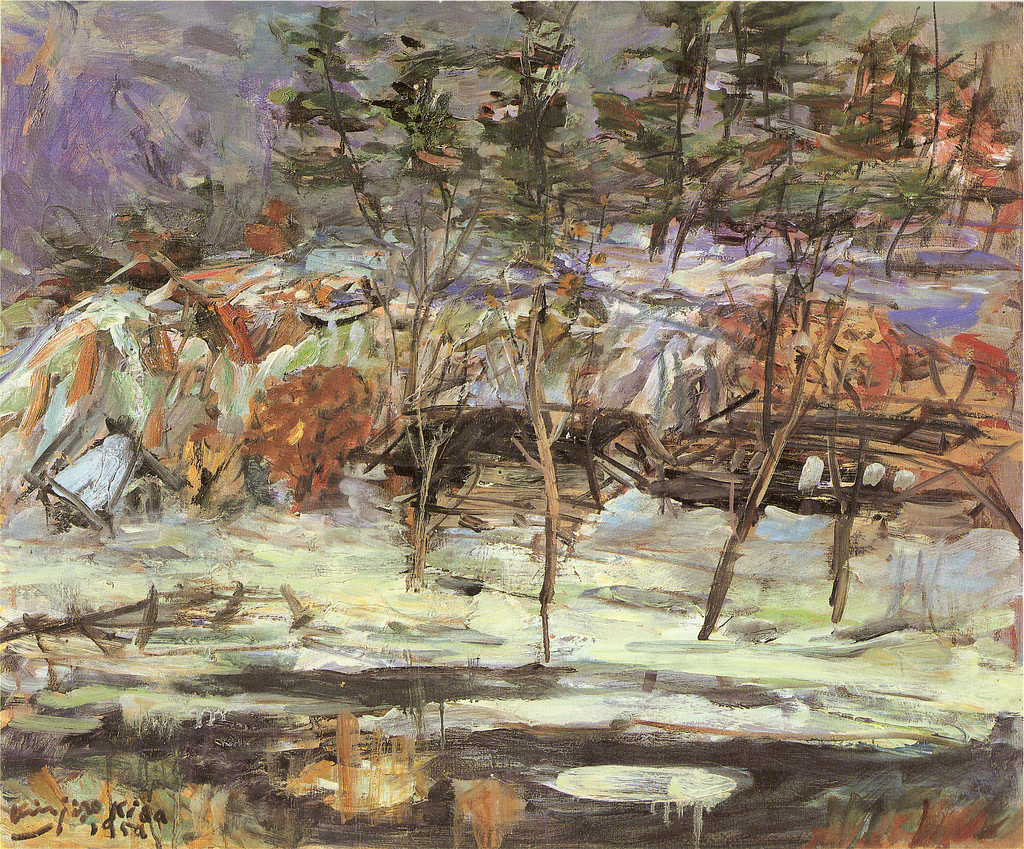
Kida Kinjiro, 1959, “Melting of Snow in Thinned Copse”

Haiku by Rowan Beckett, Anne Morrigan, and Alexander Groth

stars on stars ever growing my boyhood

Rowan Beckett (USA)
Prune Juice, issue 40, 2023

Commentary from Nicholas Klacsanzky:

Having the haiku as one line adds more interpretations to it. It can be read in these ways: “stars on stars/ever growing my boyhood”; “stars on stars ever growing/my boyhood”; “stars on stars/ever growing/my boyhood.” There is no wrong or right way to read it. I enjoy this aspect.

“stars on stars” might be a seasonal reference to winter. In this season, it is easiest to see the constellations and brightness of stars. This reference contrasts poignantly with “ever growing my boyhood.” Winter is not normally associated with growth, but this haiku demonstrates that even in the coldest times, spring can happen.

Looking at the sound, the first thing I noticed was the multiple r’s. In my opinion, this sound gives the haiku more oomph and sharpness, while the o’s elongate the reading and suggest growth.

With only seven words, the poet creates many reverberations and resonances. The right balance was made: it’s hard to imagine the haiku improving from its already powerful self by adding or taking away a word.

dawn canal 
the oarsmen draw 
a new horizon

Anne Morrigan (Canada)
Poetry Pea Journal, 1:23, 2023

Commentary from Jacob D. Salzer:

I appreciate the metaphorical value of this haiku, the clear imagery, and its meaning. This haiku shows the importance of teamwork which can create more possibilities than anything one person can do alone. The new horizon formed by their oars could be seen as a hopeful future when we work together as a community or as a team. The men in this haiku are connected with the water, which also inspires community. In addition, the dawn marks a new beginning and a hopeful future. In short, this is an inspiring haiku that shows the importance of teamwork and our connections with the Earth and each other.

cherry blossoms bloom
a distant memory of
my former winter

Alexander Groth (Germany)
5-7-5 Haiku Journal, May 9, 2024

This traditional haiku on cherry blossoms made me smile because of its format. The first line emphasizes the blooming period—maybe early spring or the end of winter. The time of blooming matters as it inspired the poet to reminisce about a memory of the former winter. This haiku is one of the best examples of showing a strong bond between nature, especially two seasons (spring and winter), and personal experiences i.e. a memory. 

In this poem, the connection between the blossoms and memory is deep yet remote. The distant memory shows something fading due to forgetting or returning to the conscious mind. The second line ends at ‘of’—a cutting word that gives a double meaning to the theme if we read it like this: ‘a distant memory of(f)’. In both cases, the cherry blossoms either made the memory fade away or refreshed it.

The closing line hints about the season or period which is ‘former winter’—a season when quietness often makes people spend their time either being nostalgic.  It also depends on the kind of memory, which is not revealed in this haiku and is still a mystery. In any case, it is cherry blossoms that trigger what seems like a pleasant memory. The lack of punctuation makes this haiku more profound and open to many interpretations. 

ESA/Hubble & NASA

Poems by Kelly Sargent, Marc Brimble, and Anthony Lusardi

fallen acorn renewing our vows

Kelly Sargent (USA) 
Frogpond, issue 47:1, winter 2024

Commentary from Nicholas Klacsanzky:

The way the word “renewing” works as a pivot to create different readings is spectacular. I think the monoku could be read in at least three ways: “fallen/acorn renewing our vows”; “fallen acorn/renewing our vows”; “fallen acorn renewing/our vows.”

The contrast between “fallen” and “renewing” creates a powerful link. Acorns are also often used as symbols of rebirth, and the monoku could be personifying it. In addition, I enjoy how the kind of vows that are being expressed is left up to the reader.

Finally, the train of “n,” “o,” and “w” sounds makes this haiku sonically pleasant. The poem begins with harder sounds and ends with softer tones. With only five words, the poem has much euphony and meaning.

waiting for confession
I notice
The Virgin’s thigh

Marc Brimble (Spain)

Commentary from Hifsa Ashraf:

The opening line of this haiku is personal and well thought out. It seems the person is going through the process of reflecting on what went wrong in their life. The mistakes bother the person but at the same time, there is no sort of hesitation, conflict, or confusion in obtaining a confession. The question is: “Is it a big confession?” “Is it someone’s first confession?” “Is it a self-motivated confession?” “Is it a forced confession?” In any case, the one who will confess is taking time to think about it.

In the second part of the poem, there is a surprising element of moving from spiritual to worldly desires. It may imply that the person will confess something about yearnings or an intimate relationship. Nonetheless, their thought process is oscillating between what is seen and what is not, what is more significant and what is less, what is right and what is wrong. It seems the person is being distracted from a symbolic meaning of life by worldly desires and is not yet ready for a deeply felt confession. 

within its web
within a hollow stump
a grass spider                      
feels the earth
and all its vibrations

Anthony Lusardi (USA)
Ribbons, Spring/Summer issue, 2022

Commentary from Jacob D. Salzer

The clear imagery and the perspective from the spider’s point of view make this a strong tanka. The web could be seen as a symbol for the web of life. I appreciate how this tanka reminds us of the interconnectedness of life and the impact we have on Earth and her creatures. The last line also opens up many possibilities as we imagine the different vibrations. When I read this tanka, I feel compassion for the spider. There could also be metaphorical interpretations in the first two lines. Ultimately, I think this tanka reminds us to be more mindful of our actions. I believe this is an important, ecologically-based tanka that inspires compassion.

Nefflier a gros Fruit. Original from the Minneapolis Institute of Art. Dated: 19th century ; Artist: Michel Bouquet ; Nationality: French ; Artist Life: 1807-1890.

Haiku from Antoine Cassar, Tuyet Van Do, and Srini

Negotiations —
owner, bank, architect, notary,
and now this mosquito…

Antoine Cassar (Malta)

Commentary from Jacob D. Salzer:

As humans, we are frequently faced with negotiations, but this haiku also has a humorous twist in the last line, which I appreciate. It seems the poet’s sense of humor in this haiku may be a kind of coping mechanism among frustrating and/or challenging situations in life.

Another unique feature of this haiku is the poet’s use of punctuation. We have an em dash, four commas, and an ellipsis, which is rarely seen in a single haiku. I think the many forms of punctuation amplify a drawn-out, elongated effect, which seems to give the impression that the poet may be tired of negotiations and wants more peace and silence. Indeed, some negotiations also go on for quite some time. For example, competing for the ownership of a house can involve several negotiations regarding the mortgage payments and the down payment. 

In short, this is an interesting haiku that blends humor with the heavy financial decisions, negotiations, and struggles that many of us face in modern life.

musical notes
across the power lines
spotted doves

Tuyet Van Do (Australia)
haikuNetra, issue 1.2, 2023

Commentary from Nicholas Klacsanzky:

I prefer haiku that employ pivot lines, and this one delivers. “Musical notes across power lines” is a neat phenomenon to imagine. However, it can turn morbid if we imagine the doves are getting electrocuted and there is sound coming from that occurrence. “Across the power lines, spotted doves” is much more tame, in my opinion, as it sees the doves adding their songs to the hum of electrical lines. This interpretation makes a connection between nature and the human world.

This haiku is also pleasant to the ear, with the strong presence of “o” and “s.” It is paced well, too, with the traditional short/long/long rhythm. Also, with only eight words, the poet focused on brevity and the economy of language. In addition, the poet made sure the poem didn’t lean into verbosity. Overall, this haiku combines a variety of poignant interpretations with technical accuracy in its craft.

where school ends wildflowers

Srini (India)
haikuNetra, issue 1.4, 2023

Commentary from Hifsa Ashraf:

This simple monoku says a lot in four words. I see it in terms of time and space. It starts with a question that lets us pause and think about the space or place. The school may be in a remote area, a war-affected domain, a refugee camp, or a city/town. The location is significant in this case. I see it as a war-affected area or a refugee camp where it’s unpredictable what will happen after school or where learning and knowledge will take a student. ‘School ends’ doesn’t mean anything certain in the future or ‘school ends wildflowers’ may lead to something specific. Another aspect could be a school where a person rejoices in a carefree life, and when it comes to an end, the worries or anxieties about the future start coming.

I like the way the poet ends it with ‘wildflowers’—something I often use in my poems, and it’s the title of my micropoetry book on refugees. ‘Wildflowers’ show both abundance and abandonment here depending on how we read it i.e. ‘school ends wildflowers’= abundance or ‘school ending at wildflowers’= abandonment. So, it can be an opportunity for a new life or a new beginning. It could also display a hope for abundance. On the flipside, it could demonstrate abandonment in a real sense where someone may get stuck with a career or responsibility, or remain directionless like wildflowers. Ultimately, I take it as something positive irrespective of the location or situation of the school or personal experiences associated with it.