
Haiku and Haiga by Lanka Siriwardana, Bonnie J Scherer, and Maire Morrissey Cummins

grandfather’s trembling feet
searching for the slippers
in this cold night

Lanka Siriwardana (Sri Lanka)
Honorable Mention, 76th Basho Memorial English Haiku Contest, 2022

Commentary from Jacob D. Salzer:

Like many well-written haiku, there is a balance in this haiku between concrete imagery and mystery. In the first reading of this haiku, we could see “trembling feet” relating to the cold temperature. However, the trembling could also be due to a medical condition and/or old age, in addition to the cold night. The words “searching for the slippers” show a kind of struggle, partly because it’s evening, but the poet’s grandfather also might have dementia or some form of memory loss.

The overall tone of this poem inspires compassion because we get a real glimpse of the grandfather’s life in a cold atmosphere. As a reader, I wonder if the grandfather lives in a home or shelter that isn’t heated well. This haiku also reminds us that a simple task many people take for granted (such as finding their slippers) can be a significant challenge for others. I am reminded of my late grandmother who had dementia. Even walking to the front door and putting on her shoes was a significant task that took quite some time. Indeed, psychologically, there seems to be a slower pace to this haiku, in stark contrast to the busy, daily lives in modern cities. This is a haiku that inspires sensitivity and compassion. 
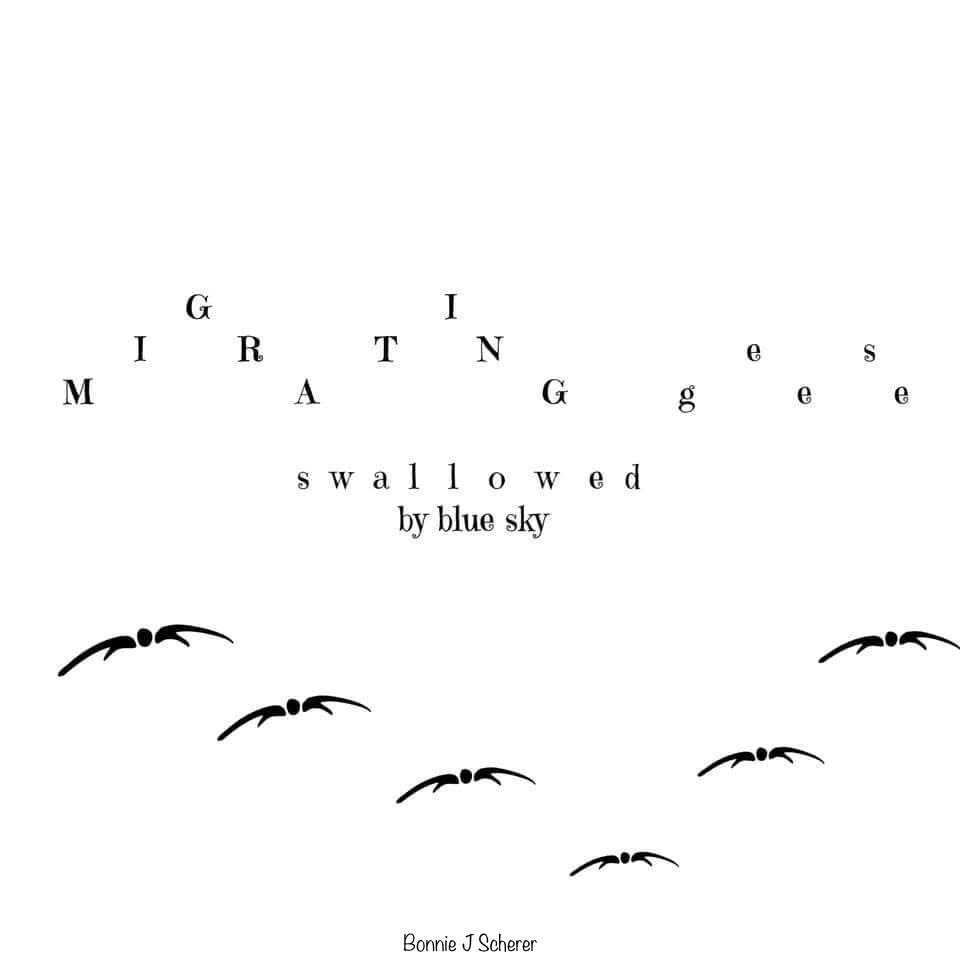
Bonnie J Scherer (USA)
Daily Haiga, 9/30/2024 

Commentary from Hifsa Ashraf:

The opening line of this haiku suggests the time of departure—probably afternoon or early evening. Migrating geese move in a flock with a specific formation, making their flight unique. 

‘Swallowed by blue sky’ makes the scene more dramatic and mysterious. It is an unusual time of depature which may be due to unfavourable circumstances i.e. climate change, war, etc. The word ‘swallowed’ indicates a critical or unfavourable situation where the geese disappeared either due to smog or smoke or in a symbolic way. 

The missing article before ‘blue sky’ perhaps points to a regular situation where geese disappear normally. We may be getting less sensitive to what is happening in nature, where birds do not feel secure in blue sky—not having the freedom of enjoying seasonal flights. It also indicates that such beautiful scenes are missing where bird lovers can enjoy bird watching. 

Overall, the vivid imagery of birds is quite sad and stark for those who love nature. 

night ferry
pitching its way
through starlight 

Maire Morrissey Cummins (Ireland)

Commentary from Nicholas Klacsanzky:

I grew up near a ferry dock, so I can easily relate to this haiku. The lights from night ferries are majestic to witness. In conjunction with “starlight,” it would be truly a spectacle. The casual speed of a ferry also makes this image more beautiful, with the ferry pitching i.e. an up-or-down movement of the bow and stern of the ship. The combination of artificial and natural light, as well as the earth and the cosmos, add to the meaning of the haiku.

Looking at the more technical aspects of this haiku, one can easily say that it follows the tradition of brevity, with only seven words used. Each word is employed well, especially “pitching,” which gives the poem more motion. Also, the “i” sounds perhaps make the starlight imagined more stark, and the “r” sounds provide more weight.

Like many fine haiku, on first read, it seems simple. Yet after looking a bit deeper, we can see layers of resonance and fantastic imagery that connect the human-made world with the cosmos.

Haiku by Anthony Lusardi, Douglas J. Lanzo, and Minh-Triêt Pham 

soft orange leaves—
how weightless she feels
in my arms

Anthony Lusardi (USA)
Dedicated to Remi June
Presence, issue #79, July 2024

Commentary from Hifsa Ashraf:

The open line allows me to pause for a while as it reflects a unique yet subtle side of autumn. Soft orange leaves make me think of not only the texture of leaves but also the time as well which raises some questions i.e. are the leaves soft because they are wet either due to dewdrops or raindrops? Are they on the ground or half-buried? Are they still hanging from the tree or stuck in the branches? What orange colour is it? The em dash makes the leaves significant in this poem but there is still a mystery about the details. 

The second line is a shift from nature to personal sentiments, where the poet creates a unique bond between the transformation of nature and personal thoughts and feelings. ‘How weightless she feels’ could reflect weakness, withdrawal, hopelessness, prolonged illness, near-death experiences, or a lack of interest. It seems the person is not feeling well and is ready to depart like soft orange leaves that are open to be annihilated or buried. The word ‘feels’ perhaps alludes to the poet not being sure about their feelings or the real state of mind of the person. The poet is sharing emotions or anticipating the future of this relationship that may be guessed from nature where orange leaves are destined to die. It is sheer hopelessness and readiness to accept the bitter reality of detachment and departure of a loved one. 

The last line shows the significance of the poet’s association with the person being mentioned where he tries to be protective and supportive, providing comfort to the person at this stage. 

This haiku is a beautiful example of a strong and subtle bond between nature and humanity. I liked the way the poet used a specific colour of leaf to project his thoughts and feelings and also left room for others to relate their life experiences with such examples from nature. 

call to prayers
the vastness
of domed desert

Douglas J. Lanzo (USA)

Commentary from Jacob D. Salzer:

An interesting juxtaposition between sound and silence, and between the limited body & mind and the vast desert. This haiku could perhaps have a kind of haunting quality. How many of our prayers are answered? Perhaps the deep silence of meditation is the highest form of prayer. From one editor’s view, my only suggestion would be to consider adding “a” before “domed.” An interesting haiku that leads us into contemplation and a deeper silence.

frosty dawn —
the metallic taste
of her lipstick

Minh-Triêt Pham (France)

Commentary from Nicholas Klacsanzky:

The first line sets the kigo in either winter or late autumn. Frost commonly looks lovely at dawn, with the sun slightly touching it and making it glitter in soft light. Yet, it can also be a reminder of a harsh reality.

This dual tone in the first line is juxtaposed with the irony of lipstick having a metallic taste. Though the last two lines are romantically inclined, there is also a touch of alarm. A lipstick with a metallic taste could indicate the presence of metal-based pigments that might not be healthy. The metallic taste could also be a sign of myriad medical issues, such as diabetes, liver issues, cancer, and more. So, the juxtaposition could be saying that a frosty dawn could be the same or similar to kissing your partner and having a metallic taste to something usually regarded as romantic. All this makes for an intriguing toriawase.

Looking at the more technical side of this haiku, the poet uses a dash as an approximation of a kireji. For me, it solidifies the seriousness and starkness of the moment. The euphony of this haiku is also important, in my opinion, with the letter “t” making a crackling sound and the letter “l” projecting strength. The haiku is also written in a rhythm corresponding to traditional Japanese standards with its short/long/short structure. Finally, the simplicity of language and brevity displayed matches the tradition of the genre.

Overall, I enjoy how the poet takes two “ordinary” events and compares them to create a “third part” of the haiku, where our imagination conjures myriad meanings that are personal yet connected to nature.

Royalty-free art without artist name