
duskfall…
the moon bumps
into a paperboat
– Alan Summers (UK)
(Published previously in The Heron’s Nest vol. XXI no. 4, 2019)
It’s difficult sometimes to summarize a whole story into the shortest possible amount of words, but when someone does it, it becomes a masterpiece. This haiku is one of those masterpieces that shows why haiku is considered as one of the finest forms of creative writing.
‘Duskfall’ with an ellipsis gives the imagery of a silent yet sad evening where there are no activities. The word itself shows the ending of life when dusk has fallen and is followed by darkness. But, the ending of life can also mean a new beginning that is deeper in nature. It looks like the locus of control is shifting from the outer world to the inner one where subtle aspects of nature get active and replace worldly life.
In this haiku, I can see both outer and inner aspects of life where outer life activities gradually enter into the night and let night complete the rest of the story. The moon bumping into a paper boat shows how things delicately work out of realities, especially when they enter into the night where a moon gradually comes close to Earth and touches the temporary or fragile part of life, which is a paper boat in this case.
– Hifsa Ashraf (Pakistan)
Mr. Summers is often experimental and inventive in his choice of words and phrasing. In this haiku, “duskfall” is one such example. It is not a recognized word by the majority of dictionaries but it is intuitively understood. It has a potent imagistic sense to it, with the motion of dusk falling either into place or dropping away. I prefer to think it is the former. As Hifsa pointed out, the ellipsis helps to create movement as well.
The next two lines provide a startling but calming image of the moon bumping into a paper boat. However, we can discern that the moon is not actually hitting the paper boat, but its reflection is.
A fun part of reading this haiku is figuring out the connection between the first line and the next two lines. The haiku seems to say: “the coming of dusk is like the moon’s reflection bumping into a paper boat.” A lot could be interpreted from this, but I feel that the image gives rise to mystery and magic.
What is also curious is that Mr. Summers plays with color with the two parts: dusk being black and the moon and paper boat being white. In a way, the coming of the blackness accentuates the white. I get a sense that the poem could be speaking of yin and yang: the sky and the earth, the night and day, are intertwined and balance each out.
Besides all this thought, witnessing the moment described would be joyous and spectacular, especially in the quiet of dusk. Like in any poetry, haiku have a layer of mental interpretation and a layer of mood/atmosphere. Understanding both can give us a comprehensive picture of a poem.
Another feeling I get from this haiku is the beauty of the “o” sounds in “moon,” “into,” and “paperboat.” These long syllables slow down the poem and create the scene of dusk potently.
It’s difficult to write an original haiku about the moon after 100s of years of tradition of doing so. Mr. Summers has done it through his unique juxtaposition, word choice, and imagery.
– Nicholas Klacsanzky (USA)
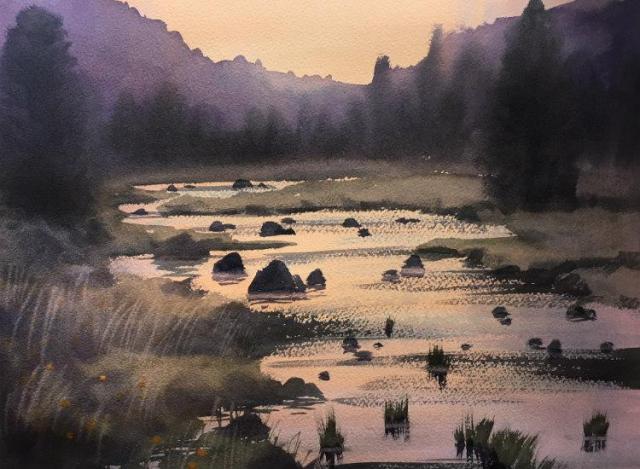
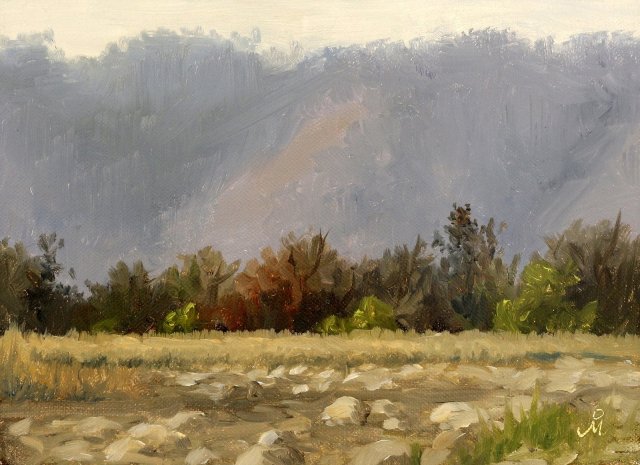
– Painting by Gareth Naylor.

 – Painting by
  Haiku Commentary