Kala Ramesh’s wood-deep echo

again the wood-deep echo of a cuckoo’s song

Kala Ramesh (India)

(previously published in Heliosparrow Haiku Journal, March 2021)

Commentary

I appreciate the synesthesia between sound and imagery in this monoku. “wood-deep echo” harbors a deep silence that is beautiful, mysterious, and almost haunting. I also visualize the cuckoo’s song resonating with the rings hidden inside trees. This creates a sense of harmony where the cuckoo and the forest have become one. I can hear the cuckoo’s song and echoes resonating within the poet’s quiet presence as well. I experience this myself as I read this too. I am transported into the scene. I can imagine the cuckoo’s song creating ripples in consciousness itself and perhaps simultaneously extending into past lives and the future.

This is an excellent monoku with depth, meaning, and a strong atmosphere.

Jacob D. Salzer

This monoku has a series of variations that make it dynamic and deep. I read it in many ways to get the layers of various themes that the poet tried to discuss.

It starts with ‘again’ which means there is a repetition of whatever is following it. It also shows the curiosity of the person who is passing through the same experience again and enjoying it fully.

The wood-deep echo may allude to memories, news, imagination, or illusions that a person feels or listens to due to deep silence, meditation, or wind. However, it seems the person has a deep connection where they want to hear what is pleasant to the ears or what is more distinctive than other voices. This also reflects a state of mind that is calm, still, and focused. A cuckoo’s song refers to something special—like in Indian mythology, a cuckoo’s song is related to the beginning of the monsoon season.  

Overall, it is a deeply personal experience of a moment that connects the person with what is going on and what is coming after. It also signifies the relationship between nature and human nature that is tightly woven with the senses. I see it as meditative where a person tries to attune to the cuckoo’s song which brings joy in their life sooner or later. 

Hifsa Ashraf

As Hifsa mentioned, the cuckoo’s song is commonly a harbinger of the monsoon season. Since the poet is from India, this can be said to be a kigo (seasonal reference) local to this country. Traditionally, the cuckoo is a kigo for about every season in Japan and a beloved bird of that country. A famous haiku magazine in Japan is named Hototogisu (cuckoo), which started in 1897.

There is no kireji, or cutting word, in this haiku. However, there is a grammatical pause after “again” which makes the haiku either two parts or one. In the English language, kireji are not commonly used in one-line haiku.

Even though there is only one image at face value, there are two considering the word “again.” The depth and ethereal nature of the cuckoo’s echo is repeated with all of its richness. The echo is wood-deep perhaps because some cuckoos nest inside trees. This richness of sound, when repeated, can bring about a sense of bliss and spirituality. The song is also a union of tree and bird, which makes it even more robust.

Kala Ramesh’s haiku often showcase euphony, and this monoku is no exception. The soothing “o”s and soft “n”s create a melodic reading—as if the cuckoo was singing through the haiku.

This haiku has a timeless feel to it, as I feel it can be read in any era and can resonate. A classic, yet modern work.
Nicholas Klacsanzky

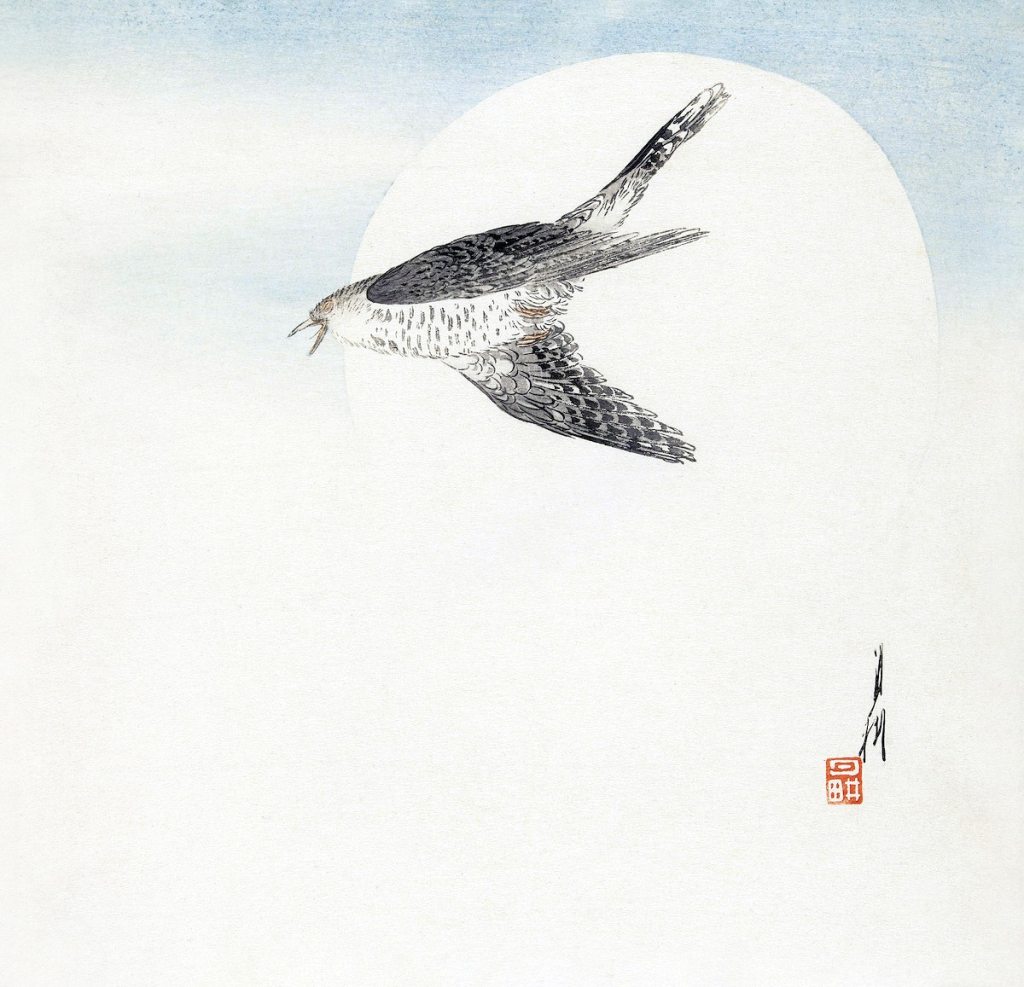
Sumi-e by Ogata Gekko

Michael Buckingham Gray’s circling osprey

circling osprey
closing a hole
in the clouds

Michael Buckingham Gray (Australia)
(published previously in Presence, 74, 2022)

Commentary

In my first reading, the imagery spoke of a sense of completeness and union. With the circling osprey in a “hole,” the cloud gains back its full cover over the sky. This could symbolize the uniformity of us all ultimately or that the clouds and the ospreys are the same (and everything else as well).

Knowing that ospreys circle in the air during courtship, this haiku takes on new interpretations. The serendipity of the cloud’s hole being covered by the courting ospreys shows that random acts, and even intentional ones, sometimes change the things that surround it. I don’t know if there is any objective sense of “good” in the imagery, but with the word “hole,” I feel as if something is being resolved. It is a feeling of positivity that is more intuitive. Perhaps, the most favored type of haiku is felt and understood intuitively.

A lovely, succinct haiku that presents exacting imagery and a special feeling.

Nicholas Klacsanzky

An osprey is a fish-eating bird of prey known for its migratory habit. The colour of its feathers and long-range flight makes it one of the most unique birds. A circling osprey is linked with the act of courtship, which is also called a sky dance. There may be other reasons for circling, though i.e. reducing energy for a flight, a balancing act of staying in the sky to stay within the thermals, or a way to prepare for migration. In any case, I can see it as a mode of survival that the bird has by having non-verbal communication with its surroundings and symbolically giving a message to its female partner or prey. This is how birds demonstrate how powerful every move or gesture they make is.

I can also see a whirlpool in the sky that is formed as a result of merging both the white features of the osprey and the clouds. It is a kind of beauty that fills the void in the sky, as the rest of this poem says. “Closing a hole in the clouds” is how powerfully and energetically a bird can fly in the sky so that one cannot see any flaws or blueness of the sky. It’s a beautiful, meditative image of covering what is yet to be completed. Life is full of such voids that need our ways of dealing with them by using our abilities and energies in the right direction.

This haiku seems to give a lesson on how one can turn things in their favour by using the right energies at the right time and by having faith in their unique potential.

Hifsa Ashraf

The clouds in this haiku could depict autumn, winter, or spring. To visualize only one hole makes me think the clouds are thick. I do think kigo (seasonal references) in haiku are not always categorized rigidly by the four seasons but can depict transitions between the seasons throughout the year.

In terms of sound, the letter “c” takes precedence and amplifies the circling motion. Also, the “o” sound brings a sense of wholeness where even the hole is an important part of the bigger picture. A see the hole in the clouds as a kind of portal into another dimension. In that sense, perhaps the Ospreys could be the gatekeepers to another realm. 

The movement of circling also reminds us of the cycles of life, and that even when we have apparent holes in our life, we are never alone. The clouds too are impermanent, as is the temporary hole.

There is no kireji or a hard break in this haiku. The poem can be read without any pauses at all, but the 3-line format allows us to read the haiku at a steady pace. I feel the lack of a hard kireji adds to the feeling of wholeness in this poem.

This is an excellent haiku that symbolizes the cycles of life and death while also leaving room for metaphors.

Jacob D. Salzer

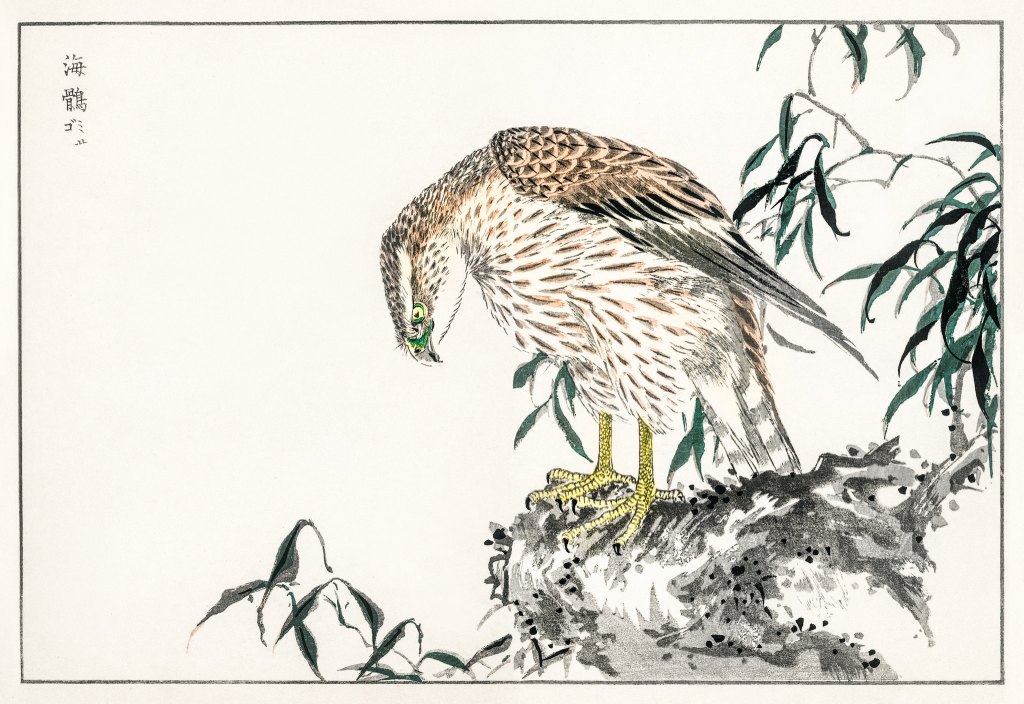
Japanese woodblock print from Pictorial Monograph of Birds (1885) by Numata Kashu (1838-1901).

Florin Golban’s old stories

old stories—
the words grow
by the fireplace

Florin Golban (Romania)
(originally published in Under the Basho, 2022)

Commentary

I appreciate how this haiku demonstrates the power of stories. It reminds me how a story with depth and meaning lives long after the words themselves. Some stories also have so much depth that new meanings and interpretations can be found in them, even after many repeated readings.

This haiku also shows how stories are connected to other stories, and how one story can inspire our imagination to create new ones.

In this haiku, the fireplace setting could bring to mind a grandma or grandpa reading to their grandchild or grandchildren, or it could be a man, woman, or child reading in solitude and deep contemplation. The fireplace provides me with calmness, warmth, and focus.

Regardless of what we imagine, this is a haiku that bridges the past with the present moment, and the future. Perhaps this haiku could inspire us to leave behind new stories for future generations. A beautiful haiku that demonstrates the power of words and stories.

Jacob D. Salzer

Old stories may refer to many things i.e. kinds of stories (fables, anecdotes, folklore, fairy tales, etc., or stories told in the past most probably in childhood that might be shared by elderly members of the family. I see it as a community-based storytelling session that used to take place in villages or towns where storytellers would share their personal experiences, voyages, or long journeys.

The second line in this haiku is impressive. It makes it profound and unique in many ways. The word ‘grow’ is something that is gradually taking shape over years. This is an excellent choice of words that can make a reader think deeper to justify its use. I can see it as an evolution of stories that pass on from generation to generation, growing in minds with changes and improvisations. Accordingly, modifications to these stories that fit well develop in each era. These stories provide lessons that people use to inculcate morality within communities, clans, tribes, and families. This is not something ordinary when there were no proper or modern means of communication.

The ‘fireplace’ could be the center of attraction for all those who gather and listen to those stories. This haiku could be set in winter when people gather around to exchange or share their life experiences or stories. I also see a connection between the fireplace and enlightenment or rekindling the mind to think deeply whilst listening to old stories.

I liked the overall imagery of this haiku that shares the vastness and significance of storytelling, which is missing in our lives now.

Hifsa Ashraf

As Hifsa mentioned, this haiku is probably placed in winter, but it also might be in autumn. The contrast between growth and possible seasons of decay is poignant.

The poet made an interesting choice to use an em dash in the first line to “cut” the two parts of the haiku. With “grow,” I would expect an ellipsis to illustrate the continuation of action. However, an em dash promotes the idea of the eternal fireplace, in my mind.

The contrast between the season and “grow” is present, but also there is a contrast between “old stories” and the constant growth of the words of the stories. This growth could happen through retelling, the cultural context changing, and the resonance the words have in readers.

In terms of pacing, the poem follows mostly the standard line lengths of English-language haiku. It has a short first line, a longer second line, and a third line of the same length. Usually, we vie for a third line that is a bit shorter than the second line, but I do not think the length of the third line in this instance makes a marked difference in the rhythm. I think the somber and introspective mood is captured well.

Euphonically, this poem has a pleasing string of “o” sounds, which brings it charm. Nostalgia may be felt as well through the pleasant “r” sounds in each line.

The pivotal word “grow” in this haiku opens up many interpretations and feelings. And, as we read and reread this haiku, it grows on us.

Nicholas Klacsanzky

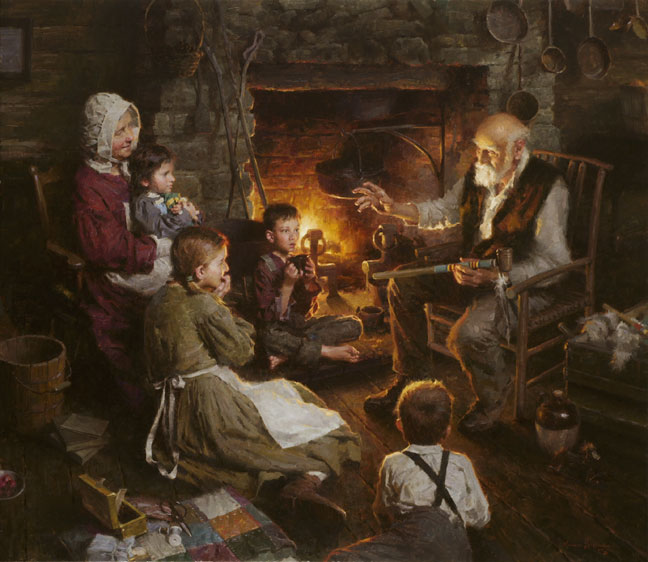
Painting by Morgan Weistling