Mona Bedi’s pottery class

pottery class
i embrace the broken
pieces of me

 — Mona Bedi (India)
First Place, Indian Kukai, #38, 2022

Commentary

The overall imagery of this haiku is apparent as there is little mystery involved here. But, it gives us deep feelings about the self, often known as the inner self. It’s an introspection where the poet has created an analogy between her feelings about herself with pottery. Clay is the element that binds us to this haiku in many ways. If it is introspection, the poet may try to share her broken self, flaws, past experiences, hardship, etc. Taking a pottery class can be taken as catharsis where the focus is not only giving venting feelings and emotions but also reshaping or remoulding the self that is still suffering or dissatisfied and trying to find peace. There is a glimpse of wabi-sabi in this haiku where you accept yourself the way you are as the word ‘embrace’ indicates and focuses on self-healing by practicing optimism and positivity.

The mystic element in this haiku is also obvious in this haiku where the words ‘pottery’ (clay), ‘broken pieces’, ‘I’, and ‘me’ depict how silently one passes through the process of transformation and goes beyond nothingness gracefully. According to Sufism, the connection between the self and clay is quite subtle and deep. It shows the humility and modesty of being, where deep understanding takes us on the journey of ‘knowing thyself’.

The sounds of ‘p’ and ‘m’ in this haiku may depict the rhythm of the thoughts and feelings that are still not on the surface. The letter ‘i’ may show how humbly and keenly a person makes themselves ready to pass through the journey within, which can take them from unknown to known. 

Hifsa Ashraf

This is a powerful haiku that expresses psychological healing and recovery. I feel acceptance and self-love in the phrase “i embrace the broken pieces of me.” In this haiku, “broken pieces” seem to be symbols for past psychological trauma that carry a heavy connotation. However, the word “embrace” gives me a vision of all the broken pieces coming together, while still honoring each piece as a unique place in our being. Furthermore, in a pottery class, there is a sense of community with the students and teacher. It seems this inclusiveness brings psychological cohesion and unity where the poet is no longer alone on her path of healing.

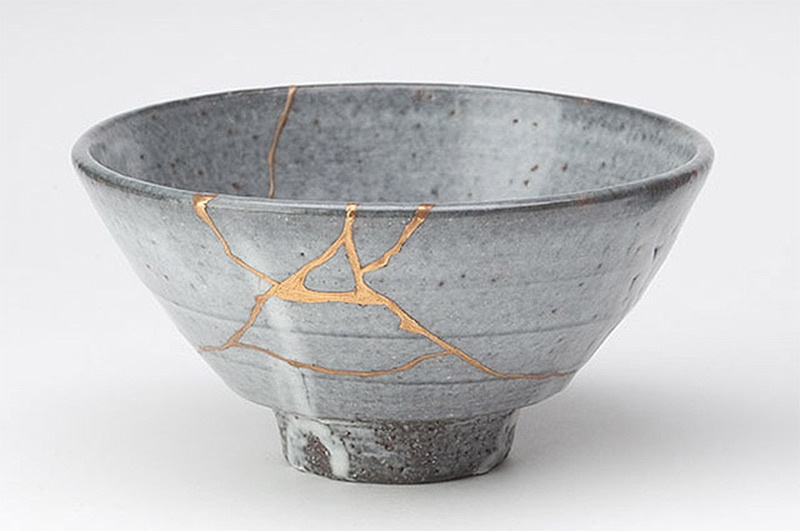
Along these lines, this haiku immediately brings to mind the ancient Japanese art of kintsugi. Here are some quotes that demonstrate how powerfully kintsugi relates to this haiku: 

Kintsugi (golden joinery) is the Japanese art of repairing broken pottery with lacquer dusted or mixed with powdered gold, silver, or platinum, a method similar to the maki-e technique. As a philosophy, it treats breakage and repair as part of the history of an object, rather than something to disguise.” “Kintsugi became closely associated with ceramic vessels used for chanoyu (Japanese tea ceremony). As a philosophy, kintsugi can be seen to have similarities to the Japanese philosophy of wabi-sabi, an embracing of the flawed or imperfect. Japanese aesthetics values marks of wear by the use of an object. This can be seen as a rationale for keeping an object around even after it has broken and as a justification of kintsugi itself, highlighting the cracks and repairs as simply an event in the life of an object rather than allowing its service to end at the time of its damage or breakage. Kintsugi can relate to the Japanese philosophy of “no mind” (mushin), which encompasses the concepts of non-attachment, acceptance of change and fate as aspects of human life.” “Not only is there no attempt to hide the damage, but the repair is literally illuminated… a kind of physical expression of the spirit of mushin….Mushin is often literally translated as “no mind,” but carries connotations of fully existing within the moment, of non-attachment, of equanimity amid changing conditions. …The vicissitudes of existence over time, to which all humans are susceptible, could not be clearer than in the breaks, the knocks, and the shattering to which ceramic ware too is subject. This poignancy or aesthetic of existence has been known in Japan as mono no aware, a compassionate sensitivity, or perhaps identification with, [things] outside oneself.

— Christy Bartlett, Flickwerk: The Aesthetics of Mended Japanese Ceramics”
Source: Kintsugi – Art of Repair | Traditional Kyoto

With kintsugi in mind, it seems traces of past trauma may never be fully erased from our individual and collective memory. However, by joining the fragmented parts of our self, I feel the broken pieces can become transformed or transmuted into a larger sense of purpose and unity. In this haiku, it seems the sharp edges that once defined each piece have now blended into a deeper compassion. Perhaps by mending the pieces together, we can also recognize the lessons our past has given us to help protect ourselves and prevent future harm. Interestingly, while this haiku is personal, I think the healing theme of this haiku could apply to families and larger communities that appear to be fragmented or broken. As one example, in some areas of life, I see the United States of America as a divided nation because so many subjects seem to divide people. With this in mind, if we consider thinking of this haiku with the phrase: “i embrace the broken pieces of my family,” “i embrace the broken pieces of my community,” or “i embrace the broken pieces of my country,” perhaps these could be healing phrases for a larger community context because it seems the first step to healing is acceptance—recognizing the broken pieces as they are. 

Along these lines, it seems fragmented communities start with fragmented individuals. If peace and unity are felt within individuals (if their broken pieces are mended together within their own self), then it seems that fragmented unity will be reflected in the world. In short, it seems larger community healing starts from within each individual. Fortunately, according to quantum mechanics and several philosophies, we are not alone and the sense of being an isolated, separate person or individual is not as concrete as it appears to be. Rather than supporting rigid individuality, science and several philosophies—including indigenous ways of life—tell us that all of life is connected.
 
In regard to quantum mechanics, here is a powerful quote that resonates with this haiku: “When quantum systems interact, the result can be the creation of quantum entanglement: their properties become so intertwined that a description of the whole solely in terms of the individual parts is no longer possible.” Source: Quantum mechanics – Wikipedia 

Along these lines, it seems by embracing the broken pieces within us, eventually, even the very sense of “me and mine” as a mental concept may ultimately dissolve into a spiritual energy that is universal. 

In short, this is a powerful haiku that speaks of acceptance, compassion, and healing. I feel it also symbolizes the gifts of our individuality in the context of a universal consciousness. 

Jacob Salzer 

I have little to add after such excellent and deep commentary from Hifsa and Jacob. I would like to comment on how this haiku is kigoless, or without a seasonal reference. This is definitely fine, since haiku written without kigo goes back all the way to Matsuo Basho and more specifically with the free verse movement of haiku in Japan. I would not say this is a senryu because it is not irreverent or cynical in nature.

Though there is kireji or punctuation acting as a “cutting word,” it is implied by the line break in line one. As Hifsa noted, there is no juxtaposition here but rather an association between the clay and our bodies or self. The length of the lines follow the standard for English-language haiku with a short first line, a longer second line, and short third line to match the traditional rhythm of Japanese haiku.

As Jacob discussed, I think it is important the poet decapitalized the “i.” It is a way to step away from the ego and to distance oneself from egoic thought.

The enjambment, or break in thought, on the second line is unique. In haiku, we don’t usually use enjambment, but I believe it works well here. The word “broken” is appropriately broken off from the rest of the phrase. Perhaps it lends to separate readings for the last two lines, respectively.

A clear haiku that strikes deep emotional and philosophical tones.

Nicholas Klacsanzky

Image from Wikipedia Commons

John Pappas’ fossil galaxy

fossil galaxy
headlights speed 
from dark to dark

John Pappas (USA)

Commentary

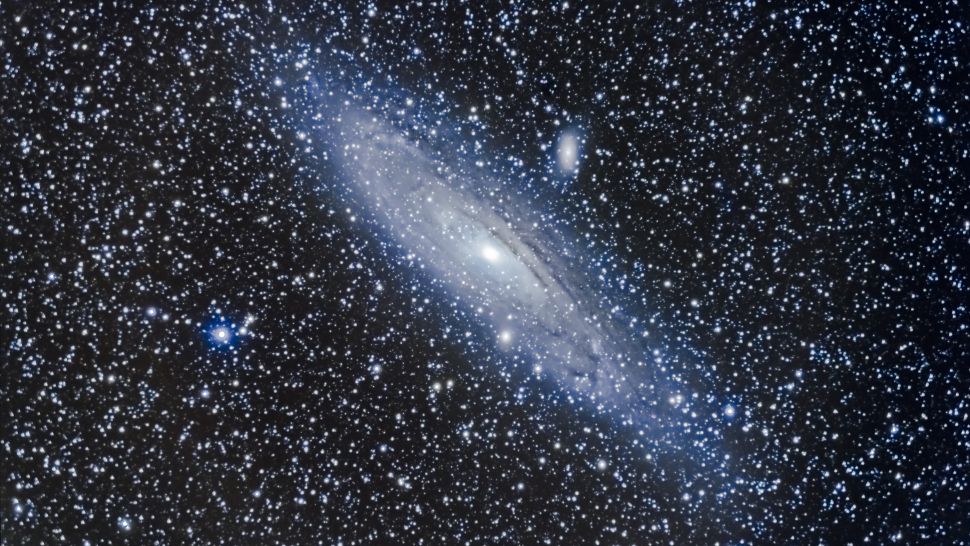
A common understanding of a fossil galaxy is that it’s a remnant of an older galaxy that existed within a current galaxy. It’s something left behind after many years for us to think over, get some lessons from, and see how things are temporary and worthless over time.

When I see a fossil, my thoughts go back to a time when that fossil had a life—maybe even an integral part of life or the environment at that time. A question comes to my mind: “why does nature preserve fossils for us?” There is a simple logical answer: “so that we can remember our history or past.” A fossil galaxy shows us the marvel and perhaps the waste of this universe that discards many elements with time but doesn’t abandon them—estrange its parts but allow them to be present.

Life is like that for us: we discard many things that were once the most valuable part of our lives but they keep circling our minds. Certain things get preserved in our memories like a fossil. We may not give attention to them, but they may elate or haunt us in the later part of life. So, I take ‘headlights speed’ as flashback memories that come to remind us of what’s in our past and how we reach this point after passing through, dark to dark. The word ‘dark’ may depict dreams (particularly nightmares) that remind us of the remnants of difficult times we try to push back in our heads.

However, the connection between our mind and space is so deep as can be observed in this haiku, where we try to connect with the galaxies outside and the galaxies within through our thoughts, memories, reasoning, logic, and analysis being an integral part of this universe. The dark is a background, whether it is our life or space that brings our history to light.

Hifsa Ashraf

It seems there are galaxies within galaxies—both inside of us and beyond us. This idea is poignantly brought down to earth, quite literally, in this haiku but also (pun intended) leaves space for our imagination and dreams. 

The fragment of this haiku “fossil galaxy” is intriguing, as it marks traces of an ancient galaxy. I also interpret “fossil galaxy” as the Milky Way Galaxy when the dinosaurs roamed Earth. In both interpretations, I appreciate the time-warp perspective in this haiku. 

The phrase “headlights speed from dark to dark” brings to mind a time-lapse of a highway, with cars moving at night and I see stars rotating above. “from dark to dark” could relate to the pollution caused by cars and other motor vehicles, unfortunately contributing to carbon in Earth’s atmosphere and climate change. If we look at the lifetime of a car, it originates from the darkness of Earth via raw materials; then factories produce pollution under the hum of electricity; then some parts of the motor vehicle are buried back into Earth. The good news is most parts of cars are recycled.

According to popularmechanics.com: “Fed by annual new-car sales that hover around 17 million, the U.S. automotive recycling industry reclaims some 750 million pounds of scrap each and every month…The automobile is the most recycled consumer product in the world — 95 percent of all vehicles are reclaimed. The rate far exceeds the numbers for recycling giants such as newspaper (74 percent), aluminum cans (51 percent) and glass (22 percent). And much of the reclaimed material winds up back in new cars: Coffee-stained carpeting becomes air-cleaner assemblies and chewed-up tires morph into brake pedals and floor mats…Still, as much as 25 percent of each car ends up in landfills. That’s largely because landfill space is still relatively cheap and the technologies to recover nonferrous material are still expensive.” Source: Where Your Car Goes to Die (popularmechanics.com)

“from dark to dark” could also be interpreted as returning to The Great Mystery or the Unknown. It shows just how brief our human lives truly are in the grand scheme of things. From one perspective, even a billion years is equivalent to a microsecond. For some, there could perhaps be a divine comedy in this view. 

In terms of “headlights speed,” I thought of all the devices we use that operate at close to the speed of light, such as sending text messages with our phones or sending an email. “It’s the electromagnetic wave rippling through the electrons that propagates at close to the speed of light…This makes the observable speed of electricity about the same as the speed of light: 186,000 miles per second.” Source: Quick Answer: Does Electricity Travel At The Speed Of Light – BikeHike (cyclinghikes.com)

It’s interesting to note that some stars have actually burnt out, but because they are so far away, their light still travels and appears to our human eyes on Mother Earth.
 
Interestingly, it seems galaxies are not just “out there” but also internal in our subconscious and our dreams. Just as a single seed gives birth to an entire forest with innumerable trees, it’s been said that the subtle samskaras or mental impressions give birth to innumerable worlds. This offers a different perspective because instead of the world and galaxies solely being seen as “out there,” they could also be seen as an internal/eternal phenomenon. 

Regardless of our interpretation(s), this is a haiku with depth, modern implications, and mystery. 

Jacob D. Salzer

With the desolation shown in this haiku, I would place the kigo or seasonal reference in either winter or fall. That being said, I’m not sure the implied kigo is that important to the quality of this haiku. In Japan and around the world, many haiku have been composed as kigoless.

Though there is no punctuation used, the line break in the first line could be said to represent a kireji or cutting word (though more accurately stated as a cutting character or sound) that shows the delineation between the two parts of the poem.

The two sections of this haiku are not too closely or too loosely connected, which illustrates the art of toriawase. The dark of the night connects with the dark of the universe. “Speed” can fit well with the idea of the speed of light. It is up to the reader, though, to see these connections and to see how they resonate with them. Well-written haiku like this one allow the reader to fill in their own gaps, though the poet leads them on certain paths of discovery.

Pacing in this haiku is pretty much standard for English-language haiku: a short first line, a longer second line, and a short third line. However, as we can see, the third line is a tiny bit longer than the second in this haiku. That’s fine because the traditional rhythm is kept with the elongated syllables in the second line.

In terms of sound, the most prominent letters are “l” and “d.” The “l” sounds provide a lightness to the reading as if to illustrate the ephemeral nature of the universe. On the flip side, the “d” sounds give a punch that brings about a sense of seriousness.

This is a unique and relevant haiku with potent imagery that drills deep into our imagination and search for meaning.

Nicholas Klacsanzky

Image credit: Alan Dyer /VW PICS/Universal Images Group via Getty Images

Luke Levi’s owl

caught
between two worlds
an owl at sunset

Luke Levi (USA)

(previously published in Fireflies’ Light, issue 25)

Commentary

I immediately connect with this haiku, partly because I am drawn towards Indigenous spirituality and appreciate how they acknowledge everything has a Spirit in the Great Mystery of life. I also connect with this haiku because I have seen owls in person that have inspired writing a few haiku about owls and their dreams. When I read “caught between two worlds,” I imagine twilight or what some people call the “golden hour” between day and night. It has been said that twilight can inspire mystical or spiritual experiences.  

At the same time, I appreciate how the poet left the first two lines open for interpretation. When I read “caught between two worlds,” my first interpretation was the gap between the material/seen world and the Spiritual/unseen world that actually may not be seen as separate at all. The Buddhist saying: Form is Emptiness and Emptiness is Form comes to mind. Even atoms are mostly “empty” space. Therefore, it seems material forms are not as concrete as they appear to be. The two worlds could also be between a lifetime on Mother Earth and a spiritual afterlife after physical death. As the sun sets into the mysteries of night, this could be a symbol for our last breath into the afterlife. The two worlds could also be between the waking-dream state that many call “reality” and the world of sleep, dreams, and the subconscious. Possible states of consciousness between these two worlds are the hypnopompic (the state right before entering the “waking” world) or the hypnagogic state (the state right before falling asleep). Regardless of our interpretation(s), I think this haiku has a universal appeal and significance. 

In more down-to-earth terms, I think “caught between two worlds” could easily apply to a wide range of relationships between two people with very different backgrounds and/or worldviews. In a broader sense, the two worlds could even be two cultures, two perspectives, or two sides of a war, etc. It seems the word “caught” holds inherent tension. It’s interesting to observe worlds within worlds here on Mother Earth: from microscopic/quantum to macro/cosmic perspectives and everything in between.

In Indigenous cultures, there are myths and legends about owls. Owls are excellent observers who are very quiet. It’s been said they mostly live their lives in solitude. In this perspective, one interpretation is the poet might be deciding whether or not to be (or possibly remain) single vs. be in a relationship. The word “caught” could imply uncertainty. 

In short, I feel this haiku expresses animistic/Indigenous spirituality, different perspectives, and the depth of relationships and solitude. I also feel this haiku is also a portal into the world of dreams and the subconscious. It seems to carry contemplative power and encourages introspection. I think it also has the power to open our hearts and minds to what is possible in this lifetime. Perhaps it can encourage us to try our best to resolve conflicts. Ultimately, it seems in the gap between two worlds, we can silence the mind and experience peace. A powerful haiku. 

 — Jacob D. Salzer (USA)

The poem starts with the simple word ‘caught’ that resonates a lot and pauses our thoughts to think for a while before moving on to the next lines. The two worlds can be interpreted as: changing seasons, day and night, present and past, life and death, or time and space. Whatever it is, there is a transition where something got stuck, and it is experiencing some sort of unknown circumstances. Being inclined to spiritualism, I can see the two worlds as materialism (outer self) and selflessness (inner self). It’s more like yin-yang where one world reflects the other, or where one world overshadows the other one, causing chaos, confusion, or bewilderment. I also see ‘caught’ as a threshold level where a person initially tries to adjust to what is not visible or known to them.

The third line reveals some specifications of two worlds where ‘owl’ and ‘sunset’ may project time and space. An owl can symbolize wealth, prosperity, a good omen, wisdom, or fortune but in certain other cultures, it is a sign of bad omen. Keeping both aspects in mind, an owl as a nocturnal bird personifies our life as a combination of both good and bad, where a person struggles by exploring their inner and outer worlds—passing through ups and downs but with choices. It depends on where a person’s locus of control is. The sunset gives a clear demarcation of two worlds where the light enters into darkness and opens the new horizon, which may be subtle or sophisticated for a person if their senses are intact with reality.

Hifsa Ashraf (Pakistan)

If I were to say what the kigo or seasonal reference is for this haiku, I would say winter. Owls are commonly a kigo for winter in the haiku tradition, but they may be different in various locales. Winter is often seen as a magical time, with gleaming snow and the cold that brings about a whole new landscape. This relates well to the supernatural symbolism of the owl.

In terms of how the two parts of haiku operate, we have the cut in the second line with the line break. It’s not a direct juxtaposition, but rather an association between the sunset and two worlds, plus the owl itself and two worlds. The sunset is a transition from one time to the next, which could be said to be another world. The owl, as we have discussed, has mystical qualities that can be seen as a bridge between two worlds or dimensions by many cultures.

This haiku might contain yugen or as described by Zeami Motokiyo: “To watch the sun sink behind a flower clad hill. To wander on in a huge forest without thought of return. To stand upon the shore and gaze after a boat that disappears behind distant islands. To contemplate the flight of wild geese seen and lost among the clouds.” There is a sense of natural awe and mystery in this haiku, plus a possible nod to nothingness as espoused by Buddhism. The nothingness in this haiku is the owl not being a part of any world, where its identity is gone. The nothingness in Buddhism is not physical but rather the emptiness of identity.

Two letters stand out to me when I read this haiku out loud: “t” and “o.” The letter “t” is great at creating an atmosphere of starkness and the letter “o” is excellent at slowing down the pace and making a piece more contemplative.

The format follows the common short-line-short lines sequence of English-language haiku that try to match the 5-7-5 sound units in Japanese judiciously. Most haiku by masters are between 6-9 words, and this one fits in nicely with eight. This ensures brevity and the effectiveness of expression.

The feeling behind this poem is deep, philosophical, and introspective. We need more haiku about owls in English, and this is a fine addition.

Nicholas Klacsanzky (USA)

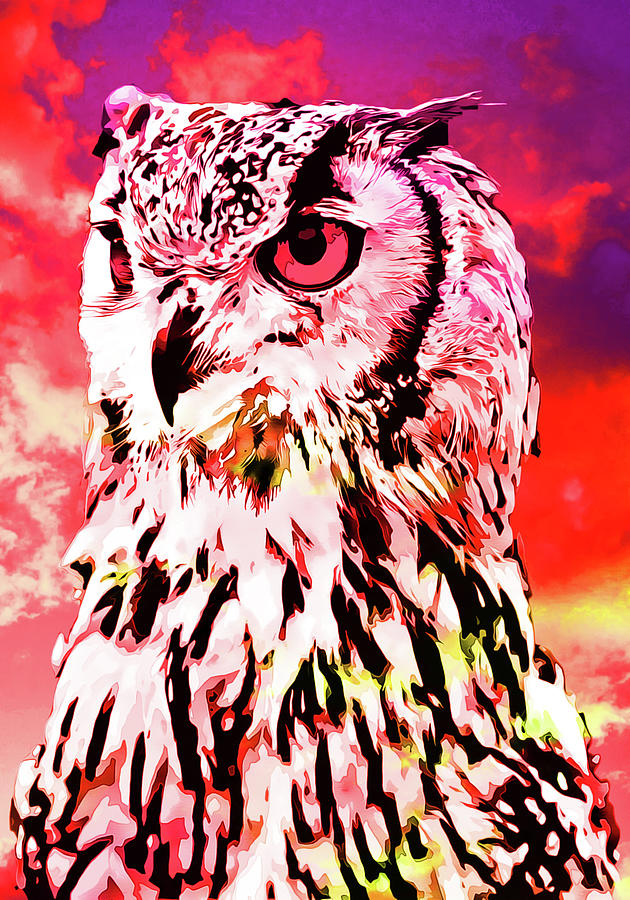
“Sunset Owl” by Alan Galindo