
an’ya’s snowflake

palm up
a snowflake lands
on my life line

an’ya (USA)
(previously published in Ardea)

The opening line presents a sweet gesture. It shows the simplicity of our connection with nature. I feel this is a soothing scene where a person feels the depth of their relationship with winter.

I can see the element of loneliness here, as deep winter may bring shades of depression and anxiety. So, snowflakes may act as a source of entertainment or a change that can divert one’s thoughts and feelings from dull and freezing weather. A snowflake sways like a falling leaf before it settles on a surface. It is a delicate element of nature that brings subtlety in our mood and feelings.

It may symbolize the life of a person who has passed through ‘cold’ realities, and faced harshness and rejection. A snowflake’s life is anonymous because it has no sound, no set pattern of falling, and irregularities or weaknesses. 

The life line on one’s hand indicates the time of death, departure, or the ending of old patterns of life that are fragile, insignificant, or useless. 

I see this haiku in two ways: both nature and human nature stand parallel in the universe and share common characteristics that connect them deeply and which makes them learn lessons or gain inspiration from each other.

Hifsa Ashraf (Pakistan)

With this winter haiku, the poet allows us to ponder whether or not fate is real, in my opinion. A life line on our hands usually is said to tell us how long we will live and how we feel about our lives. I like that the poet leaves it up to the readers to see what symbolism they want in the haiku, though.

It could reflect the “cold” or “fragile” life that the poet has lived. It could also show how something as delicate and small as a snowflake can be a thing of beauty in one’s life or how nature enters into our lives unexpectedly with something wonderful.

The poem is written in a simple style without punctuation. This is a common way to write haiku now in English and in many other languages. I like that the haiku seems like a journal entry that allows readers to come to their own conclusions. It also has a pleasant sound with many lilting “l”s and two calming “s”s on the second line.

The poet captured a moment that stirs wonder, melancholy, and philosophical thoughts within us through seemingly simple yet well-crafted language.

Nicholas Klacsanzky (USA)

“Lumberyards at Fukagawa, 100 Famous Views of Edo” by Hiroshige Utagawa, woodblock print reproduction
Jim Young’s cat

the cat
is fast asleep
and so is my leg

Jim Young (Wales, UK)

This haiku is full of compassion, love, and care. It shows a deep bond between a person with their surroundings, especially with creatures who depend on us as part of the ecosystem. I loved the overall imagery of this haiku that reflects genuineness and innocence.

Cats are known for their possessiveness and extreme loyalty. This may illustrate that they are not a mere pet. The article ‘the’ places importance on the cat and makes it the center of the poem, at least for the first two lines. ‘Fast asleep’ may be a metaphor for the comfort and calmness when a person, for a time, keeps possessions aside and focuses more on inner energies, or the inner self.

In other words, the cat always feels comfortable when it gets the personal touch of its owner, which displays the power of feelings or deep relationships that are irreplaceable. The strong bond between the man and his cat induces the feline to go to sleep, and consequently, the man’s leg.

I am not only seeing a leg here that lacks sensitivity due to the cat who is sitting on it, and the person out of love, care, and compassion doesn’t move it. I can also see the laborious work and hardship a person goes through all day long and finally feels muscular fatigue. He needs a break from his busy life, and the cat may represent a true friend who gives comfort to him.

The overall theme of this haiku revolves around the sincerity, loyalty, compassion, and care that a person needs to feel inner peace.

Hifsa Ashraf (Pakistan)

It’s a charming haiku that exudes compassion and care. Rather than disturb the cat’s sleep when the poet’s leg has fallen asleep, he allows his cat to keep resting. Cats sleep most of the day—about 15 hours on average. To let his cat sleep more without annoyance shows the poet’s feelings for the cat clearly.

There is also a sense of union here. The cat is fast asleep and a part of the poet’s body is also “asleep” from the weight of the cat. They are sharing an experience that illustrates the bond between animals and humans have had for centuries. I feel that the poet is saying to us, “Love and connection is the important thing. It is not whether we are human or not.”

With a few words and simple language, the poet has expressed a great deal of feeling and humor. I also like the sound of “cat/fast” and “asleep/leg.” An endearing haiku.

Nicholas Klacsanzky (USA)

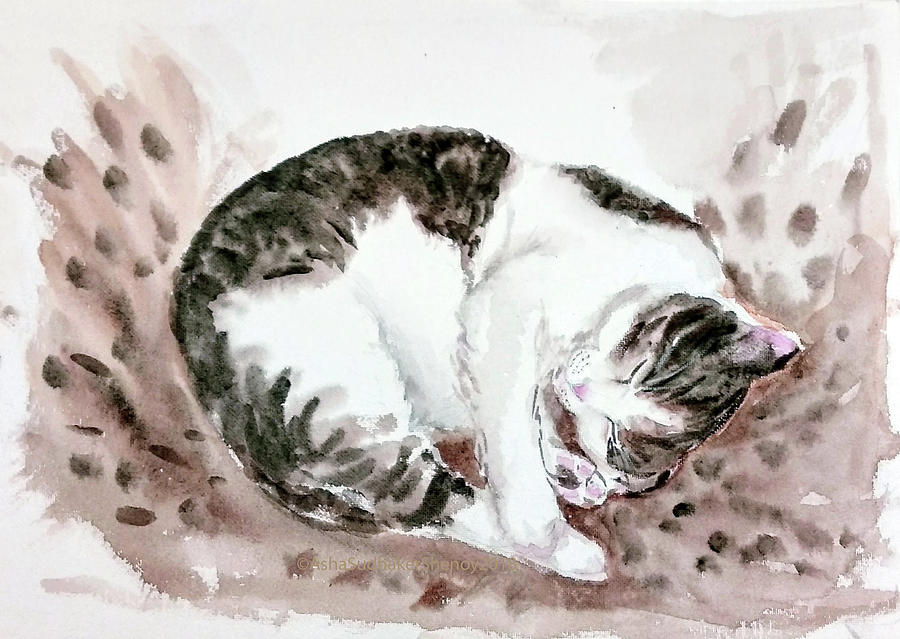
Sleeping cat by Asha Sudhaker Shenoy

Cezar-Florin Ciobîcă’s diary

mother’s diary –
between two blank pages
a pressed snowdrop

Cezar-Florin Ciobîcă (Romania)
(previously published in Brass bell: a haiku journal, June, 2014)

What struck me initially about this haiku is the relationship between a personal diary and the life of a snowdrop. The diary is supposed to be about the poet’s mother’s life. However, the pressed snowdrop becomes front and center in this haiku. It transforms into a window in the life of a beautiful flower.

Collecting souvenirs in diaries is common. My father used to do it as well. It is a form of stepping outside of yourself and saying to the reader and the diary writer: look at this. Examine it and discover the world that is this.

In the context of the haiku, I feel the poet looks at the diary of his mother after she has passed away and happens upon the snowdrop pressed between the pages. He then sees the snowdrop as the embodiment of his mother: once delightful but now no more. Their bulbous petals and color also suggest to me that the snowdrop is employed here as a metaphor for motherhood. This is another great example of how haiku bridges the human and natural world.

In each line, the soft sounds of “o” are found. This connects to the subject of motherhood and the passing away of a mother. Punctuation is also employed aptly to make the two parts distinct. Without punctuation, the second line could read as a pivot between lines one and three, which would confuse readers. Lastly, snowdrops appear usually in early spring. This seasonal reference (kigo) works well when we think of it in correlation to a mother: pure, beautiful, and comforting to look at and be around.

Overall, a great snapshot that is charged with background emotion.

Nicholas Klacsanzky (USA)

I feel as if I may have read the whole diary through this one haiku. The nostalgic feelings in this haiku show fond memories of a mother. That itself makes this haiku powerful in many ways.

A diary is a collection of day-to-day memories and events where a person sometimes shares very private feelings, and no one will listen to those feelings. The opening line ‘mother’s diary’ perhaps shows the motherhood experiences of a single mother who wants to be listened to by others but can’t

The blank pages may reflect the hesitation, reluctance, or lack of the right expression. It seems the mother wants to share very deep or private feelings but is unable to do so due to various reasons. It also illustrates how visible those feelings are when you go through the blank pages as the writer skillfully connected the blank pages with a snowdrop. A snowdrop that is cold, invisible, and anonymous may indicate tears, deep pain, traumatic feelings, guilt, and/or regrets.

The overall imagery of this haiku may suggest sadness, loneliness, departure, grief, or deep pain that leaves a mother to remain inexpressive and silent.

Hifsa Ashraf (Pakistan)

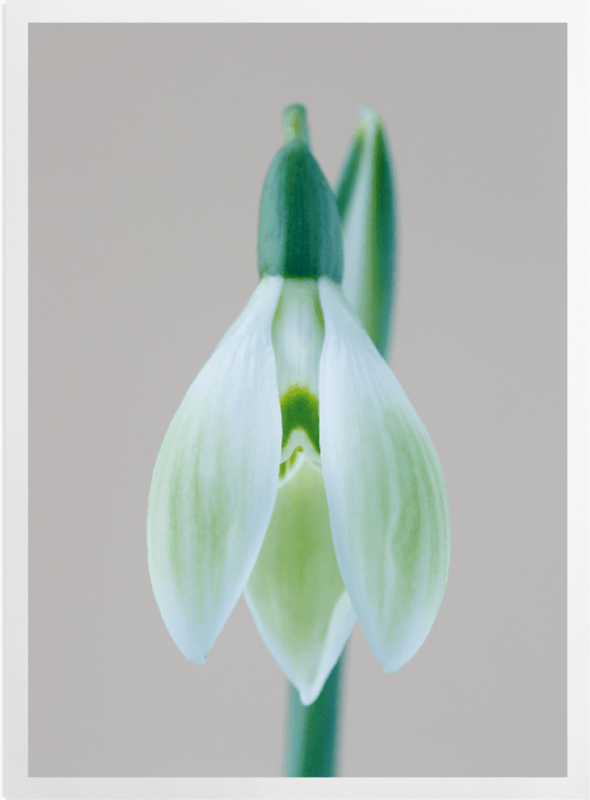
— “Snowdrop” by Clive Nichols