Haiku and Haiga by Lanka Siriwardana, Bonnie J Scherer, and Maire Morrissey Cummins

grandfather’s trembling feet
searching for the slippers
in this cold night

Lanka Siriwardana (Sri Lanka)
Honorable Mention, 76th Basho Memorial English Haiku Contest, 2022

Commentary from Jacob D. Salzer:

Like many well-written haiku, there is a balance in this haiku between concrete imagery and mystery. In the first reading of this haiku, we could see “trembling feet” relating to the cold temperature. However, the trembling could also be due to a medical condition and/or old age, in addition to the cold night. The words “searching for the slippers” show a kind of struggle, partly because it’s evening, but the poet’s grandfather also might have dementia or some form of memory loss.

The overall tone of this poem inspires compassion because we get a real glimpse of the grandfather’s life in a cold atmosphere. As a reader, I wonder if the grandfather lives in a home or shelter that isn’t heated well. This haiku also reminds us that a simple task many people take for granted (such as finding their slippers) can be a significant challenge for others. I am reminded of my late grandmother who had dementia. Even walking to the front door and putting on her shoes was a significant task that took quite some time. Indeed, psychologically, there seems to be a slower pace to this haiku, in stark contrast to the busy, daily lives in modern cities. This is a haiku that inspires sensitivity and compassion. 
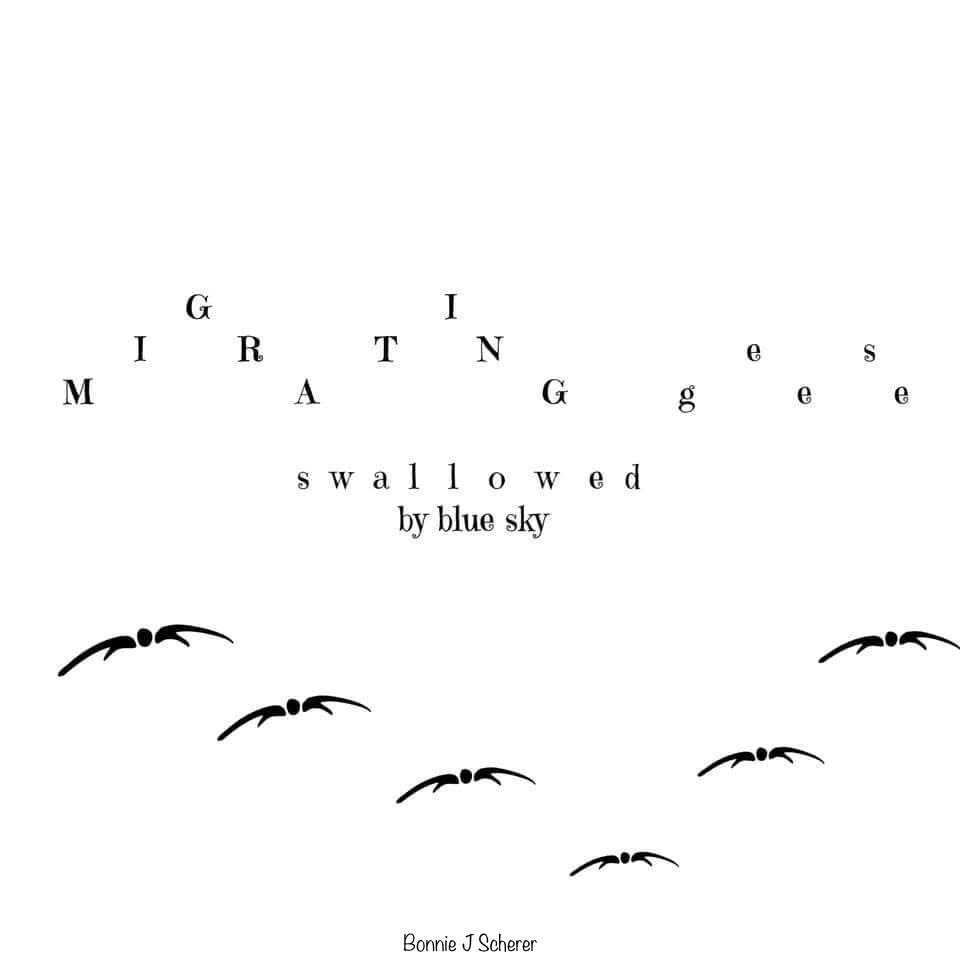
Bonnie J Scherer (USA)
Daily Haiga, 9/30/2024 

Commentary from Hifsa Ashraf:

The opening line of this haiku suggests the time of departure—probably afternoon or early evening. Migrating geese move in a flock with a specific formation, making their flight unique. 

‘Swallowed by blue sky’ makes the scene more dramatic and mysterious. It is an unusual time of depature which may be due to unfavourable circumstances i.e. climate change, war, etc. The word ‘swallowed’ indicates a critical or unfavourable situation where the geese disappeared either due to smog or smoke or in a symbolic way. 

The missing article before ‘blue sky’ perhaps points to a regular situation where geese disappear normally. We may be getting less sensitive to what is happening in nature, where birds do not feel secure in blue sky—not having the freedom of enjoying seasonal flights. It also indicates that such beautiful scenes are missing where bird lovers can enjoy bird watching. 

Overall, the vivid imagery of birds is quite sad and stark for those who love nature. 

night ferry
pitching its way
through starlight 

Maire Morrissey Cummins (Ireland)

Commentary from Nicholas Klacsanzky:

I grew up near a ferry dock, so I can easily relate to this haiku. The lights from night ferries are majestic to witness. In conjunction with “starlight,” it would be truly a spectacle. The casual speed of a ferry also makes this image more beautiful, with the ferry pitching i.e. an up-or-down movement of the bow and stern of the ship. The combination of artificial and natural light, as well as the earth and the cosmos, add to the meaning of the haiku.

Looking at the more technical aspects of this haiku, one can easily say that it follows the tradition of brevity, with only seven words used. Each word is employed well, especially “pitching,” which gives the poem more motion. Also, the “i” sounds perhaps make the starlight imagined more stark, and the “r” sounds provide more weight.

Like many fine haiku, on first read, it seems simple. Yet after looking a bit deeper, we can see layers of resonance and fantastic imagery that connect the human-made world with the cosmos.
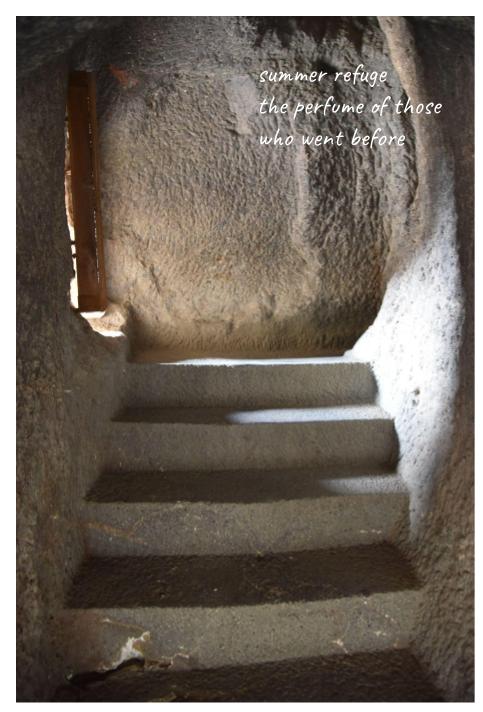
Alice Wanderer’s summer refuge

Haiku: Alice Wanderer (Australia)
Photography: Di Cousens (Australia)

Commentary

Refugees, seeking a safer place to live, demonstrate the strength and resilience of the human spirit. In this haiku, it is the scent of a refugee (or refugees) that we recognize in their absence. The word “perfume” seems to entail a strong scent that lingers. This haiku could also symbolize humility and frugality. With very few possessions, it seems refugees don’t leave many (if any) material objects behind. This makes me think: on our brief human journey of a lifetime, what are we leaving behind? What do we want to leave behind?

In turn, it seems the presence of a kind and compassionate human being is a gift that stretches far beyond material wealth. In the end, physically, we are all visitors on this Earth. The steps in the photo could be a symbol of human striving or steps in human growth/evolution. I think the long journey of refugees both spiritually and physically can redefine what truly is home. 

Jacob D. Salzer

First, I would like to say that I enjoy the shading and light in the photograph. Also, the textures in the wall and steps make it an intriguing capture. The font for the haiku is appropriate for the subject matter and matches the atmosphere of the photograph.

The seasonal reference (kigo) is in the first line with “summer refuge.” We can guess that the summers where this haiku takes place are exceptionally hot. It might even be in a desert. The poet and photographer being both from Australia can make readers think it might be in the Australian outback. This photograph could indeed be a summer refuge made by Australian Aboriginals to combat the outback heat. In this context, the last line referencing possible ancestors could gain more meaning.

There is no punctuation in the haiku (kireji), but there is a clear delineation of the two parts of the poem by a grammatical shift from the first and second lines.

How the two parts of the haiku combine and interact (toriawase) is pleasant in its melancholy. With summer being a happy and chill time, in this space of sanctuary, there are the remnants of ancestors. Whether this is a joyous or sad happening is up to the reader. “Perfume” is used interestingly in this haiku, as the poet could have easily written “scent.” “Perfume” is a much more endearing word that could have multiple meanings. But overall, this haiku could have an intermixing of emotions or be about a silent celebration of ancestors still with us.

Looking at how the lines are laid out, the pacing approximates the Japanese traditional rhythm of short/long/short.

The diction is in line with haiku principles of simplicity and brevity. It is also important that the poet left space for the reader to ponder through her choice of words.

In terms of sound, the letter “r” is especially important. With four instances and in every line, “r” gives a hard edge to the haiku that connects to the walls and steps in the photo.

Ultimately, this photo haiku (shahai) expresses inexplicable emotions with grace. Though the image and haiku might be endemic to Australia, it is written in a universal way.

Nicholas Klacsanzky


Anna Maria Domburg-Sancristoforo’s Lake Twilight

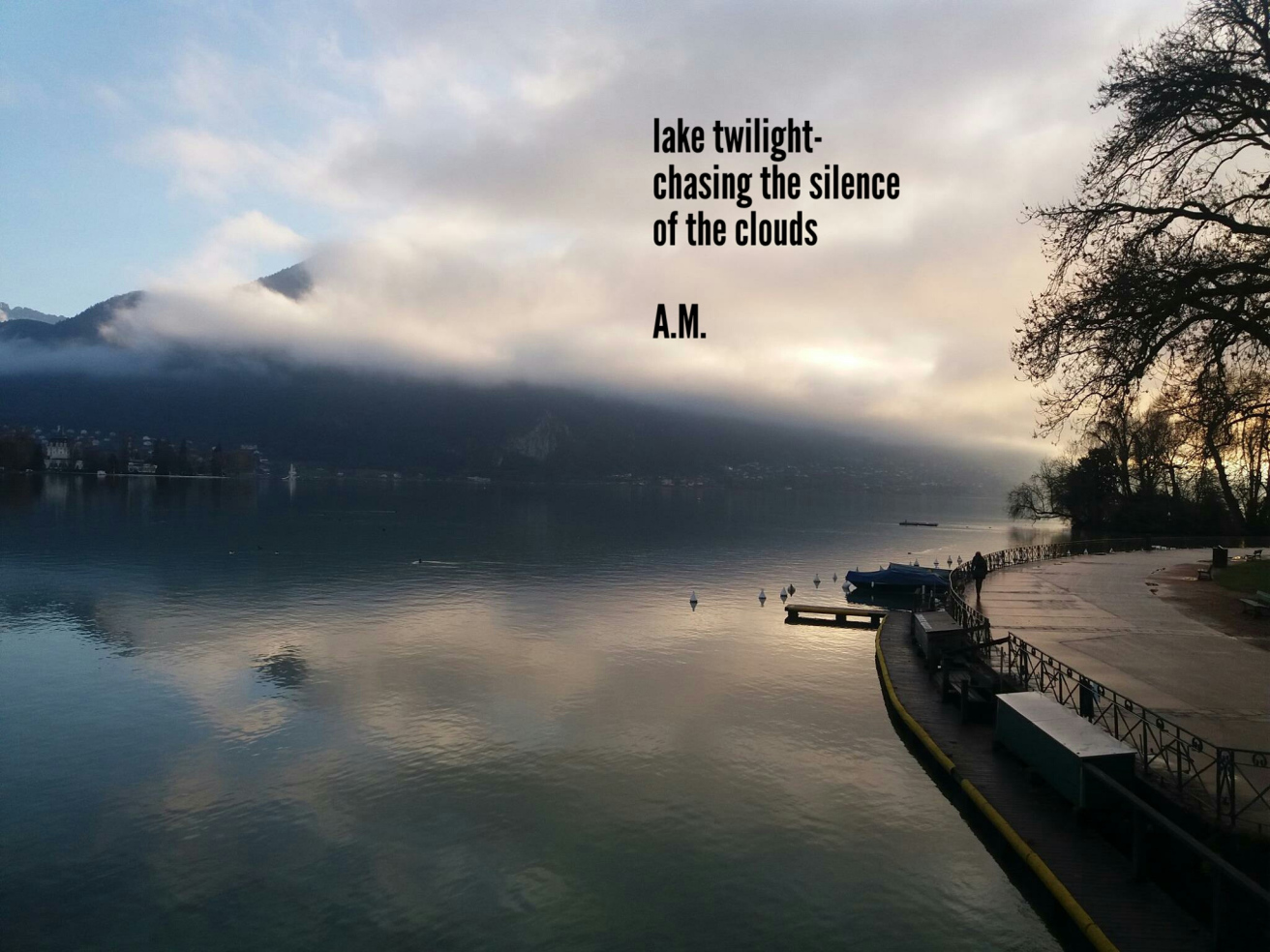
aviary-image-1517294710424Photograph by Lorena Campiotti, haiku by Anna Maria Domburg-Sancristoforo
Published in Failed Haiku, issue 28, 2018

I enjoy the mystical sense this haiku brings. With the comparison of twilight at a lake and the chasing of clouds’ silence, the reader looks through their mind’s eye to imagine a meditative experience. The poet is perhaps wanting to leave her ego behind and become one with something more primal and foundational: the silence of nature.

Twilight is a time of being between daylight and darkness—something difficult to grasp or pin down. The “chasing” of the silence that clouds contain, either by the narrator or twilight itself, is another thing of abstractness and obscurity. This is akin to the Japanese aesthetic of yugen, which suggests subtle profundity and is associated with mystery.

The structure of the poem fits the rhythm of traditional haiku well and has a clear cut marker (kireji) in the first line to bring about more complexity and a juxtaposition. The strongest sounds in the haiku are the “l”s and “i”s.  Both supply us with a lilting feeling, which in an abstract sense is like the movement of clouds.

The photograph conjures an epic scene to take in and sets the environment well. It compliments the haiku, as it does not go directly into the “chasing” part. It delivers the scene to us so we can dive more into the mind of the poet.

Nicholas Klacsanzky (USA)

The opening line of this haiku takes us to the colourful sky that can be observed at twilight. Mostly, twilight has fading colours i.e. red, purple, yellow, and blue. These fading colours reflect the colours of an aura that we have in the evening, especially at twilight. So, the lake’s twilight complements or blends with the colours of our aura. I can feel the deep silence of the lake at twilight that is due to either the migration of birds or other lake creatures, or due to abandonment. In both cases, the lake reflects the colours of twilight, as well as the mood of the person who was observing it.

Chasing silence may indicate the meditative thoughts that are closely embedded in the silence of the lake and intertwined with the colours of the sky. The narrator may have had profound experiences of seeing clouds, which may also be her ongoing thoughts (maybe chaotic), and she wants to move beyond those thoughts to finally get a peaceful mind.

This haiku beautifully presents the whole image in a subtle way, where we can observe a deep relationship among twilight colours, clouds, silence, and mood. It reveals the mystery of human curiosity to go deeper into one’s thoughts and feel the depth of subtle experiences. Overall, I enjoyed the imagery of this haiku which moved me to vividly experience a lake twilight.

Hifsa Ashraf (Pakistan)

If you enjoyed this haiku and commentary, please leave us a comment.

Paul Reps’ Green Tea

50565309_309250386372128_8422852160798064640_n

Paul Reps (1895 – 1990) (USA)

First, some background on this haiga:

“In the early ‘50s, Reps, who was in his forties, had traveled to Japan en route to visit a respected Zen master in Korea. He went to the passport office to apply for his visa and was politely informed that his request was denied due to the conflict that had just broken out. Reps walked away, and sat down quietly in the waiting area. He reached into his bag, pulled out his thermos and poured a cup of tea. Finishing his tea, he pulled out a brush and paper upon which he wrote a picture poem. The clerk read the poem and it brought tears to his eyes. He smiled, bowed with respect, and stamped Reps’ passport for passage to Korea.”

– Excerpt from Living in Balance, by Joel & Michelle Levey

Commentary

This short, intense poem has two aspects that make it interesting and deep in many ways. One aspect is related to our desire to calm our head after fatigue or mental stress. The green tea acts as a pacifier that brings the poet’s chaotic mind to peace. I believe in “tea meditation,” as it helps us to change our intense feelings that are usually a result of our shallow thoughts.

Keeping the background of this poem in mind, I think it is about fatigue due to the person feeling irritated or frustrated. It may be due to his long journey to another country, where he is not getting proper assistance. The tea brought soothing effects to his mind and he started thinking rationally about the situation.

Another deep aspect of this poem is spiritual, where a drink is the central part of the meditation practice. It is said that drinking green/herbal tea not only changes our biochemistry, but also helps us to filter/purify certain thoughts/feelings that are toxic in our nature. Every single sip of a drink works to simmer down our intense emotions and eventually facilitates us to clear our mind.

Besides these two aspects, I also see a deep connection between the person and nature, where green tea acts as fresh air in the chaotic life of a person, and helps him to get rid of the war that usually takes place in his mind.

Hifsa Ashraf (Pakistan)

From the time we are little babies, we learn to simmer down by drinking milk. To drink is a way to get in touch with our mother, and in the beginning, our mother is all of our world, so we begin to make experiences of the world by sipping. Soon, we learn also that tensions can be released by sipping milk from our mother’s breasts, and the link is that we need to sip to settle down mental or physical pain.

Later on, we can lose this habit. Usually, we find a substitute with our favorite drink and take a pause from the world, and quite often from its bitterness, by drinking it… many people unfortunately make use of alcohol, trying to relax themselves … in Italy we have the “coffee break,” which i would rather call the “tea break”… Seriously talking, a tea, even if we focus only on the water by which it is made, it has electrolytes which help the nervous system to calm down and to work in its best way.

The “cha no yu” or tea ceremony in Japanese culture has its sovereignty in the green powder melted in hot water with elegance, calm gestures, and clean movements, which add magic to the rite. There’s no doubt the monks can meditate at their best after a cup of it.

The poet uses a four-line structure, reproducing the interruptions caused by sipping, opening the second line with “of” as if he is talking and suddenly he has to stop and sip before going ahead with the poem…

To accept a conflict and not to let it steal our energies means to have the third chakra, in the area of the stomach, well balanced. People who practice meditation know that wars are probably started by people with problems with the third chakra…. Furthermore, we can move on from bad experiences if we can “digest” them, and a hot cup of tea in our hands, or better, a bowl, can really make the difference for this chakra, helping to relieve any difficulty in the process of metabolism of difficult feelings we need to cross, accept, and also let go of …

I’m amazed by the spirituality very well conveyed by Reps in his ink drawing. The perfection of the lines recalls an ensō in my mind, and reminds me of how important it is to stop and look inside, in the circle of our inner world, to find a clean, simple but powerful thought of purity and peace. The meditation of the author sounds like it is activated by the green tea’s molecules, which could set forth a chemical change soon perceived by his neurons, and felt as the strong inner movement of stopping something dangerous, a war. If only we could all do this, and together, there would be no more wars in the world… A very touching poem, with a wise and powerful message.

Lucia Fontana (Italy)

This Zenku is beloved for its simplicity. The pacing of the poem, the starkness of the painting, and the surprising last line creates many feelings and interpretations. We often forget that the commonplace can solve world problems. Moments of peace can add up to world peace.

The sense of sound works effectively too. The “o”s in “bowl,” “of,” and “stop” give a sense of vastness, in my opinion. Also, the “r”s in “drinking,” “green,” and “war” provide a feeling of roundness, like a whirring.

Sometimes things are inexplicable, but not, at the same time. I think this applies to this haiga.

Nicholas Klacsanzky (Ukraine)

Did you enjoy this haiga and commentary? Please let us know in the comments section below. 


Lucia Fontana’s Sakura

40914358_904528076423327_7907422073432047616_n

A beautiful haiga that is well conceived. In Japan, the sakura symbolizes spring or renewal, which means it also brings hope in life when it blooms. In this haiga, the sakura reflects the awakening of meditative thoughts that a person yearns for whilst strolling or walking on a path. It also means the person is contemplating about his/her deep thoughts and is taking some inspiration/motivation from nature.

On the contrary, the feelings may be opposite to what is described above. Maybe fallen or wilted sakura are present, which suggests hopelessness or a change in mood. Maybe a person is oversensitive towards some deep realities of life and relate them to nature.

Overall, the haiga indicates our approach towards different realities of life that can be either positive or negative. However, our deep understanding of those realities makes a lot of difference.

Hifsa Ashraf (Pakistan)

A very traditional haiga. The image brings us into the spring, when the weather is changing. To me, it brings a change of mood: a beautiful festival, the blooming of  sakura, people finding time in their busy lives to take a breath to admire nature.

I was surprised by the second part of the poem. I would say it brings a more modern feel to it, or a nice twist. It brings us back to the sakura, like a reminder.

Maybe there is a touch of sadness, but the second part says, “Hey, its okay to look at the sakura… it’s still blooming, and it will bloom each spring like many years before.” So, this image keeps us moving forward, and is inspiring.

Laughing Waters (USA)

I like that there are two ways of reading the content of this haiga: “sakura blooming/the silence along the path” or straight through as “sakura blooming the silence along the path.” This is one of the reasons why one-line haiku are ideal for suggesting various interpretations.

In relation to the first interpretation, the silence might be created by the beauty of the sakura, and people viewing them in awe. Also, such elements of nature are often silence-inducing, as they make us witness instead of analyzing. “The path” could pertain to a physical path, or one’s spiritual path. I think the poet is referring to both in this haiku. There is always the harbor of silence along one’s spiritual path that one can tap into through meditation and being one with the present.

If one reads the poem in a straightforward manner, it appears as the sakura are physical manifestations of silence. In fact, most things bloom without us even paying to them. We often take the growth of plants and natural life in general for granted.

I noticed the musicality of the content as well. With prominent “o” and “s” sounds, the reader can feel the relaxing nature of the stroll. And at 7 words, the monoku is quite efficient in conveying its mood and scene.

Yun, the artist, has complemented this haiku with a fine abstract sense. With the surrealistic portrayal of blossoming sakura, the meditative and spiritual haiku is expanded upon. In my opinion, the art might even bring a touch of melancholy to the overall impression.

Lucia is an expert in haiga, and it is no surprise that this haiga works so well. I look forward to see more collections of her haiga online.

Nicholas Klacsanzky (Ukraine)

Let us know what you think about the haiga and commentary below.

Sydell Rosenberg’s Feather

in a toyless cage
the parakeet discovers
a feather to twirl

02

Haiku by Sydell Rosenberg (USA) (1929-1996), art by Mary E. Rodning (USA), and translation into Japanese and calligraphy by Hiromi Inoue (Japan).

A nice collaboration (I do not know or read Japanese, so I don’t know about it, other than the looks of the writing is aesthetically pleasing). The crueltyI suppose it is unintentionalof a captive spirit is stated matter of factly. It is a powerful piece. The three elements work well together, but the haiku easily stands alone.

– Dana Grover (USA)

This is powerfully sad and shows how pathetic it is to capture a free spirit (wild bird) and keep it prisoner in a cage. I find that objectionable. The feather seems to symbolise the loneliness of the bird.

– Martha Magenta (UK)

To me, it shows desperation with ingenuity and intelligence of a captured being, but do animals have emotions such as being bored? This is a debate that’s been going on for a long time. I noticed that this was written in the 5-7-5 format and I can imagine the difficulty of writing the first line without telling too much, which to me it does.

Since the image already shows a cage why not emphasize it and not repeat what’s already shown?

Ex:

toyless prisoner
the parakeet discovers
a feather to twirl

Just thinking of the possibilities, where I could be wrong as well. My 2 cents disclaimer.

– Fractled (USA)

Wow. I think it’s very potent. To me, it speaks clear of how horribly sad and senseless it is to confine another being created to be wild and free. I can only hope it conveys the message to others on how very wrong and inhumane imprisoning a fellow earthling is, along with the selfishness and cruelty of it.

– Michelle Hyatt (Canada)

L1 might work better without “in a” since “parakeet” and
“cage” suggest being within.

– Edwin Lomere (USA)

I think the poem is quite strong. It oscillates nicely between a theme of making the most of what you’ve got (“a feather to twirl”), and one of being trapped with little available to you (“a toyless cage”).

– Dave Read (Canada)

Wow… I have mixed feelings regarding this particular haiku, but the intention to convey loneliness is stark and well-taken. First, it saddens me that the little fellow doesn’t have any material/objects to keep itself occupied and happy while being confined.

You see, I have an African Grey that never knew of being in the wild, (I spoon-fed her during infancy) but she escaped twiceonce in Maryland and another time in Georgia. One of her phrases is, ‘Help me.” In her last escape, she stayed away for about a week (I forgot the exact time frame).

She ( Lilo) ended up flying onto a gentleman’s lap as he and his brother were chatting in an open garage. Because of posting Lilo’s description/markings and behaviour patterns in a nearby pet store, I was blessed to have her returned to me. She has a 6-foot cage, several toys, eats fresh fruit and seeds daily (she growls at vegetables) and is rarely confined. At this time in my life, I can’t imagine not having her as my companion (she can live up to 60 years+).

I have spoken with many people, including friends, who believe birds should be free. Well, I must say horses should be free too. :)

Many animals can be domesticated. More importantly, to me, they should be treated with as much kindness as the next person. I have to admit most of my friends have 4-legged pets. It just so happened a little bird who truly talks to me became my best friend. That is not to say I’m not fond of felines & canines as well.

– Lovette Carter (traveler)

Since the haiku portion of the haiga has been commented on at length, I will do my best to discuss the art.

The white between the words and the cage, to me, portrays the loneliness the parakeet is feeling.

Most of the color is used on the bird itself, while the cage and the cage’s stand is painted lightly. This allows the viewer to focus on the bird as the main subject and see that with the play with the feather, the bird is perhaps drawn away from its loneliness. Even the poet’s name is written in green, which could point to the parakeet being a metaphor for the poet’s life.

At the bottom right, there is what appears to be a dark blue chair, which is an appropriate color for sadness.

Though simple, the emotions of the haiku runs through the art, and perhaps gives a glimpse into the true feelings of the poet.

– Nicholas Klacsanzky (Ukraine)

What do you think or feel about this haiga? Let us know in the comments.

Kaji Aso’s Dancing Crabs

crabs

dance crabs
under the full moon
until you become a skeleton

© Kaji Aso (1936-2006) (Japan)

Before discussing this haiga (art plus poetry), I will supply some biographical information about the artist and poet.

Kaji Aso was born in Tokyo, Japan in 1936. He received an BFA in Painting and MFA in Printmaking at the Tokyo University of Art. But he was not only an artist; he was also a teacher, singer, adventurer, poet, and philosopher. All those who speak of Kaji Aso use the words “renaissance man” to capture his many accomplishments and his boundless spirit.

In 1972, he founded the Kaji Aso Studio Institute for the Arts in Boston, MA. Here he brought together Japanese and western culture: visual art, music, poetry, philosophy, theater, and good food. He also designed and built the first Japanese teahouse in Boston, where he presided as tea master. For thirty-three years, Kaji Aso was also a professor at the School of the Museum of Fine Arts, Boston. His art is part of the permanent collections of many museums around the world, including the Museum of Fine Arts, Boston; the National Museum of Modern Art, Tokyo;  the Museum of Modern Art, NY; National Museum of Czechoslovakia;  the State Pushkin Museum, Moscow and Padua Museum of Fine Arts, Italy. Thirteen of his works are registered as Japanese National Properties.

As a talented tenor, Kaji Aso performed opera and Italian and Japanese songs. He ran in thirty-six Boston Marathons and led kayak expeditions down some of the longest rivers in the world including the Mississippi, the Nile, and the Volga.

Although haiku was just one of his many special gifts, Kaji Aso very often expressed the wisdom of his beliefs in haiku and did a lot of haiku illustrations. He organized and took an active part in many seminars and lectures about Japanese art, haiku, sumi painting and calligraphy. With countless awards and publications attributed to him, he can be rightly called a legend. [Adapted from The Living Haiku Anthology]

Commentary

In the art, we can notice the moon at the top, with the haiku written in an accented way to take in the haiku slowly. The crabs below the haiku are shown dancing by the dots below them. This type of painting is not exacting, but rather an approach is taken to capture the spirit of what is seen. This relates to wabi-sabi, allowing imperfections to be and seeing the beauty in them. Sumi art is more of a sketch of life, rather than an exact showcasing of it.

Though the art seems simple, we can get a poignant feeling from it. I perceive joy and austerity in the blots and lines of the ink. It gives off vibrations of spirituality, but also a pure simplicity that makes one joyful when viewing it.

The feeling the art exudes compliments the mood of the haiku. Though the art does not show the crabs as skeletons, it shows their dancing and allows us to feel the mysticism of the haiku more.

In terms of the haiku, each line is striking and wakes one up to the moment. Though the haiku can be taken literally, I believe it has a spiritual mood.

Crabs are a reference to different seasons, but most commonly, they reference summer. It would make sense that they would be dancing if it is summer.

The full moon has so much symbolism in Japan that it is hard to define it in a few short lines. But the full moon can mean complete enlightenment, the absolute truth, and even specific mystical beings. In the context of this haiku, I feel the full moon is in a sense luring the crabs into a mystical experience, and that the poet suggests the crabs to give up the attachment of their bodies. The poet recognizes the crabs as seekers of truth when they dance under the full moon, and is instructing the crabs as he would students of Zen or other forms of spiritual practices. There is no sense of division of the human and natural world in the mind of the poet.

We get a contrast of the full moon and the skeleton. This juxtaposition, though it seems obvious after a few readings, does not seem apparent quickly. This is because the starkness of the moment described is so strong, that the reader does not consider the aesthetic of it at first.

A masterful haiga by an enormously talented artist and poet.

– Nicholas Klacsanzky (Ukraine)


Momolu Freeman’s Guitar

summer breeze painting my old guitar

16-1

Words and art © Momolu Freeman (USA)

I believe Freeman made the right decision to make this a one liner. When you have too few words, it is often better to make a haiku one line instead of two or three.

For example:

painting
my old guitar
summer breeze

or:

summer breeze
painting
my old guitar

or:

summer breeze
painting my old guitar

… seems to have less impact on the reader and does not look as appealing on the page.

The one line version also encourages readers to see the double meaning easier. It can be read as “summer breeze/painting my old guitar” or without a stop as “summer evening painting my old guitar.” The first one is a contrast/comparison, and the second one is implying the summer breeze is painting the old guitar, either by splashing paint unto the guitar with its force, or by staining the guitar with whatever is in the surroundings. It could also be metaphorical, as the wind could be painting the guitar in an unseen way, painting it with its currents and unseen shapes.

“Summer,” the seasonal reference or kigo, is that of romance, relaxation, joy, but also the burning sun which crumbles crops. This being paired with painting an old guitar is poignant. Indeed, in a summer breeze, we can feel something of memories and the renewal of those memories. Like painting an old guitar, a summer breeze brings many memories back of joy, but also maybe of sadness or reminiscence.

No season is black and white, especially in haiku. Though seasons have themes, each season has counterpoints we can be aware of.

The “r” sound in the haiku gives the effect of wind rustling through trees and maybe the guitar itself. The “i” sound in “painting” and “guitar” seems to give greater emphasis and maybe a sense of the toil in the process of painting a guitar.

The art gives an indication of the seriousness of the topic as well. The guitar appears to have been given African attributes, and points to African-American tradition in the blues and other music based on the guitar. Though America is a young country in relative terms, the ancient African heritage brought to America by way of slavery has had a profound impact on music, from blues, jazz, rock, funk, soul, disco, house, and much more.

This haiku might be less of pointing towards a personal experience, and more of a collective experience, how Africans are reclaiming their heritage and finding it through the strains and strands of history.

– Nicholas Klacsanzky (Ukraine)

Brendon Kent’s Clouds

2016 - 1

Words and image © Brendon Kent (UK)

For the context of this haiga, or haiku and art combined, I should tell who Jane Reichhold was.

Jane Reichhold was a popular and key member of the haiku community. She was the editor of Lynx journal of haiku, tanka, and renga, and the owner of the site Aha Poetry, where a great amount of reading materials on haiku and related forms are held online. She wrote many famous books on haiku, such as Basho: The Complete Haiku, Writing and Enjoying Haiku: A Hands-on Guide, A Dictionary of Haiku, and many more influential books. She also was the recipient of the Museum of Haiku Literature Award [Tokyo] twice and the Merit Book Award twice.

It was announced that she passed away on August 5th, 2016. Many tribute haiku and articles were written for her, as she trained and influenced so many people through her essays and poetry. This haiku by Brendon Kent is a fine example of a tribute haiku for Jane.

This haiku has a clear juxtaposition and is written in a more traditional style, which I think is a prudent choice for the tone of a tribute. The poet is comparing drifting clouds to traveling from one dream to another. This juxtaposition is complemented by the image of the slightly blurred dragonfly in flight. In haiga, the image and text usually are not directly connected, but hint at each other. Brendon has done a superb job making this connection indirectly, creating a defined mood.

The use of the ellipsis shows a carrying on and delineates the two parts clearly. I think without the ellipsis, the meaning could change, and maybe Brendon wanted a more focused reading of his haiku.

I don’t know why exactly, but I feel emotional reading this haiku. It looks straightforward, but there is a definite emotion behind the words. Maybe it is the context or the solemnity with which the pacing of lines are written, but it charges me with emotion and maybe a sense of awe.

Let’s great back to the clouds. Clouds are high in the heavens, as you can say, and are an apt metaphor for Jane. She was a selfless person and committed to write poetry that uplifted people. The drifting, I believe, is a metaphor for passing into another life. The wind making the clouds drift could be a symbol for the universal spirit that is often expressed as wind in spiritual doctrines. Maybe the cloud is a symbol for Jane in the afterlife, soon to rain and bring about a new life of her own in a distant place.

The dream could be the illusion of life. Most spiritual traditions agree that we are not this body, emotions, or mind, but a pure spirit. It seems these lines are a kind of reassurance and a kind of detachment as well. This process of life and death are only transitions of the mundane, and maybe we all wake up to our spirit in between (though some say it is better to realize the spirit while living).

Or, the poet could be simply stating what happened to him. Maybe he took a nap on a forest walk, or on his backyard, and woke up to seeing drifting clouds after experiencing transitions to and from different dreams.

Haiku are usually objective reporting of what is happening, but can be seen as metaphors and symbols for much more. And knowing Brendon Kent’s work, he enjoys creating layers of meaning in his work, so it is probable that he wanted to portray both the spiritual and mundane.

On the level of sound, the “o” sound in “clouds,” “from,” “one,” “to,” and “another” create a wispy feeling for the reader, akin to clouds. It is great when the reading of a poem accurately reflects its content. The words without”o” are “drifting” and “dream,” which have alliteration and are both key words in the context of this haiku. Leaving these words as the only ones without an “o” sound makes them stand out more, which draws our attention to them more.

Though many fine tributes for Jane Reichhold have been written since her passing, this is one of the finest I have read. Wherever Jane may be now, I hope she is reading this tribute, and many others.

– Nicholas Klacsanzky (Ukraine)


Heike Gewi’s Children

04.08.16 - 1

Words and art © Heike Gewi

With four words, one can find at least four interpretations within the poem. That is one of the magical things about poetry: the line acts as a device for delivering additional meaning.

Interpretation 1: The author is missing her children 24/7.

Interpretation 2: The author’s kids have been missing 24/7.

Interpretation 3: 24/7, the kids are missing something.

Interpretation 4: Time (24/7) is absent, and that is juxtaposed with the kids.

Which interpretation should we take? What is the tone of the haiku with so many interpretations? Those are questions that can’t be answered, but shine a light on how haiku operates.

Through simplicity and implication, authors make readers dive into their own imagination to make up a third part out of the two parts of the haiku that juxtapose each other.

The art accompanying the words show the times of the day in two different locations. The emptiness in each section and the somber lines suggest melancholy.

The “i” sound in “missing” and “kids” gives a sharpness to the reading of it, which makes the apparent emergency more alarming.

The last two lines are of equal length and appear to be stacked on top of each other, which gives the impression to the reader that the poem has more fullness to it than stated in terms of length and exudes a sense of power when you see it.

Though there is no season specifically referenced, autumn comes to mind with “missing” and the mood of the art. But haiku do not need to have seasonal references to be haiku. As long as haiku aesthetics are on display, haiku are haiku. This haiku showcases an aesthetic of loneliness, but maybe not the element of sabi, which is a Japanese aesthetic of loneliness that gives solace to a sorrowful life. However, the potency of the inherent aesthetic is felt poignantly, no matter what interpretation you take.

– Nicholas Klacsanzky (Ukraine)