Jacob D. Salzer’s long journey

a long journey . . .
in mother’s clothing
the scent of snow

Jacob D. Salzer (USA)
(published in Autumn Moon Haiku Journal 7:1, Autumn/Winter 2023)

Commentary by the poet

In this haiku, I primarily wanted to honor my mother and her long Earth journey (and her soul’s journey, if readers are open-minded to past lives and reincarnation). I am also writing about my mother going for a long walk in the snow and carrying the “outside” into the house. The scent of snow in her coat lingers. I’m also recognizing the long journey of falling snow, as snow falls from miles above us to reach the Earth. I hope this haiku can act as a portal for the reader to reflect on their own mother and her unique journey.

Commentary by the other editors

This haiku sounds simple but carries many stories of life’s journey. A long journey describes a period that may last more than a year or a lifetime. But, it signifies the essence of a trip that has ups and downs, and deep personal experiences. The ellipses stop us for a while and let us ponder the various aspects or types of journeys. I see it as a life’s journey that has myriad phases and stages where the person continuously passes through experiences within the self and with other people.

The second line tells us about the traveller but it still doesn’t show whether she is the one who carries the clothing or is having a long journey. It may have two interpretations. One is that she passes through rigorous experiences i.e. departure, separation, illness, loneliness, etc. The second interpretation would be that someone close to her carries her clothes as a possession.

The last line depicts deep feelings, as the smell of snow can mean something went as cold as snow and leaves painful memories. Another aspect can be the smell of a person that comes from the clothes and the poet may take it as the smell of snow, akin to the lingering memories of a loved one. In both cases, the person remains discreet in expressing their feelings and tries to relate those emotions with the scent of snow, which does not make a sound.

Hifsa Ashraf

Thinking about the seasonal reference in this haiku, “the scent of snow” is clearly directed at winter. However, a residue of snow could mean that winter has passed and that spring has come. So, the poet could be reexperiencing winter in the time of spring. This could symbolize how the poet feels about his mother’s life or even his life reflected by the one that brought him existence.

The two parts of the haiku combine well in that duration is present in each section. “Long” and “scent” both work to illustrate time passing by. “Journey” relates well to the implied cycle of seasons. With our phases as personalities, they can be representative of seasons—though one season can carry remnants of another season in it. The poet could be referring to how memory sticks to our personalities and in direct connection to his mother, it could mean that his mother has memories “too cold” to burn away.

With the punctuation, which delineates the two-part structure of the haiku, the ellipsis illustrates the duration of the journey. It also makes certain that the reader does not inadvertently read the second line as flowing from the first line.

The pacing emulates the traditional rhythm of Japanese haiku without the restriction of the syllabic count, which is often cited as an erroneous method of matching the format of Japanese haiku. The short/long/short practice is closer to the original haiku rhythm.

Looking at the sound, the letter that jumps out at the reader is “o.” Strewn throughout the poem, it gives a sense of elongation with the long syllables. In my opinion, it also heightens the emotional resonance of the subject of the haiku.

The way human life intermixes with nature in this haiku makes it special. It creates pathos and perhaps something verging on the surreal. A relatable, yet transcendent haiku.
Nicholas Klacsanzky

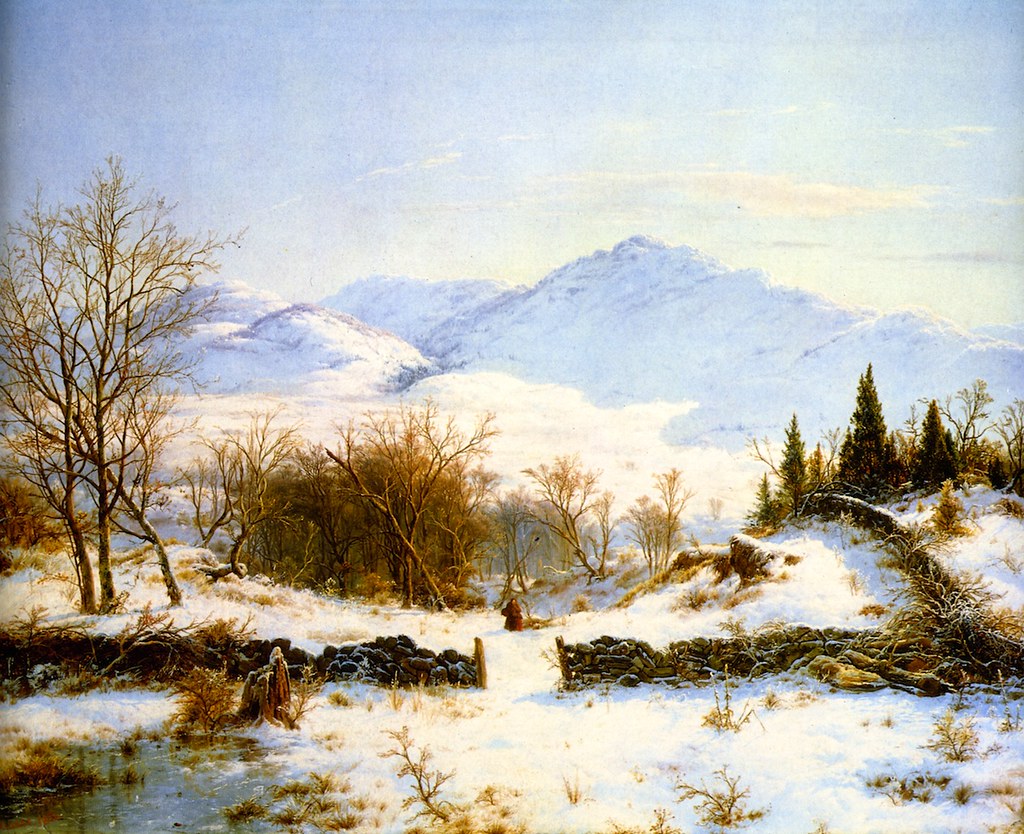
Winter Scene by Louis Remy Mignot, 1856
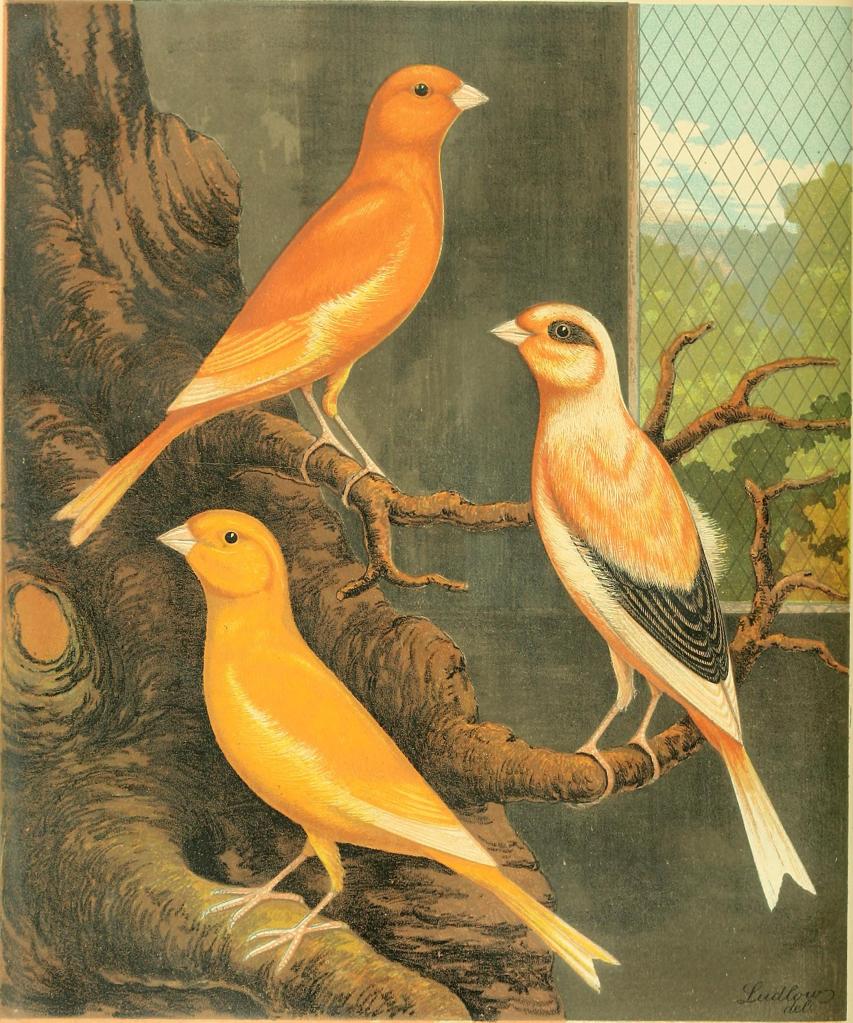
Michael Dudley’s prized canary

lockdown raised
  at sunrise he releases
       his prized canary

Michael Dudley (Canada)
(27th Kusamakura International Haiku Contest, Second Prize)

Commentary

I appreciate the notion of freedom and non-attachment in this haiku. I also appreciate the shift in perspective from a confined space to the limitless sky. What was once highly valued and clung to is now released. It seems giving space is a gift in itself, and I admire how our attention shifts from what is seen to what is unseen in this poem. In turn, maybe the very notion of “mine” is released with the canary, as this beautiful bird returns to their true home outside of human civilization. Perhaps by releasing the sense of “me” and “mine,” we can rediscover our spiritual home as well. A beautiful haiku.

Jacob D. Salzer

This haiku in a cascading style makes me think about its formation before I interpret it. It seems the person wants to convey a specific message through this style that can be read both horizontally and somehow vertically. The cascading style stops us so that we read the poem step by step before reaching a conclusion. I see it as if something is going down or ending nowhere.

Lockdown raised but what? It could be anxiety, uncertainty, frustration, or something that has a great impact on the person’s life that is being referenced. The past tense at the end of line one stresses the grave effects of the tense situation due to the lockdown. The sudden shift to the present in line two shows how smoothly the person has gotten over what he has been going through (maybe for a long time). 

The sunrise brings hope and warmth to one’s thoughts and feelings. We can feel the way the sunrise provides a sense of relief or healing. I see it as if the person is liberated after having a change in thoughts or has detached himself from what he may hold dear. This line stands alone, where one can try to guess what the whole story is.

The prized canary may have an association with the person’s life in terms of honour, achievement, memorable event, etc. But, it also symbolizes a hope for the future where the person in question has stepped over the barrier of attachment and possession. If it is a pet bird, then releasing it at the time of a lockdown is the realization of freedom, which often comes through rigorous life experiences. 

Hifsa Ashraf

If we try to figure out the season this haiku is placed in, it is not so easy. However, if I had to pick one, it would be spring. Not only is it a season with less disease (“lockdown raised”), but it is also the time when canaries are more active. Spring, in addition, symbolizes a new life—corresponding well with “sunrise” and “releases.”

The two parts of the haiku can be delineated from the grammatical pause after the first line, or even after “at sunrise.” So, punctuation is not quite needed.

The association between the words “raised” and “releases” is quite deliberate, I feel. Furthermore, the color of the sunrise and the canary are most likely similar, if not yellow. Both the canary and the sunrise are not only colorful but also bring hope and pack a punch though one lasts a short time (sunrise) and one is small (the canary).

The spacing of the lines brings about a sense of release and perhaps steps to that letting go. However, the lines still approximate the traditional rhythm of haiku in Japanese in terms of syllables with a short first line, a longer second line, and a shorter last line.

In terms of sound, the haiku prominently features the letter “i” in “raised,” “sunrise,” and “prized.” Through this sound, it creates a starker mood for the haiku and points to the importance of the canary.

With a unique format, the implication of color, a keen sense of sound, and relatable kindness, this haiku deserves study and ponderance.

Nicholas Klacsanzky

“The illustrated book of canaries and cage-birds, British and foreign” (1878) Public Domain

John Pappas’ returning geese

returning geese
a few more pebbles
on her headstone

John Pappas (USA)

Commentary

I appreciate the message of returning to the headstone of someone who was well-loved. I like how returning speaks of the cycles of the seasons as well. I also see the small pebbles as symbols of humility and modesty. The pebbles that were already there could have been placed by the poet last year or over several years, and/or some of the pebbles could have been placed by other people who knew and loved the person.

In addition, by returning to their headstone, we are reminded of our limited time here in a single human life. This puts our lives into perspective, which I think is much needed in today’s modern world. I often think cemeteries can help us reflect and reevaluate our lives and our values.

I also like the first line very much because it depicts a migration. In turn, I believe our souls are also migrating and will go to another dimension after death. The well-known saying: “Birds of a feather flock together” also comes to mind when I read this haiku. It seems the poet resonates with the energy of the person who passed away, and their spirit lives on, in many ways. I can feel a unity of spirits or souls and a deep, prevailing silence in this poem. A beautiful haiku.

Jacob D. Salzer

A very deep and thought-provoking haiku that tells the story of our short-lived journey in this world. Returning geese depict a migration or departure to another place temporarily and coming back to a place where they belong. It leaves us with a few questions: is it the departure and return of loved ones of the deceased person who was buried? Is it the departure of war victims who left without their loved ones (maybe dead in a war) and came back after peace? Is it a spiritual journey where one thinks more about annihilation and our short life span? Is it the time when someone comes back after feeling the absence of a deceased person?

I take it as an inner journey when a person, after having a lot of harrowing experiences that usually keep them away from their essence, comes back and finds the whole journey nothing but anonymity and annihilation. The obvious interpretation of this poem may be the death that symbolizes more of what is being missed about “her.” Is she a significant person in many ways? A few more pebbles on her headstone may be taken as her identity after death or the way one tries to pay tribute to her in a modest way.

In short, this haiku to me is about oscillating between life and death symbolically, where a person moves between outer and inner selves, with their life experiences pushing and pulling them towards their end.

Hifsa Ashraf

Pinning down the season referred to in the first line is not so easy, but “returning” is most likely pointing to when geese come back to their nesting sites after winter. This means that the first line could be a kigo (seasonal reference) for late February to early March, but it depends on the region. In Boston, where the poet resides, Canadian geese can be seen almost any time of the year

There is no punctuation in this haiku, but the cut between the two parts of the poem is felt after the syntactical shift at the end of line one. I can imagine an ellipsis being used on the first line but it is not needed for the poem to work. 

How the two parts combine is intriguing. I think the key word is “returning” as it can easily relate to the pebbles being put on the headstone. The headstone is most probably made of a type of rock, and the pebbles being laid there either by natural circumstances or by human intervention connects to “returning” well. The pebbles could also be an indication of the headstone coming apart and slowly going back to its original form found in nature. Lastly, I can just as well imagine the geese dropping pebbles on the headstone—though unlikely.

In terms of sound, the letter “r” features strongest in my eye. The effect is that it has a “pulling” sound which matches with the idea of returning. In addition, the letter “e” provides elongated syllables that connect to the sense of “a few more.”

Finally, the pacing of the haiku fits the standard for English-language haiku with a short first line, a longer second line, and a short third line. This approximates the rhythm of traditional Japanese haiku.

This haiku has a fine sense of mystery and imagery, which allows readers to interact with the content on different levels.

Nicholas Klacsanzky

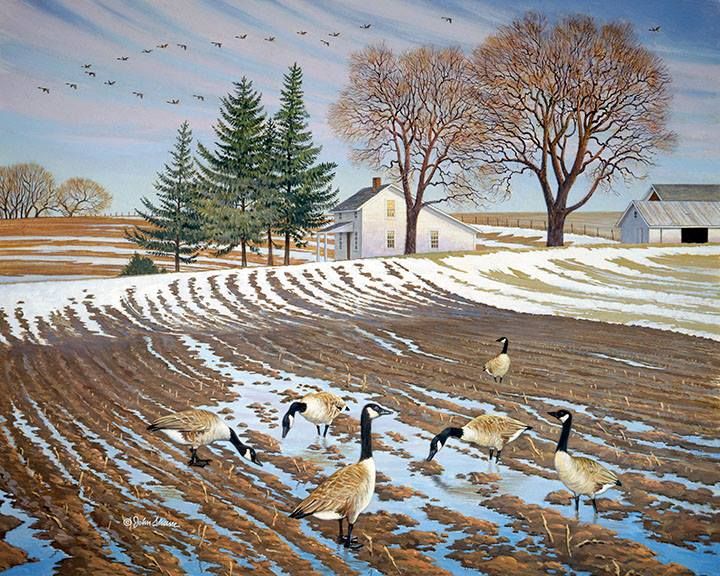
“Mud Season” by John Sloane