Ian Gwin’s faceless flowers

faceless flowers how
to mind this flesh and bone
in an age of steam

Ian Gwin (USA)

Commentary

The initial message I received in this haiku is a warning to not become another “gear in the machine” in a modern capitalistic society that seems to promote conformity and the accumulation of material objects. “Faceless flowers” seems to be a metaphor for perhaps certain workers who may, unfortunately, not feel truly valued or seen. However, I also read “faceless flowers” to perhaps mean some people are ignoring Nature. I wonder if this haiku is saying that it’s difficult to see some people’s unique individuality through the steam of modernity that can sometimes cloud our vision. 

This reminds me of a chapter in the novel A Wrinkle in Time by Madeleine L’Engle where all the suburban houses look the same and all the children are bouncing balls on their driveways at the same time, much like robots. The children also all went inside their houses at the same time, on a precise schedule. Later on in the novel, it was discovered that a large brain was controlling the actions of the people on this planet. This telling symbol of mental conditioning seems to relate to this haiku. The mention of steam also brings to mind steam engines in trains and their environmental consequences. 

“How to mind this flesh and bone” seems to translate as: “How can I take care of myself in mind, body, and spirit within modern society and feel a true sense of belonging?” It seems this is something many of us strive for and struggle with to some degree. This body that is made of the Earth’s elements seems to be disconnected from the Earth in a concrete city. As a result, do some people sometimes feel like “faceless flowers?” Are we being conditioned to believe modern city life is “normal?” Do the majority of people truly believe that “more is better?” Are we often blind to the origins of the products that we buy? Do we pay too much attention to marketing? Have our values largely shifted to a productivity-based model that ignores creativity? These are the questions that come to mind when I read this haiku. It’s a powerful poem that faces the subjects of identity, our values in modern society, and our connection and/or disconnection with Nature.

— Jacob D. Salzer

This haiku has some traditional phrasing we don’t see often these days. Through its phrasing, it presents streaks of modernity and dystopia, showing a world that is transforming from the traditional to the modern era with the sense and love for nature gradually degrading.

I see the faceless flowers as a lack of communication and connection with what is happening due to a fast-paced life. People are more involved in the artificiality of things and becoming akin to robots who keep on striving for success and satisfaction. In reality, they are far away from their essential nature.

Hifsa Ashraf

The haiku’s season could be placed in spring with the reference to “flowers” as a kigo. However, flowers bloom in several seasons.

This haiku displays unique phrasing and line breaks, with “how” sticking out on the first line and no comma before it. The sound of the line works well and puts focus on the question. You can say the “cut” (kireji) is invisible before “how” but it is syntactically evident while reading.

How the two parts of the haiku combine (toriawase) creates perhaps a comparison between humanity’s loss of identity through industrialization and the faceless faces of flowers. Essentially, through technology and our actions, we have become cogs that somehow have to maintain ourselves despite dehumanization.

Like Hifsa noted, the diction of this haiku is intriguing, especially in the second line. Also, the sound made by the letter “f” manifests a sharp resonance that matches the bitter mood. The last line has softer sounds to perhaps make a somber effect.

Ian Gwin has crafted a fresh haiku with creative phrasing, diction, and symbolism.

Nicholas Klacsanzky

The Engineer’s Handy Book, 1884, Stephen Roper

Samo Kreutz’s thousand ways

kid’s bed
a thousand ways
to disappear

Samo Kreutz (Slovenia)
(previously published in THF Haiku Dialogue, December 2022)

Commentary

I greatly appreciate the imaginative space of this haiku. This haiku transports readers into books, stories, and dreams. As a child, my parents would read to my sister and I. These are wonderful memories that I cherish. It seems in our modern world, it can be easy to forget the imagination, but when we do this, I think we all pay the price. I feel our imagination is important because it opens our hearts and minds, and can lead to many different perspectives and creative ideas.

I feel “a thousand ways to disappear” is a great way to express being completely immersed in a book, story, or dream. 

This is a touching haiku that shows the power of the imagination, stories, and dreams.

Jacob D. Salzer

A lovely haiku that covers the stories of almost every person as a child. It shows the tangible and intangible aspects of life where a child’s bed is taken as a symbol of relief where one seeks solace and catharsis. The bed helps a child to become calm and have an uninterrupted environment where they can play, sleep, dream, and listen to stories. It’s a place that takes them to another world where they can freely think, feel, and do whatever they want.

It’s a domain where there are a thousand ways to see life differently when they are on their own and where all senses converge to provide a holistic perspective that is calm and content. Adults might desire to disappear into childhood memories, to feel nostalgic, or to have deep imagination/daydreaming that keeps them away from this chaotic world. I see this as an escape from reality where a person goes back to their childhood and gets lost in a time that was carefree and without responsibilities.

Hifsa Ashraf

There is no distinct kigo or seasonal reference here. That is fine, especially since it can fit in the genre of senryu. There is a time placement of early childhood, though.

The way the two parts of the poem fit together is intriguing. Something as overlooked as a kid’s bed as an adult is given special appreciation. The word “disappear” is the most crucial, in my opinion. It connects to both adult and child selves. The juxtaposition in this haiku or senryu reminds me of the saying, “From one, comes many.”

There is no punctuation in the poem besides the needed apostrophe. This gives more of a case for fitting in the senryu genre. However, the line between haiku and senryu, especially in English, is often rather thin.

The pacing, with a short first line, a longer second line, and a short third line, is common practice in the English-language haiku world to approximate the Japanese rhythm of haiku.

The concision in which the poem is written is commendable. The poet uses just the right amount of words with the most effective phrasing. It is fitting for such a simple, yet poignant subject. The chosen diction is on point as well for the mood of the poem.

The sound of the letter “d” in this poem is key. It provides weight to the poem and a staccato rhythm, which connects to “thousands” in an abstract way.

With a mastery of simple power, the poet delivers a nostalgic and perhaps melancholic form of celebration.

Nicholas Klacsanzky

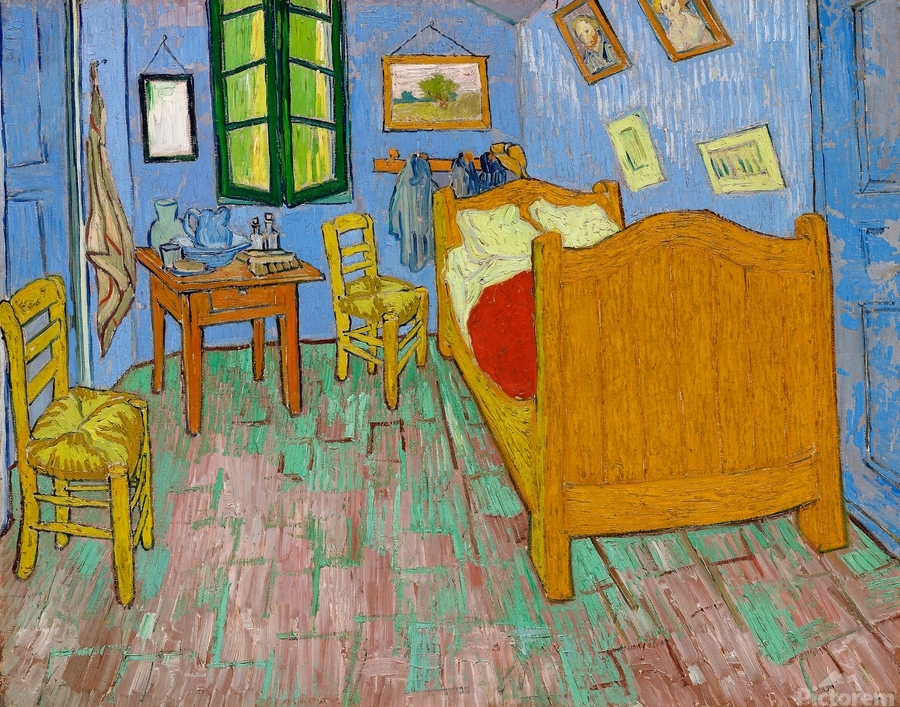
BEDROOM IN ARLES | THE BEDROOM | 1889 | VINCENT VAN GOGH

Chittaluri Satyanarayana’s river bed

river bed
the sound of water still
beneath my feet

Chittaluri Satyanarayana (India)
(published in haikuKATHA on 11/13/2022)

Commentary

The river bed in this haiku could still be wet or dry. Perhaps both the river bed and the poet carry the memory of the river. It’s interesting to note that human beings are mostly water. Indeed, there are many rivers inside of us. As we carry memories, it seems water too carries memories, though I appreciate how a river is timeless because the water is always flowing. I think this haiku could be about drought, possibly due to climate change. Against this sad sight, I’m also filled with hope that the landscape will be revitalized with the flowing river once again.

Jacob D. Salzer

This haiku reflects subtle, meditative, and deep experiences that leave deep impressions. It’s our state of mind and heart that binds us with our surroundings and sometimes, there comes a point when our senses sync together to experience unique happenings that a person waits for their whole life.

The river bed as a concrete part not only shares the secrets of different regions from where it passes through but shows a deep connection of nature with human nature through a common feature which is soil. One cannot see it with the naked eye but one can surely feel what a riverbed holds and offers to those who want to unfold the stories of its unending journey.

After being connected to the river bed, the first thing we can feel is the sound of water which is not an ordinary sound. It seems more musical and rhythmic where the waves of water pass through one’s feet and change the rhythm. The word ‘still’ may indicate the quiet of the mind or mindfulness when the person is experiencing the ‘here and now’. It may also reflect the slowing down of the flow of water—the calmness both within and outside. It’s the highly subtle experience of meditation when everything converges to one point which brings tranquility.

‘Beneath my feet’ is a shift in this haiku that binds the person to connect deeply with their surroundings. The feet, probably bare, have healing properties that help us to gain peace of mind after fatigue or stress. These healing points pass on tranquility from bottom to top i.e. from soil/earth to mind/brain where the impulses, like the waves of water, slow down our thought process and bring peace. The soil as a soft and passive element of nature clears our flaws, cracks, and voids in life as both the river bed and human body are made of early elements.

My concluding point is, that when all senses are deeply intact and in sync with nature, one can experience wonders in less than a moment. That type of experience can change the state of our mind and heart for good.

Hifsa Ashraf

What draws me into this haiku is its imaginative sense. There are multiple ways we can hear the water of a river despite it being dried up. It can come through daydreaming, imagination, hallucination, a nearby water source which is mistaken for the river’s flow, and more. The unsaid part of this haiku makes it stronger and more resonant.

If I had to place this poem in a season, I would say summer. Riverbeds commonly dry out during this season. Summer connects well to the idea of a flourishing imagination and an abundance of activity.
In terms of punctuation, there isn’t any. However, I don’t personally think it’s needed in this haiku. The line break in the first line works well to make a grammatical shift.

The pacing of the lines can be said to be the standard in the English-language haiku world, with a short first line, a longer second line, and a short third line. With the second line resting on “still,” it gains more focus and amplifies its double meaning.

Looking at the sound, a few letters stand out. In the first two lines, the letter “r” dominates and gives a sense of movement. Throughout the whole haiku, the letters “e” and “i” create a stark mood that resonates with the reappearance of the sound of water.

Ultimately, the haiku’s unique line break, strong sense of sound, and expansive space for the reader’s interpretation make this a well-crafted poem.

Nicholas Klacsanzky

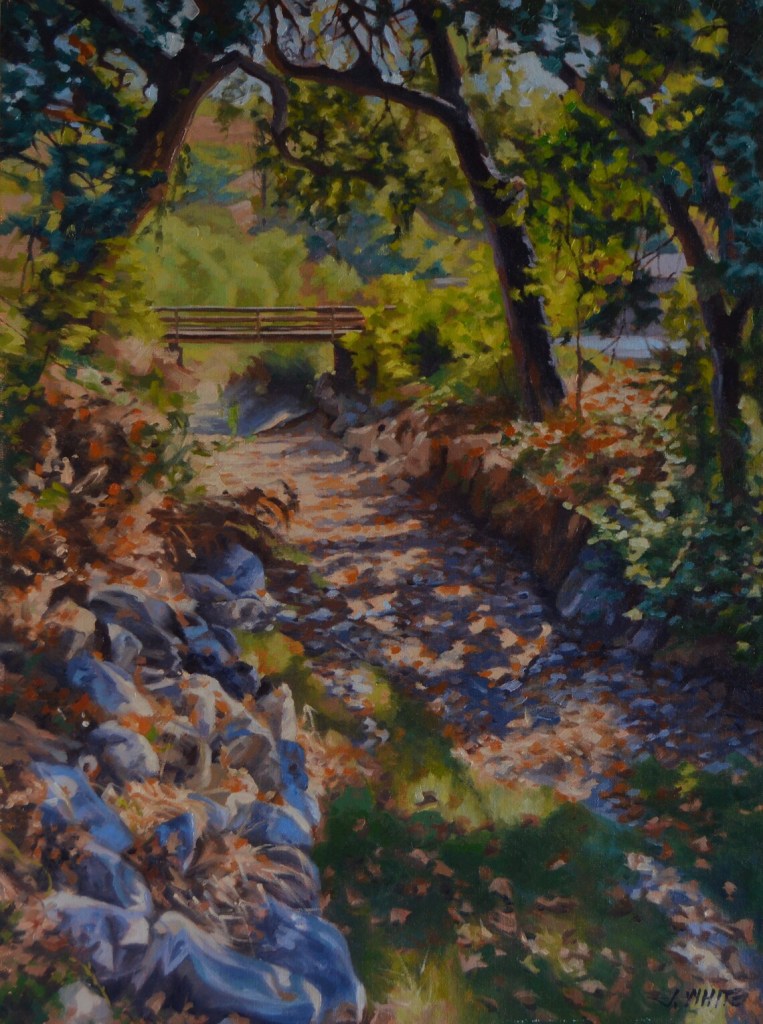
Painting by John White.