Agnieszka Filipek’s maidenhair fern

old church wall
maidenhair fern
climbing to heaven

Agnieszka Filipek (Ireland)
(previously published in The Remembered Arts Journal)

Commentary

In the first line, we get an image that communicates limitations and history. The word “old” in relation to the church wall is relative, given the structure stands on Mother Earth, who is much older. But of course, the old church also carries many years and memories within its walls. 

The focus on the church wall itself could be an image of old church ruins, though not necessarily. This interpretation could bring a sense of loss for people who once identified with the old church as part of their identity. Now all that remains could be fragments of its walls.

In the second and third lines, I feel a spiritual liberation, outside the confined physical and psychological walls of the church. I am reminded that Mother Earth Herself is the original cathedral, in which wisdom is not found in words, but in spiritual energies and silences. I am also reminded that stone structures will not stand the test of time, but Mother Earth has and prevails.

This is an important haiku that offers a portal into the limitations of certain organized religions and their architecture, juxtaposed with the ancient and mysterious power & silences of Mother Earth and the afterlife. A powerful haiku.

Jacob D. Salzer

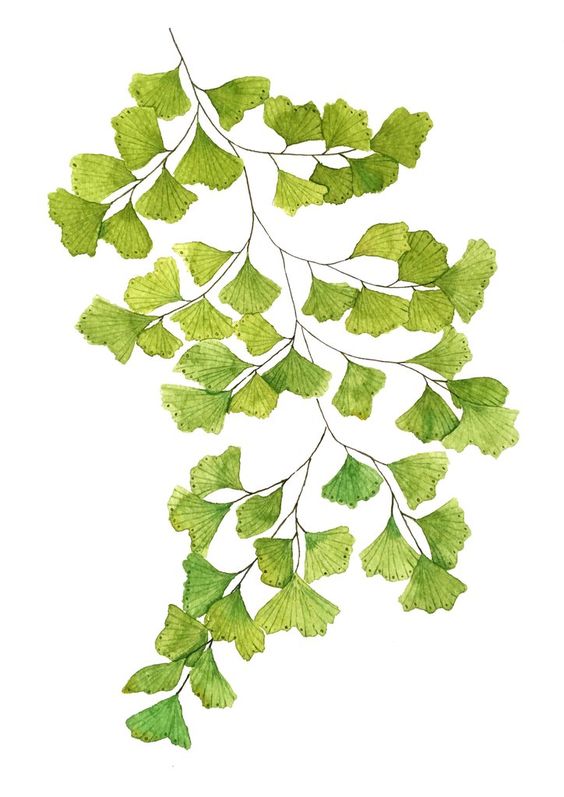
What drew me to this haiku was the image of the maidenhair fern climbing to “heaven.” There are a few things to unpack here. The lovely shape of maidenhair fern leaves is a sight of beauty, charm, and sweetness. This in contrast with the old church wall makes for a striking image. Also, maidenhair ferns have religious and/or spiritual significance, as noted by the website The Joy of Plants

“The scientific name Adiantum derives from the Greek and means roughly ‘does not get wet’. When it rains the stems droop and the water rapidly slides off the leaves, so that the plant itself does not appear to become wet. In the symbolism of plants the maidenhair fern therefore represents purity and innocence, meanings that also recur in the ancient legend that said that someone is still a virgin if they can hold a branch of maidenhair fern without the leaves moving.”

The mention of a virgin should direct you to the Virgin Mary, with various interpretations. But, it seems what is of more importance is that the fern is a symbol of purity and innocence in a place such as an old church. It gives me a thought of paganism versus organized religion and how the elemental world may once again reclaim power over our lives in the current international decline of religious fervor. This haiku also makes me contemplate how the natural world reclaims human-made structures with grace and quiet. 

The word “heaven” can relate to a religious heaven or the physical heavens or cosmos. There could also be a painting of heaven in the old church that the fern is climbing towards. 

In terms of kigo, or a seasonal reference, the maidenhair fern is found in Ireland from June to September. So, maybe it is a summer-to-early-autumn kigo. This haiku does not have punctuation or any other approximation to kireji (cutting word), but there is a clear grammatical break after the first line. Looking at the pacing, the lines do not follow the usual English-language haiku lengths of a short first line, a longer second line, and a short third line. However, I find making the last line longer as if the climb to heaven is arduous is suiting. Finally, the soft sounds of the letters “o” and “l” provide sensitivity to the reading. 

This is a haiku with judicious use of imagery and symbolism. It drives us to contemplate religion, the natural world, and original innocence. 

Nicholas Klacsanzky

This is one of the best examples of metaphoric haiku where the opening line ‘old church wall’ makes it significant as it sets the direction. I wonder whether it is about a physical wall or used as an analogy where something protects or sets limits for certain beliefs. I take it as a traditional practice of religion or something/someone that holds their beliefs firm no matter how difficult the path is.

The maidenhair fern is quite delicate, though it can survive in a moderate environment. I see it as how balanced thoughts and beliefs help someone to achieve eternal blessings that may be referred to as ‘heaven’ in this case. The simple message behind this haiku may seem religious but it represents something universal: a way to live life by following the moderate path. This path can be rewarding here as well in the hereafter and brings happiness and satisfaction which one seeks as the most significant purpose of life.
Hifsa Ashraf


Painting by Joni Murphy

Hassane Zemmouri’s butterfly hunt

butterfly hunt…
the child comes back
with a wounded knee

Hassane Zemmouri (Algeria)
(published previously in Kontinuum, Issue 3, July 2022)

Commentary

I feel that this haiku is possibly written from a memory of the poet’s childhood, as butterfly hunting was much more common in earlier times. It could also be a parent or grandparent teaching the child how to hunt butterflies in this modern day. In any case, this haiku displays innocence and the power of nature. The twist at the end can make the reader believe that the butterfly hit the child on the knee, which is at once humorous and a reminder of nature’s sway over us. Most likely, the child tripped and/or fell while running after a beautiful specimen and scraped their knee. In the child’s attempt to disturb another being, a lesson is learned about how powerless we are in the face of the natural world: even an entity as minuscule as a butterfly can escape our ingenious ways.

I could not help, as an American, thinking about the Wounded Knee Massacre (better known as The Battle of Wounded Knee). Though the poet is from Algeria, I felt the haiku has resonance with this event in that it was an attack on innocence. As History.com states:

“On December 29, the U.S. Army’s 7th Cavalry surrounded a band of Ghost Dancers under Big Foot, a Lakota Sioux chief, near Wounded Knee Creek and demanded they surrender their weapons. As that was happening, a fight broke out between an Indian and a U.S. soldier and a shot was fired, although it’s unclear from which side. A brutal massacre followed, in which an estimated 150 Indians were killed (some historians put this number at twice as high), nearly half of them women and children. The cavalry lost 25 men. The conflict at Wounded Knee was originally referred to as a battle—the Army troops involved were later rewarded with Medals of Honor—but in reality it was a tragic and avoidable massacre. Surrounded by heavily armed troops, it’s unlikely that Big Foot’s band would have intentionally started a fight. Some historians speculate that the soldiers of the 7th Cavalry were deliberately taking revenge for the regiment’s defeat at Little Bighorn in 1876.”

This haiku can also be a general symbol of the consequences of attacking guiltless parties out of ignorance, which can be seen throughout history in almost all regions of the world. 

So, this haiku, from my perspective, has a mix of humor, tragedy, and history. Through its simple language and ending twist, it implies a poignant message. 

Nicholas Klacsanzky

Is it a hunt for a butterfly or something more subtle, invisible, and deep? This was the first thought that came into my mind when I read this haiku. A butterfly hunt is not as easy as it looks, especially when a person is not fully focused. I see it as if a child wants to follow their dreams or is curious about the trail of a butterfly, which is usually mystical or difficult to trace. It shows how a curious mind looks deep into certain realities of life that cannot be easily grasped or comprehended. More specifically, this moment could be about how a child goes on an expedition that is beyond what is unseen but still exists—maybe a pursuit of fantasies or dreams tickled by their imagination. The ending is more dramatic in this case, especially when one strives to go beyond certain realities, or struggles with what path to take to kill a certain curiosity or to understand the subtleties of life.

On the other hand, I see this as a retrospection where a person regresses to their childhood, which was more memorable or contains deep memories. Butterflies may symbolize life, dreams, or happiness here and the child struggled hard to achieve joy or goals from the beginning. It also gives us a lesson about how we cannot achieve anything without struggle, with a physical one manifesting as a wounded knee in this poem. Overall, this haiku illustrates the crux of life: there is no shortcut to achieving something of significance.

Hifsa Ashraf

I feel this haiku speaks of consequences, the limits of human thought patterns/mental programming, and the gentle (and bold) power of Mother Earth.

On first read, the word “hunt” seems to imply wanting to conquer and capture the butterfly. The reasons are unclear, but I feel the child likely has a mix of curiosity and the desire to dominate, perhaps with the intent to put the butterfly in the box of scientific analysis. We don’t know how old the child is in this haiku, which creates a range of interpretations and meanings, as Nick and Hifsa have expressed.

The butterfly could be a summer or spring kigo. Either way, in the end, I feel the butterfly in this haiku got away. 

Butterflies play a vital role in pollination and complex ecosystems. As is stated on the Portland State University website:

“[Butterflies] are also extremely important ecologically. Butterflies pollinate flowering plants and serve as food for other organisms, thus forming an important link in the food chain. Populations have declined in recent decades, owing to increased pesticide use (especially herbicides); loss of fencerows; urbanization and other destruction of habitat; and loss of caterpillar host and nectar plants. Managing your garden for butterflies can help conserve butterfly populations as well as greatly enhance a traditional garden.”

Source: https://extension.psu.edu/gardening-for-butterflies

In terms of sound, the soft and long “o” sounds in the haiku carry gentleness, while, in contrast, the hard “t” and “k” sounds have a bold and immediate emphasis.

In the end, while science has its place, I feel if we only see through its limitations we can become blind to the spiritual power and mystery of Mother Earth. This haiku reminds me that curiosity has its limits and dangers as well. I feel a balance is needed between Science and Spirit, between wonder and logic—otherwise, as a species, if we lack sensitivity and reverence, we may take the consequences. 

An interesting haiku with layers of depth, significance, and meaning.

Jacob D. Salzer

“The butterfly hunt” by Berthe Morisot  (1841–1895)

Kala Ramesh’s wood-deep echo

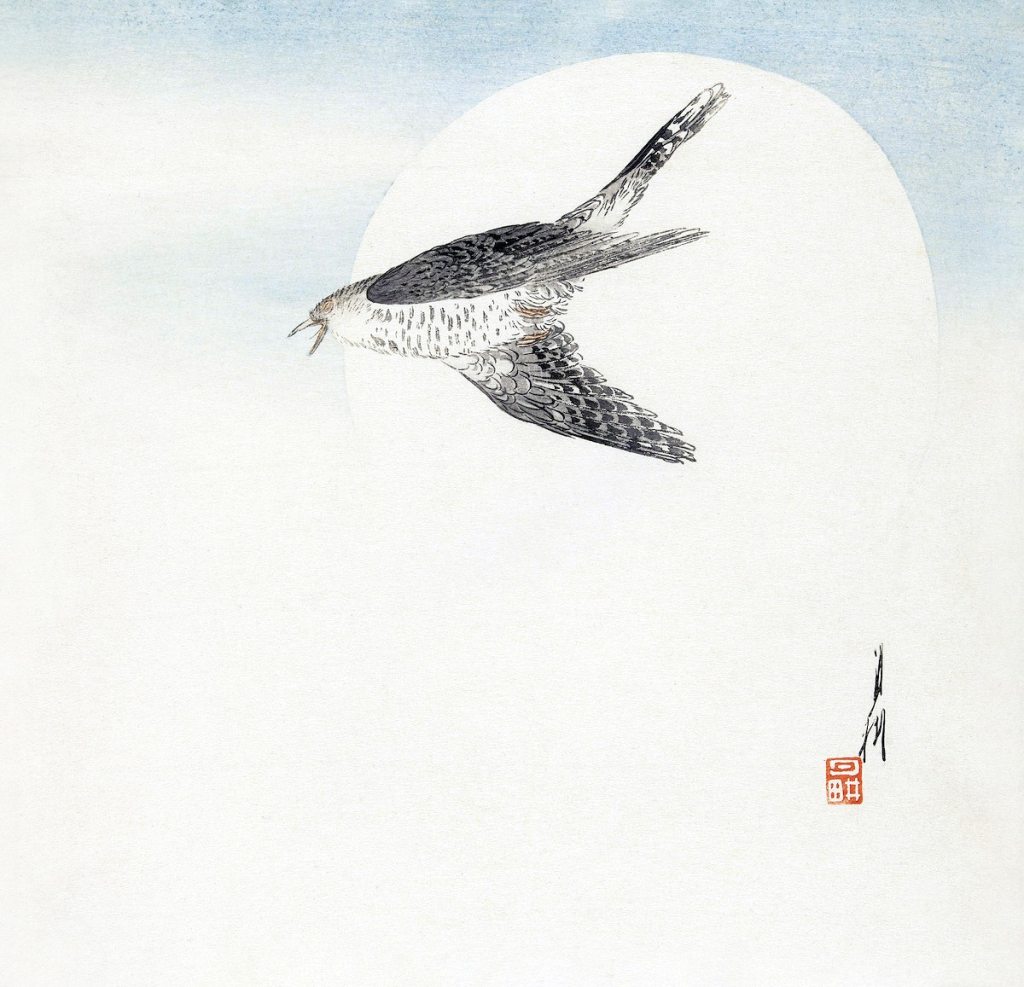
again the wood-deep echo of a cuckoo’s song

Kala Ramesh (India)

(previously published in Heliosparrow Haiku Journal, March 2021)

Commentary

I appreciate the synesthesia between sound and imagery in this monoku. “wood-deep echo” harbors a deep silence that is beautiful, mysterious, and almost haunting. I also visualize the cuckoo’s song resonating with the rings hidden inside trees. This creates a sense of harmony where the cuckoo and the forest have become one. I can hear the cuckoo’s song and echoes resonating within the poet’s quiet presence as well. I experience this myself as I read this too. I am transported into the scene. I can imagine the cuckoo’s song creating ripples in consciousness itself and perhaps simultaneously extending into past lives and the future.

This is an excellent monoku with depth, meaning, and a strong atmosphere.

Jacob D. Salzer

This monoku has a series of variations that make it dynamic and deep. I read it in many ways to get the layers of various themes that the poet tried to discuss.

It starts with ‘again’ which means there is a repetition of whatever is following it. It also shows the curiosity of the person who is passing through the same experience again and enjoying it fully.

The wood-deep echo may allude to memories, news, imagination, or illusions that a person feels or listens to due to deep silence, meditation, or wind. However, it seems the person has a deep connection where they want to hear what is pleasant to the ears or what is more distinctive than other voices. This also reflects a state of mind that is calm, still, and focused. A cuckoo’s song refers to something special—like in Indian mythology, a cuckoo’s song is related to the beginning of the monsoon season.  

Overall, it is a deeply personal experience of a moment that connects the person with what is going on and what is coming after. It also signifies the relationship between nature and human nature that is tightly woven with the senses. I see it as meditative where a person tries to attune to the cuckoo’s song which brings joy in their life sooner or later. 

Hifsa Ashraf

As Hifsa mentioned, the cuckoo’s song is commonly a harbinger of the monsoon season. Since the poet is from India, this can be said to be a kigo (seasonal reference) local to this country. Traditionally, the cuckoo is a kigo for about every season in Japan and a beloved bird of that country. A famous haiku magazine in Japan is named Hototogisu (cuckoo), which started in 1897.

There is no kireji, or cutting word, in this haiku. However, there is a grammatical pause after “again” which makes the haiku either two parts or one. In the English language, kireji are not commonly used in one-line haiku.

Even though there is only one image at face value, there are two considering the word “again.” The depth and ethereal nature of the cuckoo’s echo is repeated with all of its richness. The echo is wood-deep perhaps because some cuckoos nest inside trees. This richness of sound, when repeated, can bring about a sense of bliss and spirituality. The song is also a union of tree and bird, which makes it even more robust.

Kala Ramesh’s haiku often showcase euphony, and this monoku is no exception. The soothing “o”s and soft “n”s create a melodic reading—as if the cuckoo was singing through the haiku.

This haiku has a timeless feel to it, as I feel it can be read in any era and can resonate. A classic, yet modern work.

Nicholas Klacsanzky

Sumi-e by Ogata Gekko