R.C. Thomas’ silver lining

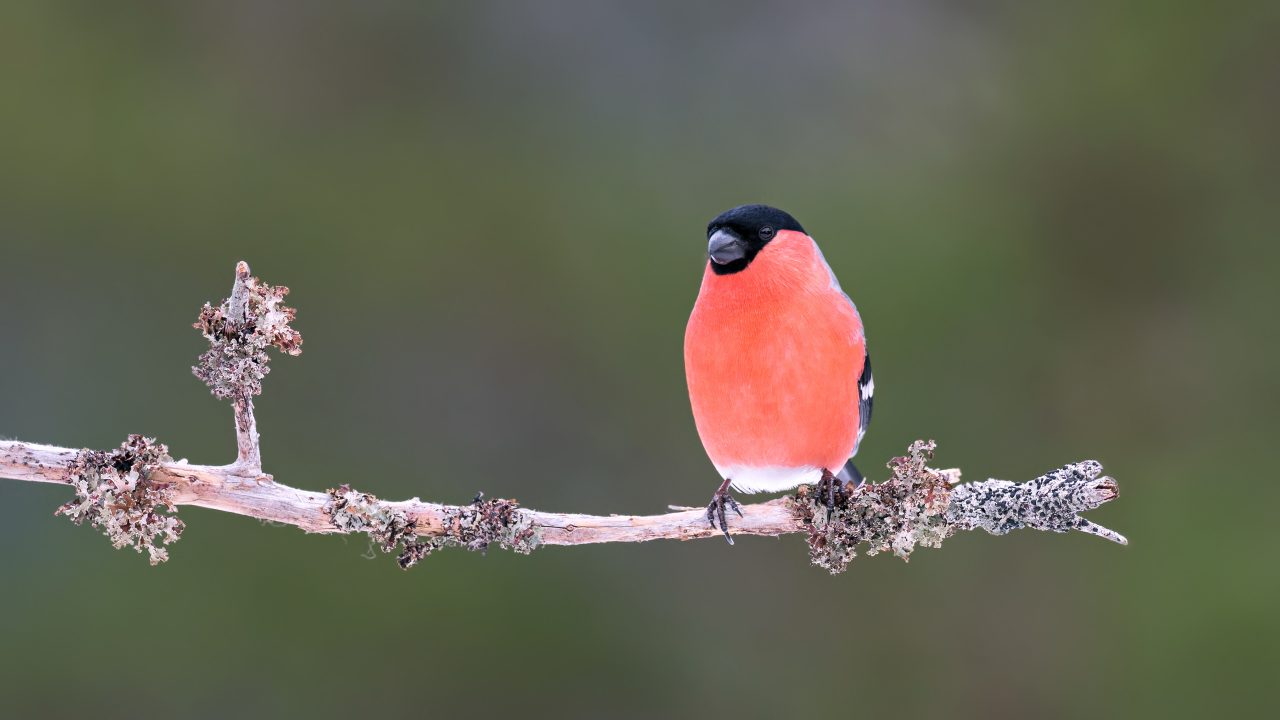
silver lining—
what the storm takes
from the magpie’s fable

R.C. Thomas (UK)
(Joint First Place, Sharpening the Green Pencil Haiku Contest, 2022) 

Commentary:

Magpies in various fables symbolize being prudent, wise, and cunning. A magpie in a fable, no matter who wrote it, is interesting and has a central place in the story. The bird itself is known for its self-centered nature that it uses to protect itself from threats. This haiku has cleverly placed the nature of a magpie by referring to a fable that centers on it. I may consider the fable as an allusion to empower the rest of this haiku. Irrespective of the discussion about the magpie being considered a good or a bad omen based on natural history, old literature has used this bird significantly in stories, poems, anecdotes, and fables, which shows how frequently it is connected with the daily lives of many people as a social bird.

Silver lining” is symbolically used to represent how easily we can get lessons from the birds around us, perhaps. The magpie, being a prudent and cunning bird, knows how to get something beneficial out of a difficult time, which is no less than a storm. I see a problem-solving aspect here where the poet tries to justify the nature of a magpie by giving it a central position and trying to convince us to see how things work when we use our minds actively and wisely no matter how hard the situation is. It also gives us a sense of realization that we as people are provided with many examples in our surroundings that can help us learn something positive. Just like in old times, people used to write fables inspired by nature and the creatures in their surroundings.

Now coming to the imagery of this haiku, I see it as black and white where the silver lining (light colour) blends with storm clouds (dark colour), and both are linked with the colours of the magpie. This can show how deeply our thoughts are linked with the shades of life and how they can reshape our approach to life.

Hifsa Ashraf

The personification of the storm in this haiku is interesting. I feel the storm is animated and full of Spirit. 
It seems the main message in this haiku is that words have power and have been affecting both humans and non-humans over thousands of years. It seems it is not only the words themselves but the energy, principles, and intentions behind the words that have significance and power. Along these lines, there are many interesting Indigenous myths and stories involving various birds, floods and storms born out of a deep reverence and respect for the Earth. I suspect there are fables about birds and storms in every culture. 

In regards to the storm in this haiku, in the book Black Elk Speaks, the Indigenous Medicine Man named Black Elk talks about his experience being in a colonized city for the first time. He says: “I was surprised at the big houses and so many people, and there were bright lights at night, so that you could not see the stars, and some of these lights, I heard, were made with the power of thunder” (Neihardt, page 135). In the notes, it says: “The Lakota word for electricity is wakhágli ‘lightning,’ hence “the power of thunder” (Neihardt, page 323). In other words, Black Elk had only seen electricity before in the form of lightning and he called storms and lightning Thunder Beings as a form of spiritual energy to be respected with reverence. 

In another interpretation, the storm in this haiku could possibly be a mental storm, perhaps caused and/or partly influenced by the fable itself. Along these lines, I think about the mistranslations and misinterpretations in some fables, and how words can be misused and abused. Unfortunately, as one example, some of the fables and metaphors found in certain religious texts are severely mistranslated and include stories of violence and dominance with a heavy emphasis on sin, fear, punishment and “my way or the highway” thinking. Furthermore, Divine Power is expressed in certain religious texts using only male “He” and “His” pronouns, consequently degrading the beauty and power of women. 

This is a consequence we all pay the price for and has clearly done a great deal of harm. In my view, if both men and women embrace the spirit of sensitivity and compassion within themselves, then we have a chance to make significant progress. 

Despite the negative consequences of certain fables, the silver lining in this haiku tells me the poet sees the bigger picture, and that the fable itself likely includes very challenging circumstances we can learn from. In short, depending on the fable, I see a potential mix of both negative and positive outcomes. Reading the fable itself could also perhaps inspire us to (pun intended) brainstorm better ones. If we look at the definitions of fable, we have: 

1) a short tale to teach a moral lesson, often with animals or inanimate objects as characters; apologue

2) a story not founded on fact

3) a story about supernatural or extraordinary persons or incidents; legend: the fables of gods and heroes.

4) legends or myths collectively: the heroes of a Greek fable

5) an untruth; falsehood: this boast of a cure is a medical fable

6) the plot of an epic, a dramatic poem, or a play

7) idle talk
Source: Fable Definition & Meaning | Dictionary.com

These definitions give us a better idea of what a fable is. In short, I see the word fable as a psychological portal into the human psyche.

The good news is, if the mind is conditioned, it can also be unconditioned. There are, indeed, many ways of seeing the world and many different ways of life. Even if someone has a specific philosophy or spiritual path, my sincere hope is they are also open-minded to other respectful, meaningful philosophies. 
I also strongly feel Mother Earth has many gifts we can all learn from. One of the greatest lessons I’ve learned from Mother Earth is the power of silence. It seems there is great wisdom in being quiet in Nature. This reminds me of a quote by Bashō: “Follow Nature and return to Nature.” Along these lines, when I read “magpie’s fable,” I initially heard stories of the bird’s life through his or her songs vs. human-made fables about the magpie. 

As a final interpretation, if taken literally, I can see light-hearted humor in this haiku as the storm has no ears to hear our human-made stories, nor does the magpie have English words to form the fable. The storm continues, and it will eventually pass, with or without humans and our stories.


Regardless of our interpretation(s), this haiku explores the deep psychological space between the human mind and Mother Earth. I think it also reminds us to be careful with our words and to be mindful of their effects and possible interpretations. An interesting and important haiku. 

 — Jacob D. Salzer

Hifsa and Jacob have explored this haiku in great depth. I’ll briefly comment on the kigo, kireji, toriawase, pacing, and sound of this poem.

The kigo, or seasonal reference, of this haiku could be between August and October since magpies are most active during this time. This makes this an autumnal haiku. The storm adds to this assumption.

The kireji, or “cutting word,” in this haiku is shown as the em dash in the first line. It successfully separates the two parts of the haiku while also giving us time to pause to imagine a silver lining.

The toriawase, or juxtaposition, is the association between the natural and fictional world. The wisdom and ingenuity of the magpie in fables are compared to a silver lining during a storm. A wonderful thought.

In terms of pacing, the length of the lines is a bit different than the standard in English-language haiku because the third line is long while it is usually short. However, the poet wrote the haiku organically and well-framed, because if the first line was placed as the third line, it would not be read as well. Also, the word “takes” is a fine place to cut the line to create suspense.

Finally, looking at the sound of the haiku, the many “i”s and “l”s create a combination of sharp and soft notes. This relates well to the rumble of a storm and the lesson of a fable.

A unique and fresh haiku with significant overtones.
Nicholas Klacsanzky

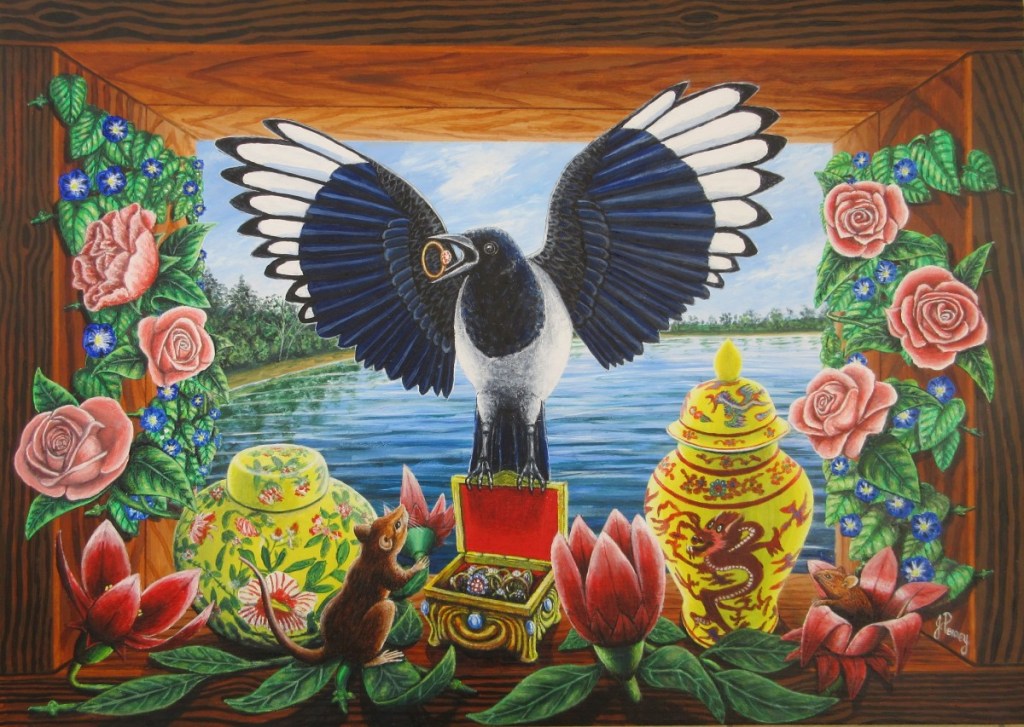
“Fantasy Magpie Fable.” Acrylic on deep wooden support by John Penney.
Arvinder Kaur’s margosa blossoms

shafts of sunlight
margosa showers blossoms
on the hopscotch

Arvinder Kaur (India)
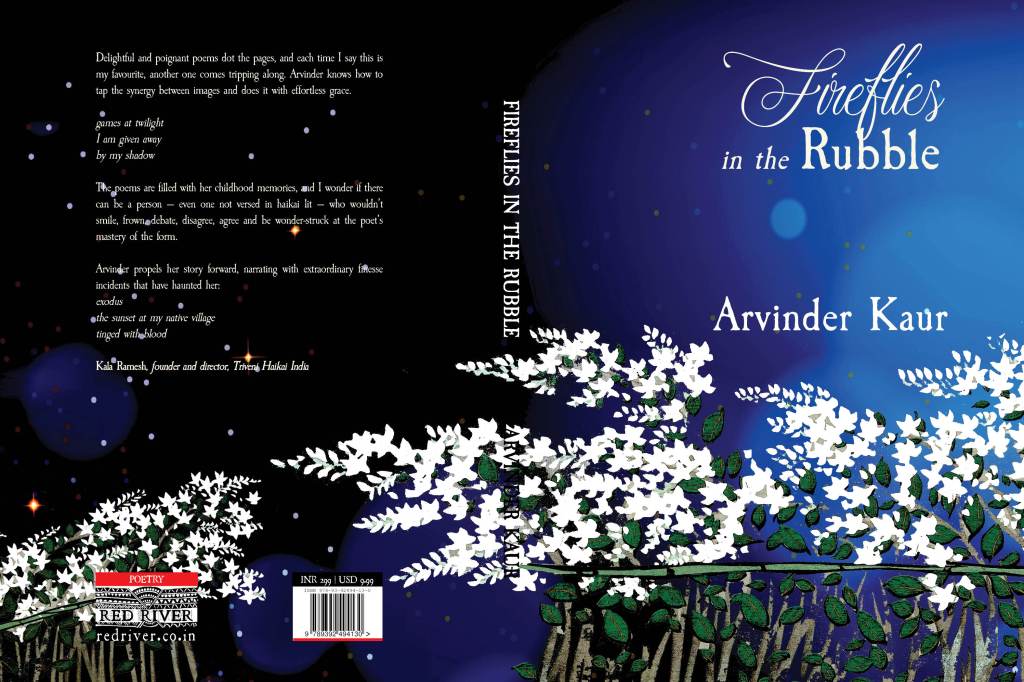
From her book Fireflies in the Rubble

Commentary

I am honoured to have read Arvinder’s book Fireflies in the Rubble. I also got many opportunities to work with her on various poetry collaborations. Out of many favourite poems, I selected this one for writing a commentary on. Like Arvinder, I feel nostalgic when I read this poem. There are many hidden feelings in this haiku that create yugen but still one can easily connect deeply with the overall imagery therein.

Shafts of sunlight are perhaps glimpses of the past—especially of childhood—that follow and bind us with sweet bitter memories. I also see this line as a reflection of one’s childhood status that put her in the spotlight as the center of her family. It also depicts subtlety about the particular place or venue, which is probably in the poet’s house. We have been given a full margin to let our imagination run wild and think of the place where sunlight highlights the significance of certain places that may stick to our minds and pull us towards them whenever we reminisce about them.

The margosa or neem tree is connected with healing and health as various parts of this tree are used in many home remedies and for herbal treatment. A margosa showering blossoms can look like the rain of flowers or an abundance of flowers that bring healing to unseen wounds or pain. I see it more as a sign of blessings where one enjoys one’s childhood without any worries and lives a carefree life.

The hopscotch is not simply child’s play but may also be a puzzle that takes us back and forth (memories) to solve them. It involves both physical and mental faculties when one plays it. I can imagine it as one of the most significant times of life where margosa blossoms may metaphorically be related to the laughter of children who are enjoying the early part of life with their friends and family. So, from sunlight to margosa and from margosa to hopscotch, I see the involvement of the key elements of nature, sky, wind, and earth, which shows the vastness of this haiku and the way our thoughts and feelings play around with them through either memories or imagination. 

In terms of the sound, the letter ‘s’ provides the tone of mystery and subtlety of this haiku, which is gracefully written about and allows us to explore more about this childhood story. 

Hifsa Ashraf

I appreciate the contrasts in this haiku: the formless light and the heavy, dense sidewalk; the dark clouds and shafts of light; the grey clouds and the vibrant rainbow of chalk colors; the soft blossoms and the hard concrete. When I read “shafts of sunlight,” I see the light breaking through holes in a cloud or in the spaces between clouds. I appreciate how the dark clouds could be implied in this interpretation. 

While hopscotch is normally found on sidewalks or city streets, I could also visualize the hopscotch in a narrow alleyway in a city, and the shafts of light could be formed by the steep buildings. In this interpretation, somewhere in the city, the wind has blown these beautiful flowers into what was once a dark alley that may often go unnoticed. 

When I looked up images of “neem tree flowers” online, the flowers remind me of stars. They are white and each flower has five petals. As the flower petals fall in abundance, I get feelings of hope, joy, and optimism that better days are yet to come. 

The descent of the flowers reminds me of how brief our human lives are. Our bodies will eventually dissolve back into the earth, just like these beautiful flowers. This is juxtaposed with the youthful energy that hopscotch brings to mind, along with childlike innocence and imagination. In this sense, I see life cycles in this haiku. To echo what Hifsa has said, perhaps this haiku could speak of returning to our childlike imagination, to dream like we did when we were children, and to find beauty in simple things. Perhaps this haiku could also be a metaphor for nonattachment and letting go, as the flowers are released from the neem tree, taken by the wind. 

In short, a poignant haiku that speaks to impermanence, hope, and finding beauty—even in dark times. 

Jacob D. Salzer

The seasonal reference, or kigo, is most likely spring due to blossoms being mentioned. Hopscotch is also representative of fun and play that is common in spring and possibly summer.

I admire the “as above, so below” aesthetic with shafts of sunlight (above) being compared to showering blossoms landing on the hopscotch (below). The sunlight gives energy and life to the margosa tree in streams of light and the tree later “streams” down in the form of blossoms. The ending image is wonderful with nature playing a human game, even though it is done inadvertently.

There is no kireji or punctuation to represent a “cutting word” to separate the two parts of the haiku. However, the line break after the first line creates a separation between the fragment and phrase. If it were me writing the haiku, I might have added an ellipsis to illustrate the motion of the showering blossoms. But, this is a stylistic choice rather than a necessary one.

The length of the lines is common for English-language haiku, with a short first line, a longer second line, and a short third line to represent the traditional rhythm of Japanese haiku approximately.

What I find intriguing is a lack of an article in the second line before “margosa” because, in my head, I add “a margosa.” However, with three (possible) nouns in a row, it could be read as “margosa, showers, blossoms” or “margosa showers, blossoms.” I believe the poet wrote it in a way with an intuitive article, though.

This haiku is teeming with positivity within its layers and imagery. I wish Kaur the best with her new book, Fireflies in the Rubble, and I hope her good energy spreads far and wide.

Nicholas Klacsanzky

You can purchase Kaur’s book on Amazon: https://www.amazon.com/Fireflies-Rubble-Arvinder-Kaur-ebook/dp/B09THDGWC4

Front and back cover of Kaur’s “Fireflies in the Rubble”

Mona Bedi’s pottery class

pottery class
i embrace the broken
pieces of me

 — Mona Bedi (India)
First Place, Indian Kukai, #38, 2022

Commentary

The overall imagery of this haiku is apparent as there is little mystery involved here. But, it gives us deep feelings about the self, often known as the inner self. It’s an introspection where the poet has created an analogy between her feelings about herself with pottery. Clay is the element that binds us to this haiku in many ways. If it is introspection, the poet may try to share her broken self, flaws, past experiences, hardship, etc. Taking a pottery class can be taken as catharsis where the focus is not only giving venting feelings and emotions but also reshaping or remoulding the self that is still suffering or dissatisfied and trying to find peace. There is a glimpse of wabi-sabi in this haiku where you accept yourself the way you are as the word ‘embrace’ indicates and focuses on self-healing by practicing optimism and positivity.

The mystic element in this haiku is also obvious in this haiku where the words ‘pottery’ (clay), ‘broken pieces’, ‘I’, and ‘me’ depict how silently one passes through the process of transformation and goes beyond nothingness gracefully. According to Sufism, the connection between the self and clay is quite subtle and deep. It shows the humility and modesty of being, where deep understanding takes us on the journey of ‘knowing thyself’.

The sounds of ‘p’ and ‘m’ in this haiku may depict the rhythm of the thoughts and feelings that are still not on the surface. The letter ‘i’ may show how humbly and keenly a person makes themselves ready to pass through the journey within, which can take them from unknown to known. 

Hifsa Ashraf

This is a powerful haiku that expresses psychological healing and recovery. I feel acceptance and self-love in the phrase “i embrace the broken pieces of me.” In this haiku, “broken pieces” seem to be symbols for past psychological trauma that carry a heavy connotation. However, the word “embrace” gives me a vision of all the broken pieces coming together, while still honoring each piece as a unique place in our being. Furthermore, in a pottery class, there is a sense of community with the students and teacher. It seems this inclusiveness brings psychological cohesion and unity where the poet is no longer alone on her path of healing.

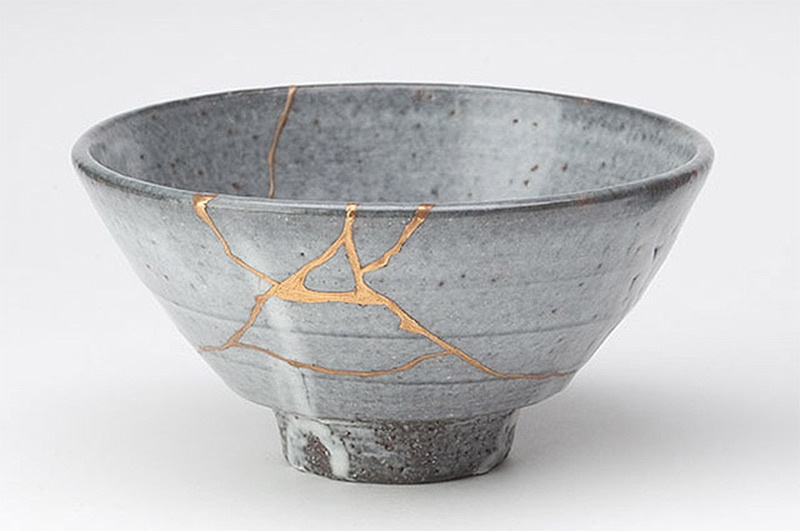
Along these lines, this haiku immediately brings to mind the ancient Japanese art of kintsugi. Here are some quotes that demonstrate how powerfully kintsugi relates to this haiku: 

Kintsugi (golden joinery) is the Japanese art of repairing broken pottery with lacquer dusted or mixed with powdered gold, silver, or platinum, a method similar to the maki-e technique. As a philosophy, it treats breakage and repair as part of the history of an object, rather than something to disguise.” “Kintsugi became closely associated with ceramic vessels used for chanoyu (Japanese tea ceremony). As a philosophy, kintsugi can be seen to have similarities to the Japanese philosophy of wabi-sabi, an embracing of the flawed or imperfect. Japanese aesthetics values marks of wear by the use of an object. This can be seen as a rationale for keeping an object around even after it has broken and as a justification of kintsugi itself, highlighting the cracks and repairs as simply an event in the life of an object rather than allowing its service to end at the time of its damage or breakage. Kintsugi can relate to the Japanese philosophy of “no mind” (mushin), which encompasses the concepts of non-attachment, acceptance of change and fate as aspects of human life.” “Not only is there no attempt to hide the damage, but the repair is literally illuminated… a kind of physical expression of the spirit of mushin….Mushin is often literally translated as “no mind,” but carries connotations of fully existing within the moment, of non-attachment, of equanimity amid changing conditions. …The vicissitudes of existence over time, to which all humans are susceptible, could not be clearer than in the breaks, the knocks, and the shattering to which ceramic ware too is subject. This poignancy or aesthetic of existence has been known in Japan as mono no aware, a compassionate sensitivity, or perhaps identification with, [things] outside oneself.

— Christy Bartlett, Flickwerk: The Aesthetics of Mended Japanese Ceramics”
Source: Kintsugi – Art of Repair | Traditional Kyoto

With kintsugi in mind, it seems traces of past trauma may never be fully erased from our individual and collective memory. However, by joining the fragmented parts of our self, I feel the broken pieces can become transformed or transmuted into a larger sense of purpose and unity. In this haiku, it seems the sharp edges that once defined each piece have now blended into a deeper compassion. Perhaps by mending the pieces together, we can also recognize the lessons our past has given us to help protect ourselves and prevent future harm. Interestingly, while this haiku is personal, I think the healing theme of this haiku could apply to families and larger communities that appear to be fragmented or broken. As one example, in some areas of life, I see the United States of America as a divided nation because so many subjects seem to divide people. With this in mind, if we consider thinking of this haiku with the phrase: “i embrace the broken pieces of my family,” “i embrace the broken pieces of my community,” or “i embrace the broken pieces of my country,” perhaps these could be healing phrases for a larger community context because it seems the first step to healing is acceptance—recognizing the broken pieces as they are. 

Along these lines, it seems fragmented communities start with fragmented individuals. If peace and unity are felt within individuals (if their broken pieces are mended together within their own self), then it seems that fragmented unity will be reflected in the world. In short, it seems larger community healing starts from within each individual. Fortunately, according to quantum mechanics and several philosophies, we are not alone and the sense of being an isolated, separate person or individual is not as concrete as it appears to be. Rather than supporting rigid individuality, science and several philosophies—including indigenous ways of life—tell us that all of life is connected.
 
In regard to quantum mechanics, here is a powerful quote that resonates with this haiku: “When quantum systems interact, the result can be the creation of quantum entanglement: their properties become so intertwined that a description of the whole solely in terms of the individual parts is no longer possible.” Source: Quantum mechanics – Wikipedia 

Along these lines, it seems by embracing the broken pieces within us, eventually, even the very sense of “me and mine” as a mental concept may ultimately dissolve into a spiritual energy that is universal. 

In short, this is a powerful haiku that speaks of acceptance, compassion, and healing. I feel it also symbolizes the gifts of our individuality in the context of a universal consciousness. 

Jacob Salzer 

I have little to add after such excellent and deep commentary from Hifsa and Jacob. I would like to comment on how this haiku is kigoless, or without a seasonal reference. This is definitely fine, since haiku written without kigo goes back all the way to Matsuo Basho and more specifically with the free verse movement of haiku in Japan. I would not say this is a senryu because it is not irreverent or cynical in nature.

Though there is kireji or punctuation acting as a “cutting word,” it is implied by the line break in line one. As Hifsa noted, there is no juxtaposition here but rather an association between the clay and our bodies or self. The length of the lines follow the standard for English-language haiku with a short first line, a longer second line, and short third line to match the traditional rhythm of Japanese haiku.

As Jacob discussed, I think it is important the poet decapitalized the “i.” It is a way to step away from the ego and to distance oneself from egoic thought.

The enjambment, or break in thought, on the second line is unique. In haiku, we don’t usually use enjambment, but I believe it works well here. The word “broken” is appropriately broken off from the rest of the phrase. Perhaps it lends to separate readings for the last two lines, respectively.

A clear haiku that strikes deep emotional and philosophical tones.

Nicholas Klacsanzky

Image from Wikipedia Commons