John Pappas’ fossil galaxy

fossil galaxy
headlights speed 
from dark to dark

John Pappas (USA)

Commentary

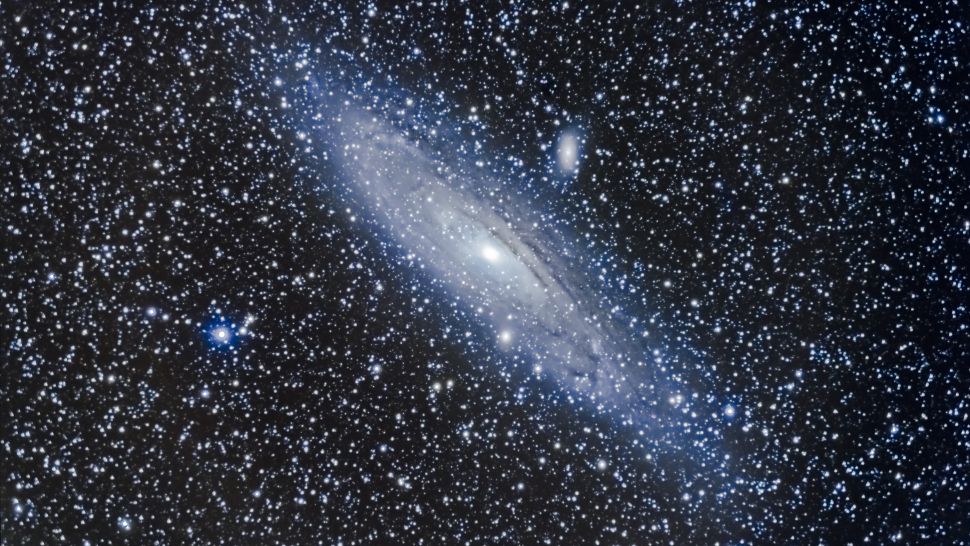
A common understanding of a fossil galaxy is that it’s a remnant of an older galaxy that existed within a current galaxy. It’s something left behind after many years for us to think over, get some lessons from, and see how things are temporary and worthless over time.

When I see a fossil, my thoughts go back to a time when that fossil had a life—maybe even an integral part of life or the environment at that time. A question comes to my mind: “why does nature preserve fossils for us?” There is a simple logical answer: “so that we can remember our history or past.” A fossil galaxy shows us the marvel and perhaps the waste of this universe that discards many elements with time but doesn’t abandon them—estrange its parts but allow them to be present.

Life is like that for us: we discard many things that were once the most valuable part of our lives but they keep circling our minds. Certain things get preserved in our memories like a fossil. We may not give attention to them, but they may elate or haunt us in the later part of life. So, I take ‘headlights speed’ as flashback memories that come to remind us of what’s in our past and how we reach this point after passing through, dark to dark. The word ‘dark’ may depict dreams (particularly nightmares) that remind us of the remnants of difficult times we try to push back in our heads.

However, the connection between our mind and space is so deep as can be observed in this haiku, where we try to connect with the galaxies outside and the galaxies within through our thoughts, memories, reasoning, logic, and analysis being an integral part of this universe. The dark is a background, whether it is our life or space that brings our history to light.

Hifsa Ashraf

It seems there are galaxies within galaxies—both inside of us and beyond us. This idea is poignantly brought down to earth, quite literally, in this haiku but also (pun intended) leaves space for our imagination and dreams. 

The fragment of this haiku “fossil galaxy” is intriguing, as it marks traces of an ancient galaxy. I also interpret “fossil galaxy” as the Milky Way Galaxy when the dinosaurs roamed Earth. In both interpretations, I appreciate the time-warp perspective in this haiku. 

The phrase “headlights speed from dark to dark” brings to mind a time-lapse of a highway, with cars moving at night and I see stars rotating above. “from dark to dark” could relate to the pollution caused by cars and other motor vehicles, unfortunately contributing to carbon in Earth’s atmosphere and climate change. If we look at the lifetime of a car, it originates from the darkness of Earth via raw materials; then factories produce pollution under the hum of electricity; then some parts of the motor vehicle are buried back into Earth. The good news is most parts of cars are recycled.

According to popularmechanics.com: “Fed by annual new-car sales that hover around 17 million, the U.S. automotive recycling industry reclaims some 750 million pounds of scrap each and every month…The automobile is the most recycled consumer product in the world — 95 percent of all vehicles are reclaimed. The rate far exceeds the numbers for recycling giants such as newspaper (74 percent), aluminum cans (51 percent) and glass (22 percent). And much of the reclaimed material winds up back in new cars: Coffee-stained carpeting becomes air-cleaner assemblies and chewed-up tires morph into brake pedals and floor mats…Still, as much as 25 percent of each car ends up in landfills. That’s largely because landfill space is still relatively cheap and the technologies to recover nonferrous material are still expensive.” Source: Where Your Car Goes to Die (popularmechanics.com)

“from dark to dark” could also be interpreted as returning to The Great Mystery or the Unknown. It shows just how brief our human lives truly are in the grand scheme of things. From one perspective, even a billion years is equivalent to a microsecond. For some, there could perhaps be a divine comedy in this view. 

In terms of “headlights speed,” I thought of all the devices we use that operate at close to the speed of light, such as sending text messages with our phones or sending an email. “It’s the electromagnetic wave rippling through the electrons that propagates at close to the speed of light…This makes the observable speed of electricity about the same as the speed of light: 186,000 miles per second.” Source: Quick Answer: Does Electricity Travel At The Speed Of Light – BikeHike (cyclinghikes.com)

It’s interesting to note that some stars have actually burnt out, but because they are so far away, their light still travels and appears to our human eyes on Mother Earth.
 
Interestingly, it seems galaxies are not just “out there” but also internal in our subconscious and our dreams. Just as a single seed gives birth to an entire forest with innumerable trees, it’s been said that the subtle samskaras or mental impressions give birth to innumerable worlds. This offers a different perspective because instead of the world and galaxies solely being seen as “out there,” they could also be seen as an internal/eternal phenomenon. 

Regardless of our interpretation(s), this is a haiku with depth, modern implications, and mystery. 

Jacob D. Salzer

With the desolation shown in this haiku, I would place the kigo or seasonal reference in either winter or fall. That being said, I’m not sure the implied kigo is that important to the quality of this haiku. In Japan and around the world, many haiku have been composed as kigoless.

Though there is no punctuation used, the line break in the first line could be said to represent a kireji or cutting word (though more accurately stated as a cutting character or sound) that shows the delineation between the two parts of the poem.

The two sections of this haiku are not too closely or too loosely connected, which illustrates the art of toriawase. The dark of the night connects with the dark of the universe. “Speed” can fit well with the idea of the speed of light. It is up to the reader, though, to see these connections and to see how they resonate with them. Well-written haiku like this one allow the reader to fill in their own gaps, though the poet leads them on certain paths of discovery.

Pacing in this haiku is pretty much standard for English-language haiku: a short first line, a longer second line, and a short third line. However, as we can see, the third line is a tiny bit longer than the second in this haiku. That’s fine because the traditional rhythm is kept with the elongated syllables in the second line.

In terms of sound, the most prominent letters are “l” and “d.” The “l” sounds provide a lightness to the reading as if to illustrate the ephemeral nature of the universe. On the flip side, the “d” sounds give a punch that brings about a sense of seriousness.

This is a unique and relevant haiku with potent imagery that drills deep into our imagination and search for meaning.
Nicholas Klacsanzky

Image credit: Alan Dyer /VW PICS/Universal Images Group via Getty Images

Paul Callus’ crescent moon

crescent moon —
the baby kicks            
inside her womb

Paul Callus (Malta)

Commentary

I appreciate how the crescent moon visually resembles the curve of the mother’s womb. There is a long historical and spiritual connection between women and the moon that can be traced back thousands of years in indigenous cultures. In the dark womb, it seems the seeds of unknown karma and samskaras (past mental impressions) are being brought to life.

I also see a playful quality in this haiku or lightness (karumi) when the baby kicks. At the same time, I appreciate how this haiku offers insights into life in the womb and how important this stage of life is. I’ve read that a baby in the womb can hear music, and this affects brain development. Classical music in particular has been shown to create more complex neural connections. The immediacy of kicks could also foreshadow the complex relationship between the mother and the child that develops over time.

In short, this is a dynamic haiku that expresses mystery (yugen), karmic impressions, and the complex relationship between a mother and her child. I also see this haiku as an expression of a mother’s unconditional love for her child. A powerful haiku. 

 — Jacob D. Salzer (USA)

As Alex Fyffe introduced me to a creative writing technique called synecdoche, so I see this haiku in that context where ‘the baby kicks’ represents the sign of a new life, hope, and connectivity.

This haiku revolves around all senses where the most obvious ones are sight, sound, and touch. The birth phase is beautifully related to the phases of the moon where the crescent moon symbolizes birth, the start of a new month, or a new beginning. If we dig deeper into this poem, we can find more analogies between the moon and the baby inside the womb i.e. delicacy, subtlety, and light. It seems the mother is keenly following the birth process where she counts every single day. It shows how excited she is about this new life and finds the kick to be a welcoming sign. The curve that is common in both cases may reflect the beauty of life that gradually passes through various phases before it’s in full bloom.

In a larger context, the relationship between cosmic objects with life on earth, especially human birth, is quite natural and interrelated. It shows the significance of the time and space we live in and how things are revealed to us during a new journey of life. 

Hifsa Ashraf (Pakistan)

Jacob and Hifsa explored the meaning and aesthetic of this haiku in great detail. I will dabble in the technical side of this haiku a bit more.

The kigo or seasonal reference of this haiku is “crescent moon.” It is a phase of a moon that can happen any time of the year, but it is often associated with autumn. With its sharp shape and mysterious air, the crescent moon is a classic haiku topic.

In the first line we also have the kireji, or “cutting word.” In English, we use punctuation to separate the parts of a haiku and give extra resonance, but in Japanese, kireji are actual words in place of punctuation. The dash is used well, with it illustrating the hard kick a baby can give within the womb. It also makes the reader stop a while to appreciate a crescent moon in their mind’s eye.

I like how the second line comes with a surprise in relation to the crescent moon, and the third line resolves why the baby is acting the way he or she is. We can assume in the second line it is about pregnancy, but the poet could have written anything, such as “the baby kicks/her diaper away.” The use of “her” is also important, as it claims the womb for the baby and not the mother.

The length of the lines are fairly standard for English-language haiku, but usually the second line is a bit longer to have a more lilting rhythm.

The two most prominent letters in this haiku is “s” and “o.” “S” here comes off as soothing and mysterious, whereas “o” elongate the syllables and make the reading leisurely. The “o” sounds also relate well to the shape of a moon.

Finally, I enjoy how to crescent moon could be a comparison of the shape of a woman’s pregnant figure, or the kick being similar to the sharp tip of a crescent moon.

Nicholas Klacsanzky (USA)

Painting by Charles Thomas

Carmela Marino’s first buds

first buds—
I dust the head
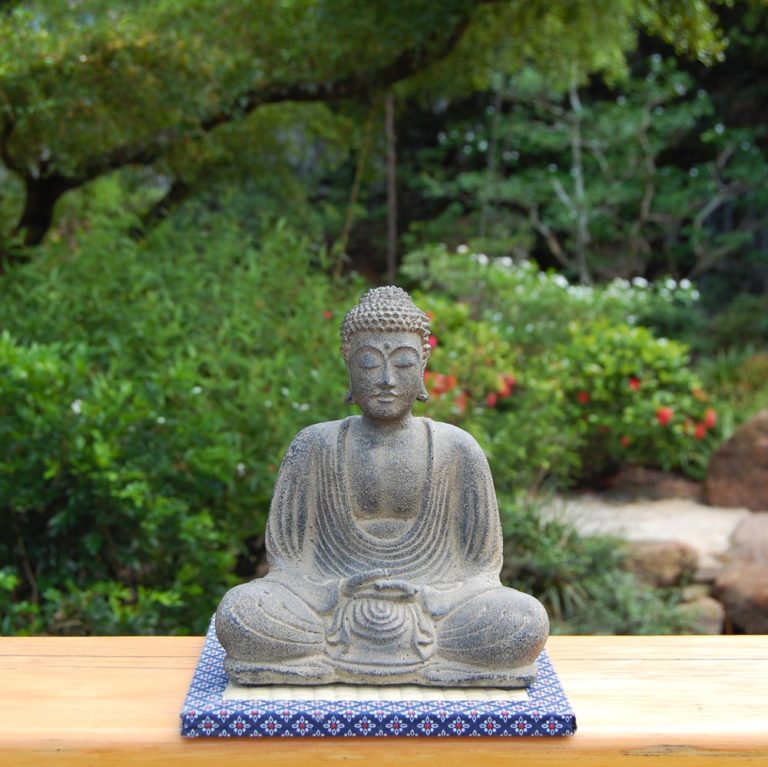
of a stone Buddha

Carmela Marino (Italy)
(previously published at the Golden Triangle Contest March 2022)

Commentary

This is an interesting haiku that touches both the hard and soft sides of life deeply and perhaps spiritually. The opening line ‘first buds’ gives some hope of spring—the season of new beginnings, or rejuvenation. The plural form of ‘buds’ makes it a bit mysterious where it looks like there is an abundance of buds on a branch, falling, or stuck on the head of a stone Buddha. But, when I take this haiku as a whole, I find it more intrinsic, more towards ‘self-enlightenment’ and/or ‘wisdom’ where buds can be the lessons of wisdom or Buddha’s philosophy unfurling in different phases of life as a sign of hope, progress, learning, and change.

It only needs some clarity, mindfulness, or crystallization of thoughts which is signified in the second line ‘I dust the head’ where the emphasis is beyond seeing i.e. introspection or meditation. I liked the way the poet blends both the delicate side of nature (buds) with the hard and concrete side of nurture (head) by masterfully using the technique of ekphrasis and yugen which may catch the eyes of many haiku lovers. 

Hifsa Ashraf (Pakistan)

I appreciate the contrasts in the juxtaposition. The flowers are soft: the Buddha statue is not. The first buds symbolize birth, while dust symbolizes death. The flowers are full of color, while the stone Buddha is not (unless he’s wearing a green moss robe). After Enlightenment, it’s been said the Buddha escaped the wheel of samsara: the endless cycles of birth and death. Actually, in a way, it seems this haiku succinctly expresses the essence of Buddhism by showing the nature of impermanence (symbolized by dust). The Buddha shows us that the mind’s attachment to what is fleeting and temporary creates suffering (while nonattachment reveals peace and ends suffering).

This haiku also brings to mind a quote by my favorite Estonian composer Arvo Pärt: “Time and timelessness are connected. This moment and eternity are struggling within us.” 

It seems impossible for the human mind to experience life that is timeless because the measurement of time seems to be hardwired into conditioned thoughts. Yet the timeless ever-flowing “now” is the only time we are ever alive. It seems the present moment is actually something the mind can never identify with because when it tries to describe the moment, it’s already describing a past event. Thus, it seems the experience of living in the timeless ever-flowing “now” is not a mental concept or idea, but rather seems to originate from the spirit without any words or thoughts. Of course, our measurement of time has its place in modern society. We frequently measure our lives in years, months, weeks, minutes, and seconds. We have work schedules, meetings to attend, and appointments to keep. In the world of jobs and making a living, time is money. However, this haiku puts our small human lives into perspective. One day, we will all physically become dust on the stone Buddha. Therefore, who am I?

Interestingly, the fact there is any dust to begin with made me initially envision a Buddha statue indoors somewhere. At first, I only saw human dust. However, on the second read, I see pollen and the poet is dusting the pollen off the Buddha statue in a garden or park somewhere. This also could be true. 

In regards to the first line, the flower buds could be symbols of hope for new generations. It’s also been said the Buddha gave his disciples a flower without speaking a word. This was a transmission of Enlightenment: a wordless unity that is devoid of thoughts. It’s also true that not all flowers bloom at the same time, but they naturally open to sunlight when the time is ripe. In a way, it seems the same could be said regarding our spiritual unfoldment. I also appreciate the saying: “When the student is ready, the master always appears.” For me, this haiku speaks to this quote as well, where the new buds are students. Perhaps most powerfully, without a single word, the stone Buddha guides us to look within, to become still and quiet. It seems only in those silent depths can I begin to realize his Spirit is not separate from my own Spirit. Perhaps eventually, ultimately, the master vs. disciple duality will seem to disappear. 

In short, this is a powerful haiku that expresses impermanence, the timeless flow of the present, and the teachings of the Buddha. 

— Jacob D. Salzer (USA)

Hifsa and Jacob wrote extensively on the meaning and interpretations of this haiku. I will in turn dive a bit into the technical world of this poem.

In the first line, we have a traditional kigo, or seasonal reference, for spring. “Buds” is fairly general, but I think the poet may have wanted to shy away from putting too much attention on the flower itself in order to focus more on the Buddha. Also in the first line, we see a dash used to separate the two parts of the haiku, which is the fragment and the phrase. This is another classical element of this haiku.

The second line brings in the action. Commonly, haiku only have one verb so that we can concentrate on one movement. Here, the “head” could be the head of a flower without reading the third line.

In the third line, we discover that the head is not of a flower but of a stone Buddha. I think it is important that the poet capitalized “Buddha” as she is not referring to not just any buddha but the Buddha in the form of a statue. She is treating this stone as the actual Buddha and giving it proper reverence. Dusting the statue’s head might signify cleaning or clearing the way to enlightenment, as with a clear mind, one can be in nirvana.

Looking at how the lines are arranged, we have a non-standard length of lines according to English-language haiku. The longest line is usually the second, but here it is the last. There is nothing wrong with this, especially since syllables and Japanese sound units don’t match up well. As long as the rhythm flows well and brings about a potent mood, which I think this haiku does. The rhythm present makes “Buddha” stand out more, which is not a bad thing at all.

We have some interesting usage of sound in this poem, too. The “u”s in “buds,” “dust,” and “Buddha” seem to provide a sense of reverence to me. The “b” sounds pop and make the haiku reading more powerful.

In terms of aesthetics, this haiku might show ba. According to Jim Kacian, “If you look up ba in any Japanese-English Dictionary you’ll find it means “place” or “site” or “occasion”. And these are all true in the most general sense—ba is a pointer to a kind of awareness that something of importance is happening in time and space.” I feel this haiku demonstrates a spiritual importance to the moment of dusting a stone Buddha’s head, where it plays with spirituality, physical objects, and manifestation.

An enjoyable haiku with multiple layers of spiritual and religious meaning.

Nicholas Klacsanzky (USA)