Haiku by Robert Hirschfield, John Zheng, Patrick Sweeney

heavy snow—
in the window
my buried name

Robert Hirschfield (USA)
Autumn Moon Haiku Journal, autumn/winter, 2024 

Commentary: I appreciate the psychological and philosophical depth of this haiku. The first line alone carries emotional weight as well in the word “heavy.” I think the dash puts more emphasis on the snow and also creates a long silence in the poem, which resonates with the deep snow. I also appreciate the window in this haiku that seemingly separates the “inside” from the “outside.” I see the window as the lens through which we see the world. As a meditation, this haiku reflects on human mortality and encourages us to reflect on our Earthly lives and life after death. I also appreciate how this haiku shifts the focus back to the beauty and power of Mother Earth who survives long after we are physically gone. I think the poet is writing from a place of genuine humility, as his name is literally and visually buried in this haiku in the last line. In turn, it seems our names are not as permanent as they seem to be. This haiku conjures up a few questions for us to consider: 1) What do we want to leave behind after our last breath on Earth? 2) Who are we without our names? 3) What are our thoughts on life after death? 4) Are we open to the Great Mystery? I think this haiku expands our perspective and asks us to consider how important our seemingly separate sense of individuality is in relation to life itself and the cosmos. I would argue that no one is ever truly alone in this world (or in the afterlife). It seems our unique individual selves are, in the end, expressions of one universal energy, just as each snowflake is uniquely different but made of the same substance. It also seems that all of life is connected in infinitely complex and mysterious ways that we can never fully comprehend with our limited minds. In short, this is a powerful and humbling haiku that encourages us to meditate on our identity, our Earthly lives, Mother Earth spirituality, and life after death.
Jacob D. Salzer

John Zheng (USA)

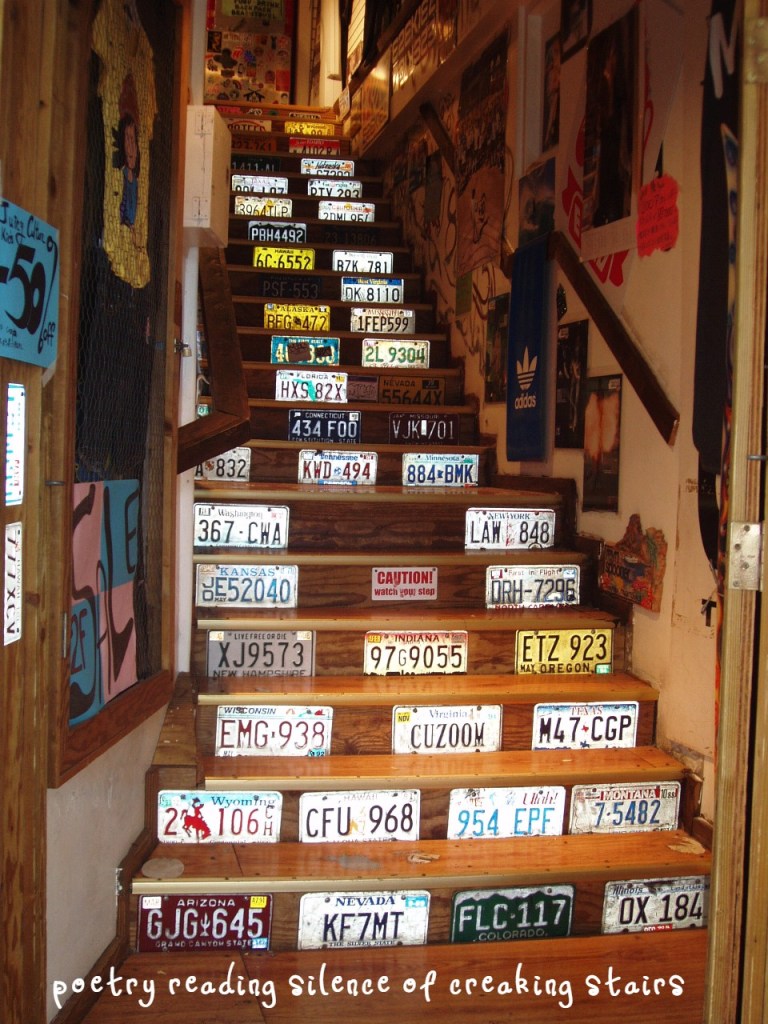
Commentary: When I looked at this photo haiku for the first time, it reminded me of a summer vacation in my childhood in my village. My grandmother used to tell us a story in an old-fashioned room in our family house where there was a wooden ceiling, creaky stairs, a charpai, and an ancient wooden door. We used to sit on the stairs listening to our late evening stories from her and there was complete silence in the room except for the wind that would pass through the gaps in the wooden ceiling. I can relate to this haiku very well. It seems like a meditative session where everyone is mesmerised by profound poetry that has enchanting effects on listeners. Reading poetry is an art that can bring all the senses to one point and make them not only listen to it but also absorb the vivid imagery or storyline. It suddenly stops the world around us and lets us relate it to our feelings and thoughts. 

I see another aspect to this photo haiku as well. It may depict the cessation of past routines of storytelling or reading. It may suggest that the poet is all alone and there is no one to listen to their poetry. The silence of creaking stairs could mean no one from the upper part of the house comes down. Maybe, once there were children or other household members who used to gather for poetry readings and now they have gone. It’s a simple yet deep photo haiku that depicts the irony of today’s fast-paced life where no one has time for such creative activities. 

Hifsa Ashraf

curvature of spacetime at the early bird special

Patrick Sweeney (USA)
Wales Haiku Journal, Spring 2023

Commentary: I’m a fan of reading about physics, and haiku about spacetime are always interesting to me. In this haiku, there is an unexpected pairing with “early bird special.” For those not acquainted with this, it is a business strategy to offer discounted prices for those who buy an item early. So, the relation between the two parts is that the early bird special is akin to a curvature in spacetime in that it is sort of a bending of time. The early bird could also be referring to an actual bird or a person. Either way, it is a unique combination of elements that makes a connection between the lofty and the practical. I feel that is one of main missions of haiku: to make a web of connections between innumerable beings to demonstrate that we are all in this together somehow.

Looking at the more technical aspects, the kigo or seasonal reference is not clear—though early bird specials are often offered at the start of seasons. The flow of the poem could be seen as two parts or as one phrase, which works to its benefit. The use of sound in the haiku is subtle but powerful with a fantastic run of “r,” “t,” and “l” sounds. The “r” sounds are more favorite as they make me feel as if the sound is curving like spacetime. Overall, this is a beautiful-sounding haiku with a fine twist that is at once relatable and abstract.

Nicholas Klacsanzky

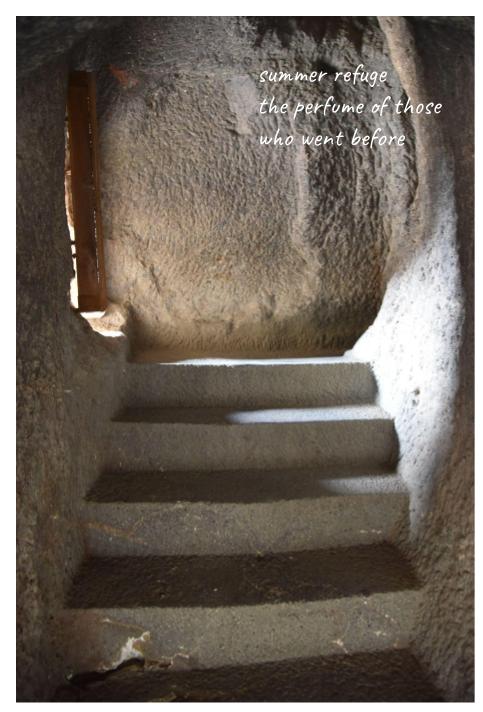
Alice Wanderer’s summer refuge

Haiku: Alice Wanderer (Australia)
Photography: Di Cousens (Australia)

Commentary

Refugees, seeking a safer place to live, demonstrate the strength and resilience of the human spirit. In this haiku, it is the scent of a refugee (or refugees) that we recognize in their absence. The word “perfume” seems to entail a strong scent that lingers. This haiku could also symbolize humility and frugality. With very few possessions, it seems refugees don’t leave many (if any) material objects behind. This makes me think: on our brief human journey of a lifetime, what are we leaving behind? What do we want to leave behind?

In turn, it seems the presence of a kind and compassionate human being is a gift that stretches far beyond material wealth. In the end, physically, we are all visitors on this Earth. The steps in the photo could be a symbol of human striving or steps in human growth/evolution. I think the long journey of refugees both spiritually and physically can redefine what truly is home. 

Jacob D. Salzer

First, I would like to say that I enjoy the shading and light in the photograph. Also, the textures in the wall and steps make it an intriguing capture. The font for the haiku is appropriate for the subject matter and matches the atmosphere of the photograph.

The seasonal reference (kigo) is in the first line with “summer refuge.” We can guess that the summers where this haiku takes place are exceptionally hot. It might even be in a desert. The poet and photographer being both from Australia can make readers think it might be in the Australian outback. This photograph could indeed be a summer refuge made by Australian Aboriginals to combat the outback heat. In this context, the last line referencing possible ancestors could gain more meaning.

There is no punctuation in the haiku (kireji), but there is a clear delineation of the two parts of the poem by a grammatical shift from the first and second lines.

How the two parts of the haiku combine and interact (toriawase) is pleasant in its melancholy. With summer being a happy and chill time, in this space of sanctuary, there are the remnants of ancestors. Whether this is a joyous or sad happening is up to the reader. “Perfume” is used interestingly in this haiku, as the poet could have easily written “scent.” “Perfume” is a much more endearing word that could have multiple meanings. But overall, this haiku could have an intermixing of emotions or be about a silent celebration of ancestors still with us.

Looking at how the lines are laid out, the pacing approximates the Japanese traditional rhythm of short/long/short.

The diction is in line with haiku principles of simplicity and brevity. It is also important that the poet left space for the reader to ponder through her choice of words.

In terms of sound, the letter “r” is especially important. With four instances and in every line, “r” gives a hard edge to the haiku that connects to the walls and steps in the photo.

Ultimately, this photo haiku (shahai) expresses inexplicable emotions with grace. Though the image and haiku might be endemic to Australia, it is written in a universal way.

Nicholas Klacsanzky


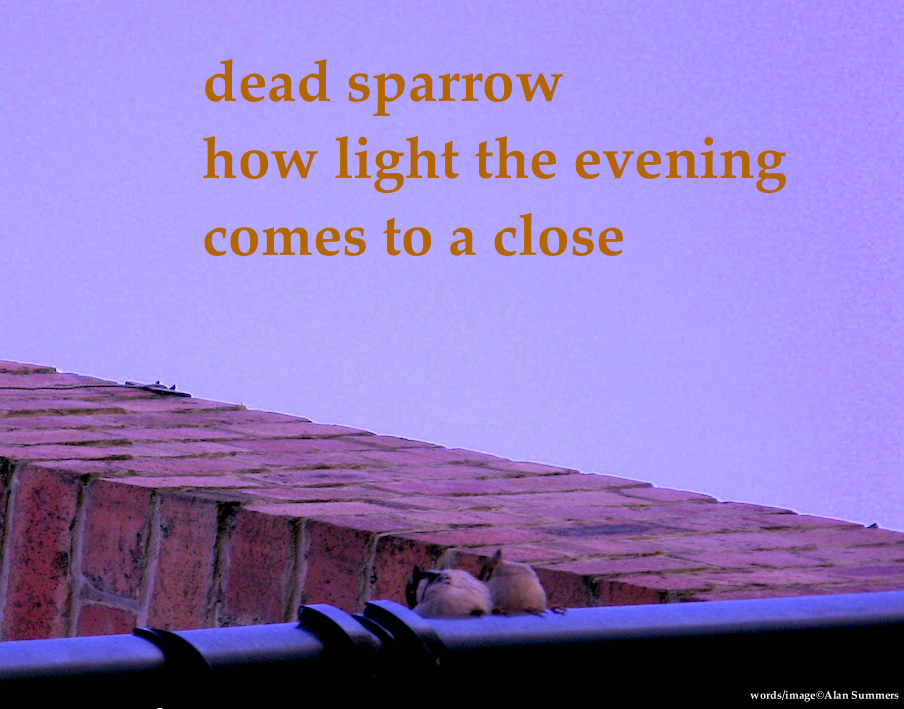
Alan Summers’ Sparrow

dead sparrow haiku Alan Summers Screen Shot 2016-04-20 at 08.33.22
Haiku Canada Review, vol. 11, no. 2, (October 2017) ed. LeRoy Gorman

The first line shocks us into the present moment. Sparrows are beloved birds, not only because of their miniature size, but also because of their sweet songs and ubiquitousness. Sparrows as a kigo, or seasonal reference, qualifies for each season, and this adds to their universality perceived in the haiku.

The last two lines depend much on how one reads “light.” Is it light in color, light in weight, or physical light? Summers does not say, but from the feeling we get from reading to the end of the haiku, we might say it is a mixture of both compassion and irony.

The compassion comes from nature giving a spontaneous signal of care or love through a light sky in the evening. This period of the day is lovely and gives off a sense of peace.

The irony could be in the fact that with such a fateful day of a death, the dusk comes lightly (maybe an extended twilight) instead of a definite darkness that would go along with the mood of the day.

This haiku reminds us that nature can be unforgiving and be compassionate simultaneously—and most likely, this is all a matter of spontaneity.

Through the use of sound, Summers makes an even stronger impression on the reader. The use of “l” in “light” and “close” brings about the seriousness of the subject matter, in my opinion. With the alliteration of “comes” and “close” I believe the finality of the event is felt more.

The haiku seems effortlessly written, but the phrasing also appears to have been chosen with intention.

The way I interpreted the photo was that this is the view of the dead sparrow, if it could see. But maybe it is still seeing….

Alan Summers has composed an endearing and contemplative shahai (photo haiku) of feeling and nuance.

– Nicholas Klacsanzky (Ukraine)

Rika Inami’s End

when the end
comes upon me ―
sirens blowing
through the darkness
rushes to the fire
© Rika Inami (Japan)
IMG_7618

This self-eulogy is evocative in its simplicity and pacing. There is nothing difficult to understand in this tanka, but the subtle meaning behind it might be.

The end of the tanka is not about her, but about fire, an all-consuming element. I think Rika is expressing that in the end, she will become one with her surroundings, or maybe  she or her life was an illusion all along.

It also seems the author is saying that when her end comes, there will be no use in trying to pity her or get involved in feelings. But rather, the author could be pointing to the problem that made her die in the first place. “Fire” has a lot of symbolism attached to it, such as passion, anger, inspiration, and so on.

With the em dash in the second line, we feel more of her end, as she gives us time to take it in. The em dash might seem unnatural, but for poetry, it totally makes sense to have there. In tanka, we sometimes use punctuation to show two parts more clearly. So, Rika is also demarcating the parts in the tanka.

The photo connects indirectly to the tanka wonderfully. The red of the maple leaves shows the fire and the latern is similar to a siren light.

The most prominent sound to me in this tanka is the “o” sound in “comes,” “upon,” “blowing,” “through” and “to.” It gives an effect of a suspension of time and makes us read the poem slower.

A humble poem about one’s death, written in a simple style. But that is just the surface. I think this tanka brings up a lot of symbolism and thoughts about the reality/illusion of life, where we go when we die, and what we are meant for in the end.

– Nicholas Klacsanzky (Ukraine)

Lucky Triana’s Last Time

16_-_1 (1)

Sometimes we need to poke humor at ourselves just to stay sane.
Lucky Triana’s “beauty parlour” tanka does this effectively.
a puss caterpillar
passes by
i can’t remember
the last time i went
to a beauty parlour

words and image
© Lucky Triana (Indonesia)

This tanka captures the need for self-image and a little vanity, but builds it all from a cuddly “puss caterpillar” that the poet sees passing by.

Maybe she forgot that her hair is important or maybe she is evolving into a more beautiful night being. If she looks disheveled like the caterpillar does in its latter stages, then perhaps she is going to need that beauty parlor.

I love the touch of mystery that the venomous puss caterpillar image gives us. But touch is something you want to avoid. Perhaps she is too dangerous to touch, but the hair stylist will have to deal with it and that adds another layer of humor.This tanka might be leaning more to kyoka but for now, I’d say, spruce up and go out clubbing this weekend. Soon the night will be all yours as a moth.

Thanks for sharing with us.

– Edwin Lomere (USA)

Martha Magenta’s Last Goodbye

last_goodbye

Words and image by Martha Magenta (UK)

This tanka is packed with emotion and is centered around a stark image.

Last goodbyes are something almost anyone can identify with and the emotions it brings. Sometimes, we never forget these moments, and they linger in our memories each day.

The abruptness of the rain filling the footprints, before the ocean tide could, is poignant. It magnifies the sadness the poet feels and represents a lack of mercy.

But on the other hand , you can see it as a blessing. Looking at the footprints of a loved one who has left can be agonizing and the rain filling the footprints up so quickly show the spontaneous compassion of nature.

So, we have a sad and compassionate view of this tanka, simultaneously.

The language is simple, to the point, and well-paced. It is hard to imagine adding or taking out a word. That is a sign of a strong tanka. Plus, the tanka hits the correct emotional chord and tone that touches readers. If a tanka sounds metallic, it is hard to say that it is a tanka.

The sound of the tanka is important as well. The “o” sound is represented in “our” “goodbye” “on” “how” “your” and “footprints.” This gives the sense of length of yearning–the sense of time being too long. Another thing to note is the alliteration of “footprints filled” which adds emphasis.

The art associated with the tanka (I think it is a photo with painted-over rain) is moody and adds to the atmosphere that the tanka creates.

– Nicholas Klacsanzky (Ukraine)

Marilyn Ward’s Rainfall

2016 - 1

I believe this photo-haiku brings out the humility of animals and the no-mind state that spirituality expounds on.

In the first line, we get the pleasant image of spring rain, which is a sign of nourishment and kindness, you could say.

The second line presents a mystery. Who is drinking out of the gutter? And from such a pretty scene as a “spring rainfall” we get the contrast of a gutter.

In the last line, we learn that a goldcrest, a lovely, small bird, is drinking out of the gutter. I think it is called a goldcrest because of its royal appearance of a gold streak on its head and wings.

This royal bird is drinking from a gutter, and just accepts life as it is. It doesn’t have thoughts like, “I am above drinking out of a gutter–I am a magnificent bird.” It just drinks because it is thirsty and the water happened to be there. The use of “a goldcrest” instead of “the goldcrest” further shows the humility of the bird. The freshness of the spring rain is compared to the fresh mind or beginner’s mind of the bird.

The isness of this haiku is much in line with Zen philosophy. In Zen, there is a philosophy that having awareness without thought is a state of meditation. If you have thoughts, you are not truly meditating. You are adding your own shades to reality when you have thoughts. Reality, as it is, is something different than what we think or feel about it. It just is, and this haiku, in my mind, champions this philosophy.

The sound of the haiku is quite nice with “r” going through “spring” “rainfall” “drinking” “gutter” and “goldcrest.” The “r” sounds, coincidentally, like rain.

The photo shows the beauty of the spring rain and the lettering adds further to the mood of the haiku.

A fine photo-haiku that just is.

– Nicholas Klacsanzky (Ukraine)

Lucky Triana’s Intimate Talk

84-tsMX2oY9FJ5zeMCyKpyjXRQL8cf7S3C5T9D_1QPmBWAYxjBh1ksM6b6a-_-DbdwhDPER07Q=w2095-h1179-no

To me, the power of this haiku is the surprise ending. The first two lines set up a scene and atmosphere, and then the third line hits us with the reality of the moment.

After the surprise is made, readers might think, “Why is the poet talking to her shadow?” It could be a mental problem, it could be a sign of desperation, it could be a sign of an epiphany, or it could be even a sign of joy. The poet did not tell us which one it is, but from the tone of the poem, I would guess it is more tending towards melancholy and somberness.

What is interesting about the haiku and the “aha” moment is that despite the poet being alone, the candle itself has created a shadow for the poet to be comforted with and to even converse with. So basically, the poet is saying that we are truly never alone.

What this intimate talk entails is anyone’s guess, but I consider it to be an introspection about the direction of the poet’s life.

I like the alliteration of “candle corner,” the “t” sounds in “intimate talk” and the “l” sounds in “candlelit” and “talk.” The sound of the haiku is appealing and makes the reading of it more stark.

In addition, I like the mysteriousness of the photo. Its ambiguousness lends us to thinking that it could be a sunset, abstract art, or something otherworldly. This mood heightens the mood of the haiku.

The haiku (or shahai, because it is a photo-haiku) comes across naturally, but I am sure Lucky spent more time on it than what is perceived. But well-written haiku should across as effortless, and this one is a fine example.

– Nicholas Klacsanzky (Ukraine)

Marina Balmaceda Paredes’ Breath

16+-+1

I love the journey of this tanka. It shows how our actions, like a simple breath, can be integrated with the nature and return back to affect our lives later on. The photo adds to the atmosphere, and maybe makes the breeze a sea breeze.

Names are kind of like leaves. They grow out from a being and are reminders of who we are. The poet is probably speaking the name of a loved one and has an insight about how her breath is carried throughout the natural world and returns to her own place of residence, throwing up leaves in her window to make a curtain in order for her to sleep better. The last line comes as a surprise and makes one peaceful simultaneously.

The sound of the tanka is resonant. The “i” sound flows through it with “i” “it” “stir” and “curtaining.” This sound gives off a starkness. Also, “breeze” “leaves” and “curtaining” have a sort of internal rhyme that makes me feel the wafting of the breeze more.

I also enjoy how the poet sets the lines, like a breeze carrying on. Marina has worked on this tanka thoughtfully and with great intention.

– Nicholas Klacsanzky (Ukraine)

Martha Magenta’s Stars

SAVE_20160518_192817

Each word in this shahai (haiku with a photo) is significant and carries many dimensions. Though the haiku can be taken literally, as two lovers far away from each other, and them gazing at different night skies, the metaphorical quality of the haiku easily comes through.

The tone of the haiku is almost argumentative. It is quite personal, like the reader is listening in on a couple’s heated conversation. “hemisphere” can mean literally the hemisphere one is in, or the hemisphere of the loved one’s brain, or in a more abstract sense, the perspective of the loved one.

“gaze” is not a light word here. From the tone of the haiku, it seems be used in a negative manner.

What I got from this haiku is that the poet does not like how a certain loved one perceives or notices only the exterior or holistic points in the poet, while the loved one is missing the “stars,” the small things that create the larger picture of who she is.

And what a large entity we have in the photo, of which appears to be a panorama of a galaxy or two (or maybe infinity itself, because we are infinite, right?). I believe this shows the wideness the poet wished the loved one saw in her.

Though there seems to be more than enough pronouns, the haiku is so engaging that I didn’t even consider it a problem.

The wording is concise and it is well-phrased. I would move this to being a senryu rather than a haiku based on its tone. But ultimately, the feeling behind the poem is more important than the categorization.

– Nicholas Klacsanzky (Ukraine)