Haiku from Antoine Cassar, Tuyet Van Do, and Srini

Negotiations —
owner, bank, architect, notary,
and now this mosquito…

Antoine Cassar (Malta)

Commentary from Jacob D. Salzer:

As humans, we are frequently faced with negotiations, but this haiku also has a humorous twist in the last line, which I appreciate. It seems the poet’s sense of humor in this haiku may be a kind of coping mechanism among frustrating and/or challenging situations in life.

Another unique feature of this haiku is the poet’s use of punctuation. We have an em dash, four commas, and an ellipsis, which is rarely seen in a single haiku. I think the many forms of punctuation amplify a drawn-out, elongated effect, which seems to give the impression that the poet may be tired of negotiations and wants more peace and silence. Indeed, some negotiations also go on for quite some time. For example, competing for the ownership of a house can involve several negotiations regarding the mortgage payments and the down payment. 

In short, this is an interesting haiku that blends humor with the heavy financial decisions, negotiations, and struggles that many of us face in modern life.

musical notes
across the power lines
spotted doves

Tuyet Van Do (Australia)
haikuNetra, issue 1.2, 2023

Commentary from Nicholas Klacsanzky:

I prefer haiku that employ pivot lines, and this one delivers. “Musical notes across power lines” is a neat phenomenon to imagine. However, it can turn morbid if we imagine the doves are getting electrocuted and there is sound coming from that occurrence. “Across the power lines, spotted doves” is much more tame, in my opinion, as it sees the doves adding their songs to the hum of electrical lines. This interpretation makes a connection between nature and the human world.

This haiku is also pleasant to the ear, with the strong presence of “o” and “s.” It is paced well, too, with the traditional short/long/long rhythm. Also, with only eight words, the poet focused on brevity and the economy of language. In addition, the poet made sure the poem didn’t lean into verbosity. Overall, this haiku combines a variety of poignant interpretations with technical accuracy in its craft.

where school ends wildflowers

Srini (India)
haikuNetra, issue 1.4, 2023

Commentary from Hifsa Ashraf:

This simple monoku says a lot in four words. I see it in terms of time and space. It starts with a question that lets us pause and think about the space or place. The school may be in a remote area, a war-affected domain, a refugee camp, or a city/town. The location is significant in this case. I see it as a war-affected area or a refugee camp where it’s unpredictable what will happen after school or where learning and knowledge will take a student. ‘School ends’ doesn’t mean anything certain in the future or ‘school ends wildflowers’ may lead to something specific. Another aspect could be a school where a person rejoices in a carefree life, and when it comes to an end, the worries or anxieties about the future start coming.

I like the way the poet ends it with ‘wildflowers’—something I often use in my poems, and it’s the title of my micropoetry book on refugees. ‘Wildflowers’ show both abundance and abandonment here depending on how we read it i.e. ‘school ends wildflowers’= abundance or ‘school ending at wildflowers’= abandonment. So, it can be an opportunity for a new life or a new beginning. It could also display a hope for abundance. On the flipside, it could demonstrate abandonment in a real sense where someone may get stuck with a career or responsibility, or remain directionless like wildflowers. Ultimately, I take it as something positive irrespective of the location or situation of the school or personal experiences associated with it. 


Haiku by Ivy Raff, Sushma A. Singh, and Daniela Misso

Mist runs fingers through
green tendrils of mountain hair
One soulmate? A myth

Ivy Raff (USA)

Commentary from Jacob D. Salzer:

I think the first two lines are original and interesting. They show what the third line tells. I appreciate the notion regarding the dangers of relying on one person to meet so many needs in life. Ultimately, I am averse to the idea of a soulmate, which seems to have become a cultural norm in the West. 

This is a 5-7-5 haiku. While there is nothing wrong with 5-7-5 haiku, I would encourage the poet not to be solely restricted to this format when writing haiku in English.

It’s also interesting to include questions in haiku. Most times, I feel leaving the question open to the reader is most effective. In this haiku, the question is answered, which may be too telling for some readers. Still, I feel the juxtaposition is strong. I think this haiku is an excellent start to a conversation about relationships, marriage, and divorce. An interesting haiku.

Here is a statistical article on divorce in the U.S.: https://www.forbes.com/advisor/legal/divorce/divorce-statistics/

summer visit
mother fits into
a smaller hug

Sushma A. Singh (India)
The Heron’s Nest, Issue 4, December 2018
Shortlisted for The Touchstone Awards 2018
Red Moon Anthology 2018

Commentary from Hifsa Ashraf:

Sometimes, we don’t need a lot of words to tell our loved ones how we are feeling about them. A heartfelt moment is enough to say it all.

‘Summer visit’ indicates vacation time or long days. Either way, the person wants to have spare time to spend with their mother after a long time. Summer days, especially in Eastern countries, are really hot and humid. People usually feel uncomfortable physically and mentally. They need someone around them who can soothe their feelings. Visiting one’s mother is mostly a profound experience where there is deep communication on both sides.

In this poem, we can see the power of non-verbal communication where simply a small hug can make a lot of difference and tell the whole story of her poor health. I also see other hidden aspects here i.e. departure, lonliness, grief, etc. that has a great impact on health. One can feel it if they visit that person after a while.

Lastly, the letter ‘m’ dominates in this haiku with some underlying feelings that are left unexpressed. 

a goodbye
lost in the wind
morning swallows

Daniela Misso (Italy)
Frogpond 46:3, Autumn 2023

Commentary from Nicholas Klacsanzky:

The first aspect of this haiku that I noticed was the pivot line. It can work for both the first and third lines. The two ways the pivot line can be read reveal potent meanings. The second thing that struck me was the sense of sound. The elongated “o”s in the haiku slows the pace and allows the reader to soak in the poem. The string of “o”s also brings about emotions, such as melancholy and sympathy.

With only eight words, the poet doesn’t waste anything. The words “lost” and “morning” are the most impactful, in my opinion. Both may be hints to the kigo or seasonal reference. This haiku could be about the migration of swallows and that being compared to a goodbye being said. In addition, it could be a contrast between the harshness of a goodbye and the joy of morning sparrows. Either way, this haiku strikes several emotional chords and is also technically efficient on top of that.

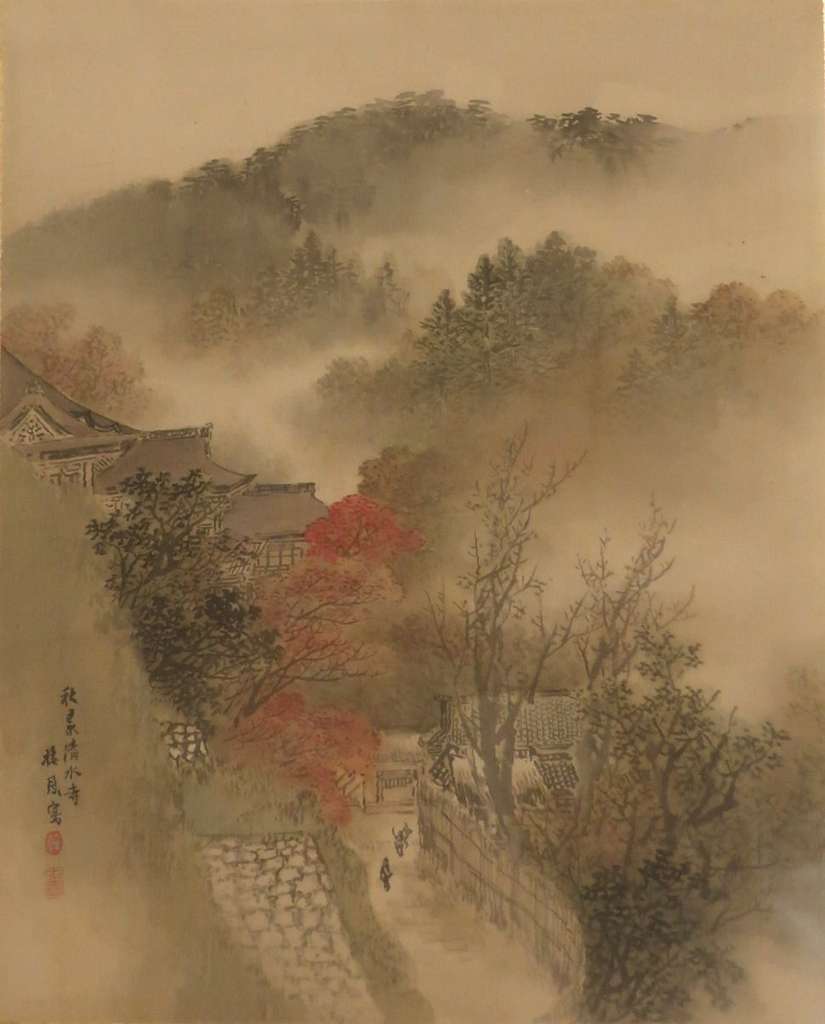
Kiyomizu Temple in Autumn by Yamamoto Shunkyo, 1891

Haiku by Anthony Lusardi, Charlotte Jung, and Marjolein Rotsteeg

green caterpillar
             carried by black ants
                                          to the colony

Anthony Lusardi (USA)
Seashores, issue #8, 2022

Commentary from Jacob D. Salzer:

I appreciate this haiku for a few different reasons. On first read, this haiku gives us a real glimpse of the remarkable social intelligence and physical strength of ants. They truly live and work as a community versus a focus on individuality, and by doing this, they accomplish far more tasks than any individual could do alone. Yet this haiku is also showing a stark and swift movement between two worlds. The presumably (and mysteriously) dead caterpillar died prematurely and did not reach metamorphosis to become a butterfly. As a result, the ants now claim it as their own. In parallel with the ant’s colony, it seems colonialism has hindered the spiritual development of our human potential, partly by seeing Nature through a very limited lens to maximize industrial and financial gain, which creates a blind psychological separation and destroys much of life on Earth in the process. When I read “colony” in this haiku, I think of the inherent dangers of pride and group conformity that ignores the critical importance of diversity. On the other hand, when I see a single dead caterpillar, I think of the dangers of extreme individuality. In the end, it seems finding a balance between group/community activities and individual endeavors is important.

While I understand the importance of an interdependent community, I also see this haiku as a warning to not conform to the superficial materialistic values of collective Capitalism because it ignores our spirit and obscures a true sense of belonging. In short, I think our human species is in dire need of a spiritual and cultural metamorphosis or transformation. Hopefully more people will be willing to change their views and lifestyles, embrace diversity, re-commune with the Earth, and align with our deeper Spirit of love and compassion before it’s too late. This is a powerful haiku with multiple interpretations and deep meaning.

on the pond
a film of ice
a leaf’s pirouette

Marjolein Rotsteeg (The Netherlands)
Japan Society ‘haiku of the week’, week 48, 2023

Commentary from Hifsa Ashraf:

This haiku suddenly captured my attention as I visualized the scene. It’s a wabi-sabi moment. I liked the way the poet blended two of nature’s elements and brought them close together like a juxtaposition. The pond looks like a stage where a film of ice (with a unique structure and position) made the poet see it beyond seeing. This presents creative imagery where a leaf pirouettes on patterns of ice. It must be a sudden frost or an unpredictable change in the weather where everything in nature is frozen and still. I see how certain changes in nature pause the ongoing movements of transformation.

During the pause, let us think creatively! It’s a challenge for our imagination to see things as they are or to take that transformation as something more beautiful, delicate, and subtle. At that time, one can use their energies positively and find solutions in a creative and unique way. 

The elevator and me

building

emptiness

Charlotte Jung (USA/Sweden)
Haikuniverse, 2020, and also in “Haiku 2020,” Modern Haiku Press

Commentary by Nicholas Klacsanzky:

There are several interpretations of this haiku that one could perceive, but first I want to appreciate the use of space between the lines to create a sense of emptiness. It’s a visual aspect that adds more to the haiku effortlessly.

This poem gets us thinking about what emptiness truly is. Thinking about emptiness being built is quite a philosophical exercise. But, I believe in various spiritual traditions, emptiness is not quite like the physical emptiness expressed in science. And, in this haiku, I lean towards the poet thinking along the lines of those spiritual traditions. With this context, an elevator, a part of the industrial world, building a sense of emptiness with a person is profound. Though the elevator isn’t sentient, it can inadvertently generate a spiritual emptiness for the person(s) inside it.

Another take is that the poet feels one with the elevator during the ride up or down and that the building feels or appears empty in this highly focused moment. It is an illustration of a Zen moment or being “in the zone,” where surroundings fade away and hyper-attentiveness ensues.

Though the haiku does not have a seasonal aspect, I believe the connection it shows between the natural (person) and artificial world (elevator) creates a haiku aesthetic. Emptiness is also a traditional Japanese artistic principle, which can relate to yohaku no bi or ma.

Finally, some notes on the sound and pacing. Most haiku in English do not begin with a capital letter but it does not distract too much in my eyes. The first line is longer than the last two lines, where the minimalism lends to more interpretations than if matters were spelled out in more verbose language. For the sound, the letter “e,” and its corresponding sounds in “i,” give the poem a greater feeling of lightness that connects with the theme of emptiness.

Brush drawing by Cornelius Markee, circa 1763