Hassane Zemmouri’s butterfly hunt

butterfly hunt…
the child comes back
with a wounded knee

Hassane Zemmouri (Algeria)
(published previously in Kontinuum, Issue 3, July 2022)

Commentary

I feel that this haiku is possibly written from a memory of the poet’s childhood, as butterfly hunting was much more common in earlier times. It could also be a parent or grandparent teaching the child how to hunt butterflies in this modern day. In any case, this haiku displays innocence and the power of nature. The twist at the end can make the reader believe that the butterfly hit the child on the knee, which is at once humorous and a reminder of nature’s sway over us. Most likely, the child tripped and/or fell while running after a beautiful specimen and scraped their knee. In the child’s attempt to disturb another being, a lesson is learned about how powerless we are in the face of the natural world: even an entity as minuscule as a butterfly can escape our ingenious ways.

I could not help, as an American, thinking about the Wounded Knee Massacre (better known as The Battle of Wounded Knee). Though the poet is from Algeria, I felt the haiku has resonance with this event in that it was an attack on innocence. As History.com states:

“On December 29, the U.S. Army’s 7th Cavalry surrounded a band of Ghost Dancers under Big Foot, a Lakota Sioux chief, near Wounded Knee Creek and demanded they surrender their weapons. As that was happening, a fight broke out between an Indian and a U.S. soldier and a shot was fired, although it’s unclear from which side. A brutal massacre followed, in which an estimated 150 Indians were killed (some historians put this number at twice as high), nearly half of them women and children. The cavalry lost 25 men. The conflict at Wounded Knee was originally referred to as a battle—the Army troops involved were later rewarded with Medals of Honor—but in reality it was a tragic and avoidable massacre. Surrounded by heavily armed troops, it’s unlikely that Big Foot’s band would have intentionally started a fight. Some historians speculate that the soldiers of the 7th Cavalry were deliberately taking revenge for the regiment’s defeat at Little Bighorn in 1876.”

This haiku can also be a general symbol of the consequences of attacking guiltless parties out of ignorance, which can be seen throughout history in almost all regions of the world. 

So, this haiku, from my perspective, has a mix of humor, tragedy, and history. Through its simple language and ending twist, it implies a poignant message. 

Nicholas Klacsanzky

Is it a hunt for a butterfly or something more subtle, invisible, and deep? This was the first thought that came into my mind when I read this haiku. A butterfly hunt is not as easy as it looks, especially when a person is not fully focused. I see it as if a child wants to follow their dreams or is curious about the trail of a butterfly, which is usually mystical or difficult to trace. It shows how a curious mind looks deep into certain realities of life that cannot be easily grasped or comprehended. More specifically, this moment could be about how a child goes on an expedition that is beyond what is unseen but still exists—maybe a pursuit of fantasies or dreams tickled by their imagination. The ending is more dramatic in this case, especially when one strives to go beyond certain realities, or struggles with what path to take to kill a certain curiosity or to understand the subtleties of life.

On the other hand, I see this as a retrospection where a person regresses to their childhood, which was more memorable or contains deep memories. Butterflies may symbolize life, dreams, or happiness here and the child struggled hard to achieve joy or goals from the beginning. It also gives us a lesson about how we cannot achieve anything without struggle, with a physical one manifesting as a wounded knee in this poem. Overall, this haiku illustrates the crux of life: there is no shortcut to achieving something of significance.

Hifsa Ashraf

I feel this haiku speaks of consequences, the limits of human thought patterns/mental programming, and the gentle (and bold) power of Mother Earth.

On first read, the word “hunt” seems to imply wanting to conquer and capture the butterfly. The reasons are unclear, but I feel the child likely has a mix of curiosity and the desire to dominate, perhaps with the intent to put the butterfly in the box of scientific analysis. We don’t know how old the child is in this haiku, which creates a range of interpretations and meanings, as Nick and Hifsa have expressed.

The butterfly could be a summer or spring kigo. Either way, in the end, I feel the butterfly in this haiku got away. 

Butterflies play a vital role in pollination and complex ecosystems. As is stated on the Portland State University website:

“[Butterflies] are also extremely important ecologically. Butterflies pollinate flowering plants and serve as food for other organisms, thus forming an important link in the food chain. Populations have declined in recent decades, owing to increased pesticide use (especially herbicides); loss of fencerows; urbanization and other destruction of habitat; and loss of caterpillar host and nectar plants. Managing your garden for butterflies can help conserve butterfly populations as well as greatly enhance a traditional garden.”

Source: https://extension.psu.edu/gardening-for-butterflies

In terms of sound, the soft and long “o” sounds in the haiku carry gentleness, while, in contrast, the hard “t” and “k” sounds have a bold and immediate emphasis.

In the end, while science has its place, I feel if we only see through its limitations we can become blind to the spiritual power and mystery of Mother Earth. This haiku reminds me that curiosity has its limits and dangers as well. I feel a balance is needed between Science and Spirit, between wonder and logic—otherwise, as a species, if we lack sensitivity and reverence, we may take the consequences. 

An interesting haiku with layers of depth, significance, and meaning.

Jacob D. Salzer

“The butterfly hunt” by Berthe Morisot  (1841–1895)

Kala Ramesh’s wood-deep echo

again the wood-deep echo of a cuckoo’s song

Kala Ramesh (India)

(previously published in Heliosparrow Haiku Journal, March 2021)

Commentary

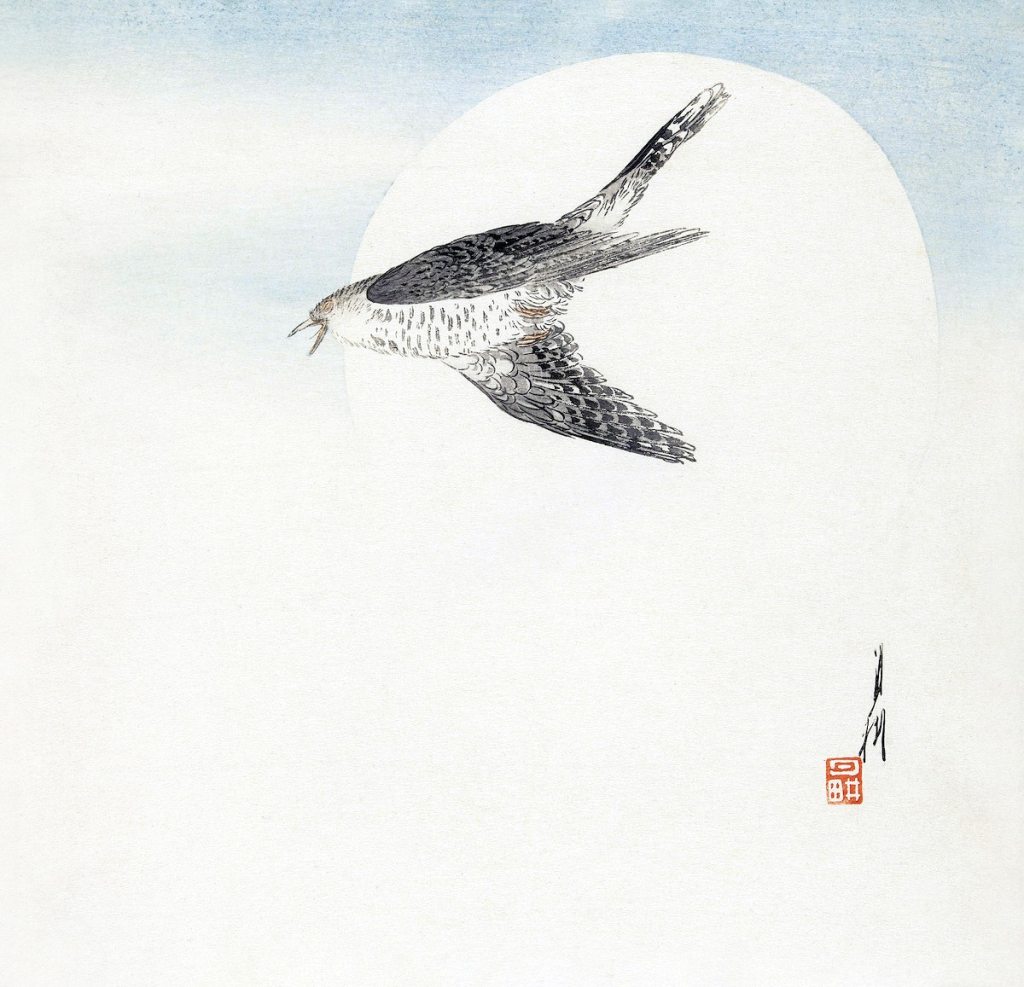
I appreciate the synesthesia between sound and imagery in this monoku. “wood-deep echo” harbors a deep silence that is beautiful, mysterious, and almost haunting. I also visualize the cuckoo’s song resonating with the rings hidden inside trees. This creates a sense of harmony where the cuckoo and the forest have become one. I can hear the cuckoo’s song and echoes resonating within the poet’s quiet presence as well. I experience this myself as I read this too. I am transported into the scene. I can imagine the cuckoo’s song creating ripples in consciousness itself and perhaps simultaneously extending into past lives and the future.

This is an excellent monoku with depth, meaning, and a strong atmosphere.

Jacob D. Salzer

This monoku has a series of variations that make it dynamic and deep. I read it in many ways to get the layers of various themes that the poet tried to discuss.

It starts with ‘again’ which means there is a repetition of whatever is following it. It also shows the curiosity of the person who is passing through the same experience again and enjoying it fully.

The wood-deep echo may allude to memories, news, imagination, or illusions that a person feels or listens to due to deep silence, meditation, or wind. However, it seems the person has a deep connection where they want to hear what is pleasant to the ears or what is more distinctive than other voices. This also reflects a state of mind that is calm, still, and focused. A cuckoo’s song refers to something special—like in Indian mythology, a cuckoo’s song is related to the beginning of the monsoon season.  

Overall, it is a deeply personal experience of a moment that connects the person with what is going on and what is coming after. It also signifies the relationship between nature and human nature that is tightly woven with the senses. I see it as meditative where a person tries to attune to the cuckoo’s song which brings joy in their life sooner or later. 

Hifsa Ashraf

As Hifsa mentioned, the cuckoo’s song is commonly a harbinger of the monsoon season. Since the poet is from India, this can be said to be a kigo (seasonal reference) local to this country. Traditionally, the cuckoo is a kigo for about every season in Japan and a beloved bird of that country. A famous haiku magazine in Japan is named Hototogisu (cuckoo), which started in 1897.

There is no kireji, or cutting word, in this haiku. However, there is a grammatical pause after “again” which makes the haiku either two parts or one. In the English language, kireji are not commonly used in one-line haiku.

Even though there is only one image at face value, there are two considering the word “again.” The depth and ethereal nature of the cuckoo’s echo is repeated with all of its richness. The echo is wood-deep perhaps because some cuckoos nest inside trees. This richness of sound, when repeated, can bring about a sense of bliss and spirituality. The song is also a union of tree and bird, which makes it even more robust.

Kala Ramesh’s haiku often showcase euphony, and this monoku is no exception. The soothing “o”s and soft “n”s create a melodic reading—as if the cuckoo was singing through the haiku.

This haiku has a timeless feel to it, as I feel it can be read in any era and can resonate. A classic, yet modern work.

Nicholas Klacsanzky

Sumi-e by Ogata Gekko

Michael Buckingham Gray’s circling osprey

circling osprey
closing a hole
in the clouds

Michael Buckingham Gray (Australia)
(published previously in Presence, 74, 2022)

Commentary

In my first reading, the imagery spoke of a sense of completeness and union. With the circling osprey in a “hole,” the cloud gains back its full cover over the sky. This could symbolize the uniformity of us all ultimately or that the clouds and the ospreys are the same (and everything else as well).

Knowing that ospreys circle in the air during courtship, this haiku takes on new interpretations. The serendipity of the cloud’s hole being covered by the courting ospreys shows that random acts, and even intentional ones, sometimes change the things that surround it. I don’t know if there is any objective sense of “good” in the imagery, but with the word “hole,” I feel as if something is being resolved. It is a feeling of positivity that is more intuitive. Perhaps, the most favored type of haiku is felt and understood intuitively.

A lovely, succinct haiku that presents exacting imagery and a special feeling.

Nicholas Klacsanzky

An osprey is a fish-eating bird of prey known for its migratory habit. The colour of its feathers and long-range flight makes it one of the most unique birds. A circling osprey is linked with the act of courtship, which is also called a sky dance. There may be other reasons for circling, though i.e. reducing energy for a flight, a balancing act of staying in the sky to stay within the thermals, or a way to prepare for migration. In any case, I can see it as a mode of survival that the bird has by having non-verbal communication with its surroundings and symbolically giving a message to its female partner or prey. This is how birds demonstrate how powerful every move or gesture they make is.

I can also see a whirlpool in the sky that is formed as a result of merging both the white features of the osprey and the clouds. It is a kind of beauty that fills the void in the sky, as the rest of this poem says. “Closing a hole in the clouds” is how powerfully and energetically a bird can fly in the sky so that one cannot see any flaws or blueness of the sky. It’s a beautiful, meditative image of covering what is yet to be completed. Life is full of such voids that need our ways of dealing with them by using our abilities and energies in the right direction.

This haiku seems to give a lesson on how one can turn things in their favour by using the right energies at the right time and by having faith in their unique potential.

Hifsa Ashraf

The clouds in this haiku could depict autumn, winter, or spring. To visualize only one hole makes me think the clouds are thick. I do think kigo (seasonal references) in haiku are not always categorized rigidly by the four seasons but can depict transitions between the seasons throughout the year.

In terms of sound, the letter “c” takes precedence and amplifies the circling motion. Also, the “o” sound brings a sense of wholeness where even the hole is an important part of the bigger picture. A see the hole in the clouds as a kind of portal into another dimension. In that sense, perhaps the Ospreys could be the gatekeepers to another realm. 

The movement of circling also reminds us of the cycles of life, and that even when we have apparent holes in our life, we are never alone. The clouds too are impermanent, as is the temporary hole.

There is no kireji or a hard break in this haiku. The poem can be read without any pauses at all, but the 3-line format allows us to read the haiku at a steady pace. I feel the lack of a hard kireji adds to the feeling of wholeness in this poem.

This is an excellent haiku that symbolizes the cycles of life and death while also leaving room for metaphors.

Jacob D. Salzer

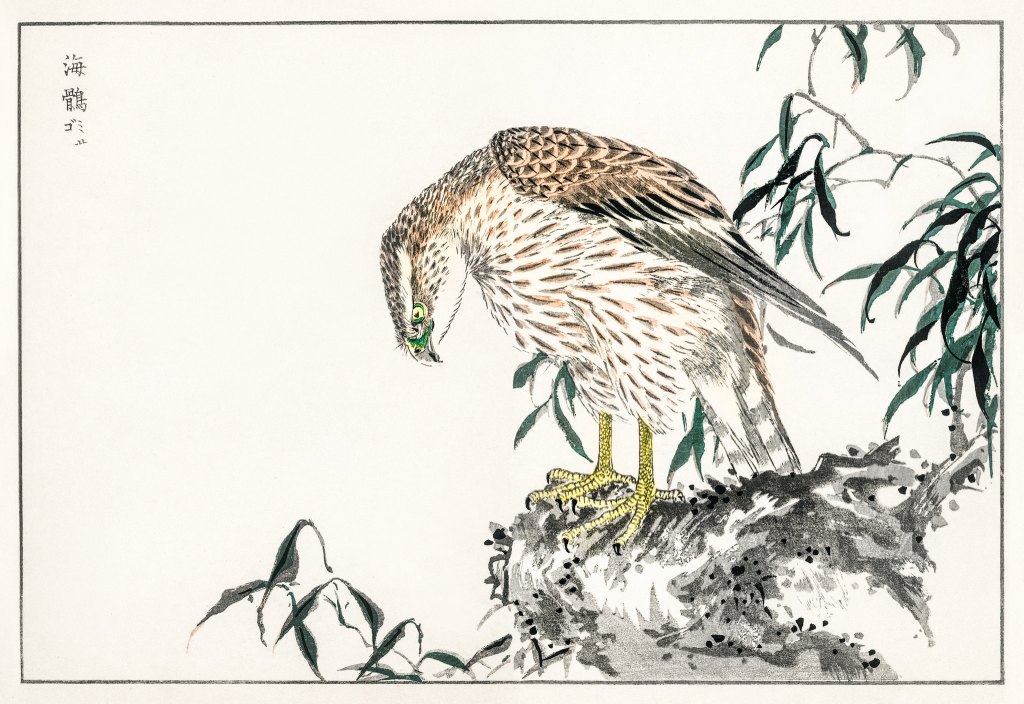
Japanese woodblock print from Pictorial Monograph of Birds (1885) by Numata Kashu (1838-1901).