Florin Golban’s old stories

old stories—
the words grow
by the fireplace

Florin Golban (Romania)
(originally published in Under the Basho, 2022)

Commentary

I appreciate how this haiku demonstrates the power of stories. It reminds me how a story with depth and meaning lives long after the words themselves. Some stories also have so much depth that new meanings and interpretations can be found in them, even after many repeated readings.

This haiku also shows how stories are connected to other stories, and how one story can inspire our imagination to create new ones.

In this haiku, the fireplace setting could bring to mind a grandma or grandpa reading to their grandchild or grandchildren, or it could be a man, woman, or child reading in solitude and deep contemplation. The fireplace provides me with calmness, warmth, and focus.

Regardless of what we imagine, this is a haiku that bridges the past with the present moment, and the future. Perhaps this haiku could inspire us to leave behind new stories for future generations. A beautiful haiku that demonstrates the power of words and stories.

Jacob D. Salzer

Old stories may refer to many things i.e. kinds of stories (fables, anecdotes, folklore, fairy tales, etc., or stories told in the past most probably in childhood that might be shared by elderly members of the family. I see it as a community-based storytelling session that used to take place in villages or towns where storytellers would share their personal experiences, voyages, or long journeys.

The second line in this haiku is impressive. It makes it profound and unique in many ways. The word ‘grow’ is something that is gradually taking shape over years. This is an excellent choice of words that can make a reader think deeper to justify its use. I can see it as an evolution of stories that pass on from generation to generation, growing in minds with changes and improvisations. Accordingly, modifications to these stories that fit well develop in each era. These stories provide lessons that people use to inculcate morality within communities, clans, tribes, and families. This is not something ordinary when there were no proper or modern means of communication.

The ‘fireplace’ could be the center of attraction for all those who gather and listen to those stories. This haiku could be set in winter when people gather around to exchange or share their life experiences or stories. I also see a connection between the fireplace and enlightenment or rekindling the mind to think deeply whilst listening to old stories.

I liked the overall imagery of this haiku that shares the vastness and significance of storytelling, which is missing in our lives now.

Hifsa Ashraf

As Hifsa mentioned, this haiku is probably placed in winter, but it also might be in autumn. The contrast between growth and possible seasons of decay is poignant.

The poet made an interesting choice to use an em dash in the first line to “cut” the two parts of the haiku. With “grow,” I would expect an ellipsis to illustrate the continuation of action. However, an em dash promotes the idea of the eternal fireplace, in my mind.

The contrast between the season and “grow” is present, but also there is a contrast between “old stories” and the constant growth of the words of the stories. This growth could happen through retelling, the cultural context changing, and the resonance the words have in readers.

In terms of pacing, the poem follows mostly the standard line lengths of English-language haiku. It has a short first line, a longer second line, and a third line of the same length. Usually, we vie for a third line that is a bit shorter than the second line, but I do not think the length of the third line in this instance makes a marked difference in the rhythm. I think the somber and introspective mood is captured well.

Euphonically, this poem has a pleasing string of “o” sounds, which brings it charm. Nostalgia may be felt as well through the pleasant “r” sounds in each line.

The pivotal word “grow” in this haiku opens up many interpretations and feelings. And, as we read and reread this haiku, it grows on us.
Nicholas Klacsanzky

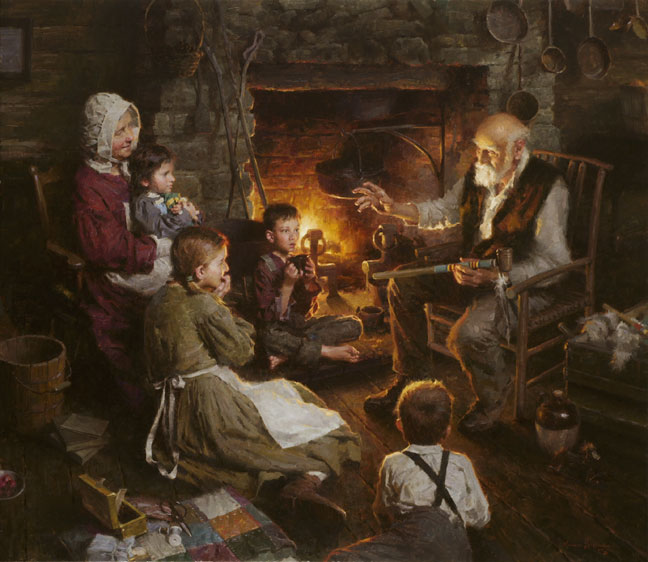
Painting by Morgan Weistling

Pris Campbell’s small town festival

small town festival
a cherry blossom drifts
into the tuba

Pris Campbell  (USA)
Sakura Award, Vancouver Cherry Festival, 2018

Commentary

Right away, the first line sets the scene. I hear the music and imagine myriad colors at this festival. There is a great deal of humility here as well. I feel the people living in this small town are not seeking attention from mass media outlets. Instead, I feel they host the festival to simply celebrate life in their own small and meaningful ways. 

I also appreciate the contrasts in this haiku between the cherry blossom and the tuba. The cherry blossom is soft, quiet, and small, while the tuba is hard, loud, and relatively large. For me, these contrasts add humor to the haiku and show how the soft, quiet people have their place and are just as valuable as the loud people in this small town. I also like how the cherry blossom drifting into the tuba shows how some things in life cannot be planned but rather happen spontaneously. I also feel the anticipation of the next note of the tuba resulting in the cherry blossom flying out into the wind like a piece of confetti. I feel joy imagining this scene. 

It seems the details of this festival will not make the news outside this town (actually, a lot of positive, uplifting events don’t make headlines in mainstream news). However, I feel the energy of this festival creates invisible ripples that subtly uplift human consciousness as a whole, because everything is connected. In addition, because this haiku won a Sakura Award (and was subsequently read by many people all over the world), this haiku spreads joy and has honored both the festival and the people living in this small town. As a result, this haiku demonstrates how a single haiku can honor and shine a light on people whose lives are rarely seen or noticed. On a personal level, this haiku reminds me to be grateful for this life and the little that I have.

This haiku also reminds me of the Water Village scene in Akira Kurosawa’s Dreams movie. Coincidentally, there are flowers and villagers playing tubas toward the end of this scene! Here is a link to watch it for free online: Akira kurosawa | Dreams Film | The village of the Watermills – Bing video.

This haiku speaks volumes about humility, offers a different perspective, and encourages us to be grateful for what we have and to find joy in life. It also reminds me of how small things in life make a difference in ways we will never know. A powerful haiku.

 — Jacob D. Salzer

Small-town festivals are full of life and colours as I have personally experienced. The gathering of people and the cultural blend make such festivals rich in many ways. This richness captures our senses and lets us enjoy every single aspect of a festival, which unites us with the strings of our uniqueness.

A cherry blossom and tuba elude to the kind of festival it is. The festival could be more eastern, where the poet tried to oscillate between two extremes in terms of sight, sound, and touch. One extreme includes cherry blossoms that are soft, delicate, silent, and peaceful while the other extreme is the tuba which reflects loudness, music, and liveliness. This is how a small-town festival blends the variations of life and beautifully presents them.

Living in the present moment is a quality of small-town festivals. They make people focus more on the ‘here and now’ and challenge their threshold levels to register things that people usually don’t notice. The holistic picture of this haiku may include the wind, the movement of petals, and music that sounds more like orchestrating to the ears and allows people to enjoy it together. 

Hifsa Ashraf

The kigo or seasonal reference in this haiku is “cherry blossom,” which marks spring or late spring. It matches the joyous mood associated with small-town festivals and also the playful last line.

There is no kireji or “cutting word” in this haiku, but the grammatical break in the second line works well. If punctuation was to be used, perhaps an ellipsis would illustrate the word “drift.”

The association between the two parts of the haiku is interesting. One interpretation or feeling behind the association could be that being in a small-town festival is like being a cherry blossom petal that drifts into a tuba. As a contrast, it could be that in a tight-knit community event, there is a cherry blossom entering the new, big world of the tuba. Also, the first line could simply be setting the scene and not trying to make a comparison or contrast. But, what interests me most about the image is that there is suspense and that this beautiful thing in the natural world has become a part of a human-made element.

In terms of pacing, this haiku follows the standard rhythm of English-language haiku, which is a short first line, a longer second line, and a short third line. This approximately matches the traditional rhythm of Japanese haiku.

In looking at euphony, the “l” sound in the first two lines brings a softness to the reading, while the “t” sound presents a more pointed reading. Even more, the “o” sound in the first two lines adds more to the musical quality of the haiku.

Overall, this haiku is highly effective due to its unique imagery, sense of place, and sound.

Nicholas Klacsanzky

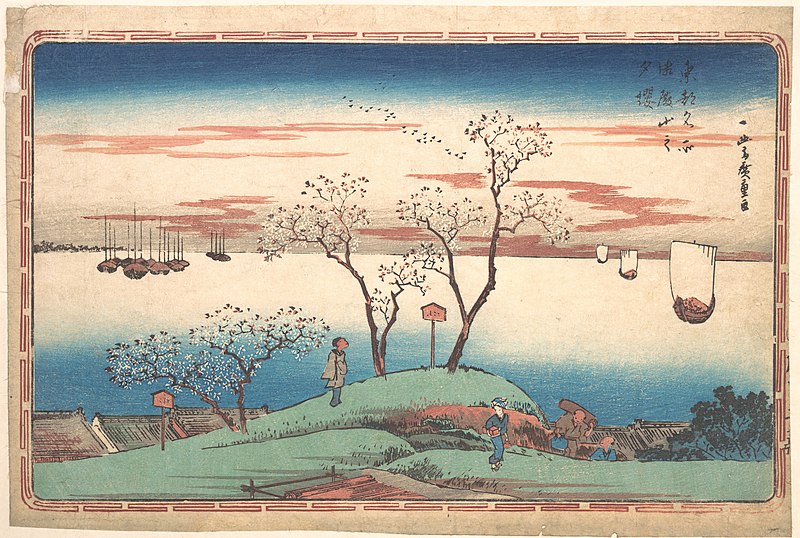
Evening Cherry Blossoms at Gotenyama – print by Utagawa Hiroshige, 1831.

Deborah A. Bennett’s Linden Trees

cars passing all day 
in between 
the silence of linden trees 

Deborah A. Bennett (USA)
(published previously in Wales Haiku Journal, Spring 2022)

Commentary

The stark comparison between cars and the linden trees in this haiku is a humble reminder of just how loud and fast-paced human life can be. Without notice, trees quietly and efficiently provide oxygen, store carbon, clean the air, and cool down city temperatures with their shade. I see trees as spiritual giants and their resilience is well-portrayed in this haiku. Trees were here long before humans and they do their work, regardless of human beings polluting the Earth on a daily basis. Ultimately, all human beings come and go, but the regenerative power of trees and forests can stand the test of time and has proven to regenerate, even after nuclear power plant disasters and cataclysmic events. This is partly due to the vast mycelium networks underground. Mycelium are master decomposers; they create more depth and nutrient-rich soil, but they also communicate and connect trees and plants in infinitely complex ways that we as humans cannot fathom. 

On the note of interconnectedness, perhaps this haiku can also inspire more people to use alternative ways of transportation that result in less pollution. We are physically made of elements from the Earth. If we see ourselves as not separate from the Earth as isolated individuals, but rather as spiritual beings who are intimately and deeply connected with the Earth and the Great Mystery, then I think more of us will naturally choose to be more mindful and lead better, more meaningful lives.

In short, this is an important haiku that juxtaposes fast-paced human life with the resilient power of Mother Earth and trees. A powerful haiku.

Jacob D. Salzer

Cars passing all day may be symbolic of the rush in our daily lives that revolves around materialism where one is involved in earning money, making a career, and living up to the expectations of the modern fast-paced life. I also see how these cars passing can be linked with pollution. With more carbon emissions and polluted air, we are running after a materialistic life. I can also see how vehicles are defining our social statuses and our routines. This mechanic life where distances become shorter to destinations creates vacuums internally in terms of health, lifestyles, and relationships.

The second line ‘in between’ demonstrates how miserable this life can be. The silence of linden trees might symbolize how we have muted nature, birdsong, and wind, and brought a pause to the natural cycle which is destructive in many ways. The linden tree is a remedial tree that is good for coughs and colds. We have not only destroyed the growth of trees but also ruined the healing process that usually comes from nature. Noise and air pollution have clogged our minds. Sometimes we cannot enjoy the nature around us or see how deeply it has affected us. The destructive aspects of nature can surprise us, as we are not fully attuned to it. So, our real success or progress is not our fast-paced life or technology that facilitates us, but the nature that keeps us moving on naturally and simply. It inspires us to focus more on our genuineness and real potential.

To me, this haiku is about the balance between nature and nurture, which is significant for a healthy and peaceful life.

Hifsa Ashraf

I like how this haiku can be read in various ways due to the pivot in the second line. It can be read as one flowing phrase, or as “cars passing all day” (full stop) and then “in between” (pause) “the silence of linden trees.” Additionally, it can be read as “cars passing all day in between” and then “the silence of linden trees” as a juxtaposition. This allows for multiple interpretations.

With the “silence of linden trees,” I believe this haiku might be placed in autumn. Without leaves, the trees don’t make a sound. The poet could also be speaking of the internal quiet of a tree or that it never speaks.

With a lack of punctuation, the pivot line can work its magic. A lot of haiku use punctuation in place of a kireji, or “cutting word.” However, in this haiku, the lack of punctuation seems to be a benefit.

The length of the lines is not standard for English-language haiku. Usually, it is a short first line, a longer second line, and a short third line. The poet could have placed the current first line as the third line, but that would do away with the power of the pivot in the original version:

in between 
the silence of linden trees 
cars passing all day 

It seems the poet is not so interested in following the standard format and writes haiku organically. This is commonly a sign of expertise.

Sonically, the L sounds carried throughout create a sense of softness. This reflects the silence well. The assonance of the A and E sounds also makes for a mellow reading.

With a combination of a meditative and melancholic feeling, this haiku brings us into a new state of mind that is once relatable and unfamiliar.

Nicholas Klacsanzky

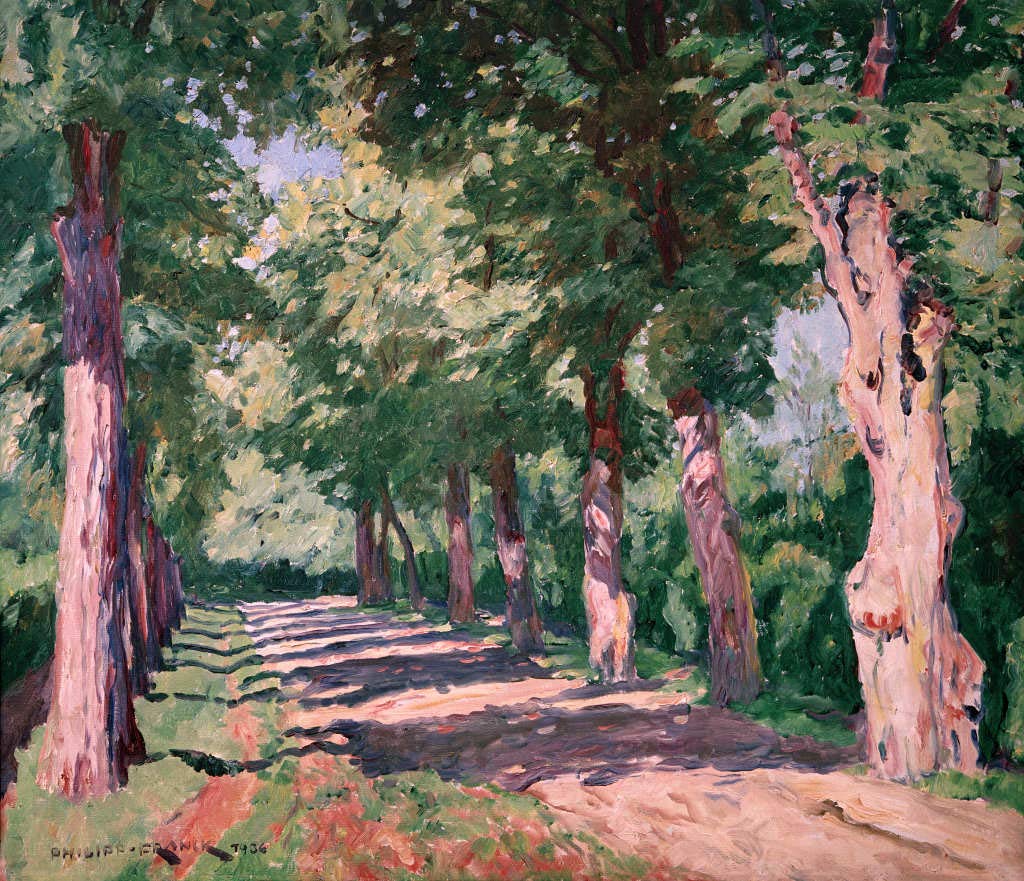
Painting by Philipp Franck, Avenue of Linden Trees