Cristina Rascón’s pueblo remains

peregrine falcons
rising into the blue . . .
pueblo remains


in Spanish:

halcones peregrinos
se elevan hacia el azul . . .
restos de pueblo

Cristina Rascón (Mexico)
(first published in Spanish in the Mexican journal Taller Igitur as a part of a rengay with Michael Dylan Welch called Bandelier)

Commentary

One of the main reasons I am attracted to this haiku is the focus on the term “pueblo.” The term can refer to both “a North American Indian settlement of the southwestern US, especially one consisting of multistoried adobe houses built by the Pueblo people” and “a member of any of various North American peoples, including the Hopi, occupying pueblo settlements chiefly in New Mexico and Arizona. Their prehistoric period is known as the Anasazi culture” (Oxford dictionary). So, this haiku may be speaking of recent remains or ancient ones.

In the context of the rengay the haiku is in, the content could be directly about the Bandelier National Monument. As Wikipedia says, “The monument preserves the homes and territory of the Ancestral Puebloans of a later era in the Southwest. Most of the pueblo structures date to two eras, dating between 1150 and 1600 AD.” Also, this haiku is the last link in the rengay, giving it a poignant finality. In each of the links, birds are mentioned. It is a fine choice to end with such a majestic and grand bird as a peregrine falcon. The preceding link by Michael Dylan Welch is:

a canyon wren
in the pinyon pine

The sound of “pine” from Welch’s link and “remains” from Rascón’s link matches well. The “o” sounds in each link also connect superbly. I also like the lift from the ground (pinyon pine) to the sky (into the blue).

This haiku might also be speaking to remains not only of buildings but also of human bones. According to the Kansas Historical Society’s Migration Magazine, “Many Pueblo peoples were forced to become servants in Spanish homes. Sometimes the Spaniards would cut off one foot of young adult males as a way to control them. The Spanish priests tried to convert the Pueblo peoples to Christianity. They pressured the Pueblo Indians by hanging, whipping, or putting them in prison.” I believe this haiku is speaking about the bleak past of these peoples and the rise of peregrine falcons into the blue sky is a symbol of nature reclaiming the lands. There might be an element of forgiveness or acceptance in this imagery.

I imagine the falcons rising from the remains themselves, akin to a lotus rising from the mud. Europeans have stained the history of these peoples, yet they endure. This haiku bravely provides optimism and beauty in the face of tragedy.

Nicholas Klacsanzky

A peregrine falcon is one of the fastest birds in the world. They hunt small mammals, reptiles, and insects. Symbolically, it has connotations with religion and prestige. I can see how this particular bird could be used to highlight dire situations in countries where there is starvation, war, or some kind of destruction.

I see it more from the perspective of war as peregrine falcons might allude to wrongdoings or a societal crisis due to conflicts and rage. “Rising into the blue” gives me a feeling of danger for people who believe in symbolism or have faith in archaic symbolic meanings and may prepare for the worst. But in this situation, it seems nothing has happened as such. The peregrine falcons rising into the blue may indicate the blue sky or a depressive situation where damage has been done. It shows how we as a society don’t give importance to nature’s sentiments.

In addition, I see the historic element in this haiku as the poet may be referring to something that happened in the past or maybe, a kind of folklore or a fable that revolves around the power and influence of falcons. These falcons could metaphorically depict the power of a clan, a tribe, a political party, or activists who use to influence or rein over the village with autocratic power. “Pueblo remains” is used perhaps to show how historical remains provide lessons to focus on what went wrong in the past and learn something from them—especially in the current era where every country is ready to begin a war without considering the destructive aftermath that may linger for many years and affects many generations.

In terms of punctuation, the ellipsis in the second line lets us imagine the tyranny of the political or societal powers that bring depression and destruction.

Hifsa Ashraf

The peregrine falcons rising into the blue could represent the spirits of the Pueblo people who have passed away and have escaped this world. Thus, this haiku could speak of a spiritual transition into the afterlife.

The rhythm of this haiku has a natural pace that is easy to read or say out loud. The “p” sounds start the first and third lines, which seems to add an echo and more gravity in the poem. Visually, the last line is buried beneath the first two lines, which also is a kind of portal into the remains of Pueblo ancestors whose generations span thousands of years. 

According to one website: “The Pueblo Indians, situated in the Southwestern United States, are one of the oldest cultures in the nation. Their name is Spanish for “stone masonry village dweller.” They are believed to be the descendants of three major cultures, including the MogollonHohokam, and Ancient Puebloans (Anasazi), with their history tracing back for some 7,000 years” (Pueblo Indians – Oldest Culture in the U.S. – Legends of America).

The word peregrine has Latin roots, which adds yet another dimension to the historical meaning of this haiku. 
According to nps.gov: “The peregrine falcon is one of nature’s swiftest and most beautiful birds of prey. Its name comes from the Latin word peregrinus, meaning “foreigner” or “traveler.” This impressive bird has long been noted for its speed, grace, and aerial skills. Now, it is also a symbol of America’s recovering threatened and endangered species” (Peregrine Falcon (U.S. National Park Service)).

Thankfully, this symbolism of hope is based on efficient action that was taken to remove the peregrine falcon from the endangered species list in 1999: “Many people are aware of the population declines of this species due to problems with egg-shell thinning caused by persistent organic pollutants such as DDT. Populations of this species were driven to the brink of extinction and the peregrine falcon was federally listed as an endangered species in 1973. Reducing DDT in our environment provided peregrine falcons with a chance to recover and the population in Alaska has grown rapidly from 1980 to the present. The American peregrine falcon was removed from the endangered species list in 1999” (Peregrine Falcon (U.S. National Park Service)).

The ellipsis in this haiku acts as the break or kireji and provides a pause before the third line. For me, the ellipsis adds mystery as to where the peregrine falcons go and where our spirits go after death into the Great Mystery. 

The poet chose to write pueblo in lowercase. Perhaps this signifies how the pueblo people are deeply unified with their environment versus seeing themselves as ‘above’ the Earth or as conquerors. 

An important haiku with deep historical and spiritual meaning. 

Jacob D. Salzer

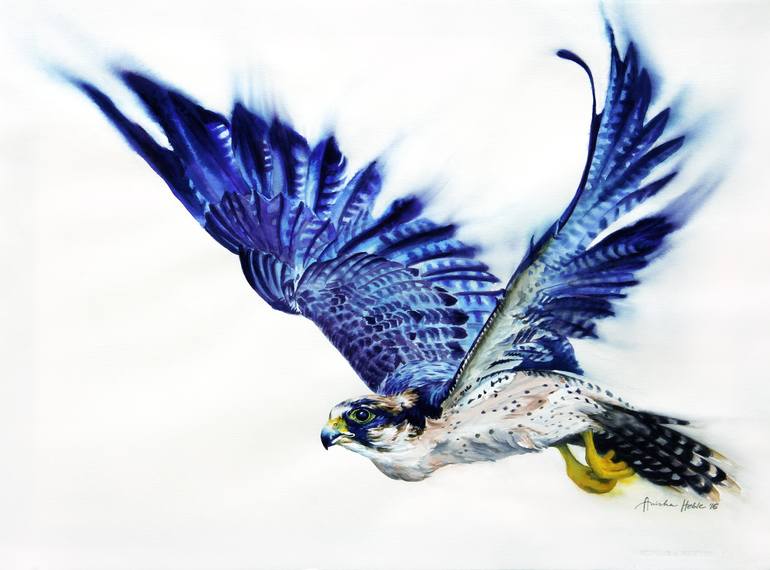
“Peregrine Falcon I,” painting, watercolor on paper, by Anisha Heble
Kala Ramesh’s notes

notes trickle
down a riverbed of sand …
the memory of water

Kala Ramesh (India)
 (Highly Commended, Santoka International Haiku and Haiga Contest)

Commentary

This is one of my favourite haiku. It is well crafted with all the necessary flavours of a great haiku that touches all the senses. I loved the way Kala used personification or a hint of surrealism, which lets our minds wander through this imagery and dig deeper into the theme of this haiku.

‘Notes trickle’ is rhythmic and musical to my ears. While reading, I paused for a moment and enjoyed the subtle and soothing sound of water. We all hear the sound of water daily but only a few of us truly listen to it and enjoy the sense of here and now where nothing else matters. It takes us further to the unseen part of this haiku where ‘trickle down’ allows the sound, message, or piece of music to be absorbed into the memory of a riverbed. This is how a haiku connects us to what is ‘beyond seeing’.

A riverbed of sand is the abode of many tiny creatures. It seems its water sings a song or a lullaby for the dwellers of the riverbed. It’s the sound of water that subtly captures the pulse of wind, rain, sunlight, moonlight, or the environment and transforms it into something that only active listeners can feel and hear.

The memory of water could mean a sort of live recording of the true essence of life, where even harsh weather or climate change can’t stop water from singing its songs. There is a lesson here for all of us to see how powerful the language of music is, which nature speaks every day to inspire us to sing along or at least appreciate. It’s a true blessing. Nature never ceases to connect with us through the language of its sound. With memories, we have sound, and it is important to recall the most positive of memories to transform our lives.

I can’t ignore the mystical or meditative side of this haiku. To me, it’s about mindfully focusing and observing every single moment of nature. This helps us to be crystal clear in our thoughts and soothe our minds with music—the most powerful language. If I were there, I would be like a whirling dervish who enjoys every single beat of water and synchronizes my feelings and thoughts with it to show the wholeness of the universe.

Hifsa Ashraf

I appreciate how the first line of the haiku focuses on the sound of water, without saying water outright. The water could be rain, or it could be the slow resurgence of a river that was dried up during a drought. This haiku may be depicting challenges due to climate change or perhaps depict a scene in a desert. If this is a drought and/or in a desert, I feel a sense of desolation and a stark sadness at the sheer lack of water. However, the verb “trickle” has a gentle and natural quality that brings me hope and eases the mind. The first line also leaves room to imagine notes from a musical instrument or perhaps we can hear notes from a bird singing. Even though this is a more abstract interpretation, I appreciate how the musical notes can synchronize with the water’s sound in my mind’s eye.

The second line focuses on the bottom of a river, which we often don’t see, either because of the river’s depth or, unfortunately, due to water pollution. In this haiku, the sand made me visualize a riverbed by the ocean. The riverbed provides a channel for the rain to flow into the sea. As a river loses its shape and merges into the sea, similarly, it seems the individual soul (Jiva) is ultimately on a quest to reunite with universal Divinity (Shiva). 

If this riverbed of sand is in a tropical forest by the ocean, I appreciate how the water in this haiku merges and dissolves into the sand and the unseen depths of the Earth, into unseen roots and fungi networks. There is an infinitely complex matrix that unites a forest and life underground that is nourished and powered by water. Here are two excellent interviews on this subject published in The Sun magazine: Hidden Worlds | By Mark Leviton | Issue 545 | The Sun Magazine and Going Underground | By Derrick Jensen | Issue 386 | The Sun Magazine.

The last line of this haiku has profound depth and universal power. All of life on Earth depends on water. Through the lens of biochemistry, our human bodies are 60-75% water. A person can survive one month without food but wouldn’t survive three days without water (Biological Roles of Water: Why is water necessary for life? – Science in the News). Unfortunately, over 600+ million people on this Earth don’t have access to clean water (Clean Water – Our World in Data). Focusing on the memory of water seems to relate to how water can change forms and disappear throughout eons of time, whether that’s mist evaporating or rain soaking into the Earth. Approximately 71% of the Earth is covered in water. According to one article, “Research funding partly by NASA has confirmed the existence of liquid water on the Earth’s surface more than 4 billion years ago” (NASA – NASA Scientist Confirm Liquid Water on Early Earth). With this in mind, the memory of water reaches far into the ancient past, into the history and birth of this Earth. At the same time, the memory of water in this haiku expresses just how precious and vital it is for our future. 

A powerful haiku with musical overtones that revers and honors the miracle of water.

— Jacob D. Salzer

When I read this haiku, I saw two interpretations: the wind running through a dry riverbed and creating sounds similar to the trickling of water. The second interpretation was that the poet saw the riverbed of sand and projected the music of water onto the scene. This is quite interesting because it illustrates that through our memories, what we perceive is often filtered by our past. It brings a sense of sadness that the only music we hear from the riverbed is from our minds. But on the other hand, it can be positive because it means we can hear beauty through memory even when nature is desolate.

In looking at the pacing of the haiku, we have the standard English-language haiku format of a short first line, a longer second line, and a short last line. This pacing approximately matches the traditional rhythm of Japanese haiku.

The kigo or seasonal reference for this haiku is probably summer due to the dryness of the river. However, the poet resides in India, which has six seasons. It may be in summer (Grishma Ritu), but I am not so knowledgeable about India’s seasons. This haiku might be telling us that even in harsh conditions, our memories can sustain us.

The kire or cut in the haiku happens in the second line with a grammatical shift made in the third line. The poet employed an ellipsis as an approximation of kireji or “cutting word.” The ellipsis seems to show the music being played in the poet’s mind or through the wind. It also symbolizes the continuation of the water’s music being heard despite the dry riverbed.

Since this haiku is about music, it can be expected that the poet has weaved sonic elements into it. The Os, Ts, and Ds stand out the most to me. This creates an interplay of soft and hard sounds, and perhaps this lends to the feeling of the poem being both melancholy and optimistic. When I read the haiku aloud, I hear the softness of the water’s trickle.

Overall, this haiku is a fine example of layered moods and imagery, with musicality in its content and its reading.

Nicholas Klacsanzky

Since Kala Ramesh is also a Hindustani classical singer, instead of artwork, here is a video of Hindustani classical music in Raag Puriya Dhanashree sung by Begum Parveen Sultana. I believe it encapsulates the mood of her haiku:

Kashiana Singh’s iris

regal iris
the purple scar
on my breast

Kashiana Singh (USA)

Commentary

This is a moving haiku that I feel is a portal into many challenges we face as a community. 

The juxtaposition between the regal iris and the purple scar speaks volumes about sensitivity, hope, and healing. Like most flowers, the regal iris is delicate with a beautiful yellow/white design on the petals when it blooms. The delicate connection between the iris flower and the poet brings me hope and a feeling of unity between the poet, the flower, and the Earth. 

The purple scar in this haiku could be from many things. It could be from past physical/domestic abuse, breast cancer surgery, or an accident. My first impression is the poet had breast cancer surgery or a biopsy and is now recovering from the procedure. In this interpretation, I feel the regal iris provides hope and comfort while the poet is faced with a cancer diagnosis (or a potential cancer diagnosis if a biopsy was done). Unfortunately, according to the CDC (Centers for Disease Control and Prevention), cancer is the second leading cause of death in the United States (source: FastStats – Leading Causes of Death (cdc.gov)) and according to the WHO (the World Health Organization), “In 2020, there were 2.3 million women diagnosed with breast cancer and 685 000 deaths globally. As of the end of 2020, there were 7.8 million women alive who were diagnosed with breast cancer in the past 5 years, making it the world’s most prevalent cancer” (source: Breast cancer (who.int)). In my own family, my mother has friends who are breast cancer survivors. A combination of chemotherapy, surgery, and a positive attitude got them through the treatment until they were cancer-free. I truly believe their positive attitudes and support from family and friends made a real difference in their treatment and recovery. The scars remain but they are like the markings of a true warrior. 

When looking up the color purple in relation to cancer, I discovered: “What color is used for cancer awareness? A light purple or lavender ribbon often is used to represent all cancers as a whole.” Furthermore, “The purple ribbon is most commonly used to raise awareness for animal abuse, Alzheimer’s disease, domestic violence, epilepsy, lupus, sarcoidosis, Crohn’s disease and pancreatic cancer” (source: What color is used for cancer awareness? – Know Breast Cancer). This adds another layer of meaning in regard to the color purple in this haiku. I discovered The Mayo Clinic has a good article on breast cancer prevention and lowering the risks: Breast cancer prevention: How to reduce your risk – Mayo Clinic.

Unfortunately, I also learned domestic abuse is surprisingly common in the U.S., according to an article in The Sun magazine: The Most Dangerous Place | By Tracy Frisch & Finn Cohen | Issue 537 | The Sun Magazine.

All this being said, this is a very touching haiku that speaks volumes about physical abuse, breast cancer, breast cancer recovery, sensitivity, hope, and healing. I greatly appreciate the poet’s vulnerability and hope her purple scar will bloom into much better days ahead. 

Jacob Salzer

Breast cancer is one topic that always remains sensitive and delicate like the disease itself. I have seen people sharing their personal experiences through poetry with some hope, light, and resilience and it is much needed to talk about this issue. In my country Pakistan, this issue recently got some attention as awareness programmes have been initiated by the government, which is a ray of hope for many people—especially women who avoid talking about this issue due to shaming, taboos, myths, or cultural barriers that ends up in a point of no return.

The regal iris is juxtaposed with a purple scar on the breast, which may be used in this poem for two reasons: firstly, the colour, structure, and delicacy that can be linked with breast cancer; secondly, the flower is a symbol of faith and courage. I can see more in it like the word ‘iris’ that is cleverly used in this haiku—maybe keeping in mind that it’s also a ring-shaped membrane behind the cornea and responsible for vision and sight. So, it may be how we perceive, interpret, and deal with breast cancer before and after treatment. Like I said earlier, there are many myths or taboos associated with breast cancer in my country. So, it depends on the perceptions of both the patient and the people in their surroundings.

The purple scar may indicate many perspectives but I will focus on three. First, it may indicate the initial or later stage of breast cancer where the breast gets purple due to the spread of the cancer virus. Second, it may indicate the treatment where the purple scar shows some healing—the slow one in this case. Third, it indicates the socio-cultural perspectives that bruise the life of a patient even if they survive it. Whatever the reason, I see hope and faith in this haiku due to the use of a regal iris that persuades us not to focus on other reasons and allows the life of the person to bloom again fully.

Hifsa Ashraf

I feel the poet used “regal” as both an adjective and as a possible term in taxonomy. Sometimes irises are referred to as regal flowers and even have names such as “prince iris, “queen iris,” and “his royal highness iris.” This may also vary across languages. These types of irises are most likely to be seen in the late spring gardens. So, you could place this haiku in late spring. This seems appropriate for the subject matter, where there is a sense of melancholy with the passing of spring.

For this haiku, there is no punctuation to emulate the kireji or cutting letter. However, the cut between the two parts of the haiku is clear. The fragment of the first line and the phrase of the last two lines are obviously delineated.

The comparison between the color of the iris and the poet’s scar has many implications, as Jacob and Hifsa have elucidated. The power of these two images side by side is that they interact, with beauty and tragedy interweaving. The result is a sort of unison.

This haiku is quite economical, being only eight words and 11 syllables. The lengths of the lines follow the standard for English-language haiku of a sort first line, a longer second line, and a short third line to model traditional Japanese haiku rhythm.

Looking at its sound, the Rs, Ss, and Ls stand out. There is a slant rhyme with “iris” and “breast” which brings a musical quality to the reading. The mood from the sound is somber but highly digestible.

With its color, imagery, sound, and societal relevance, this haiku has potent resonance.

Nicholas Klacsanzky

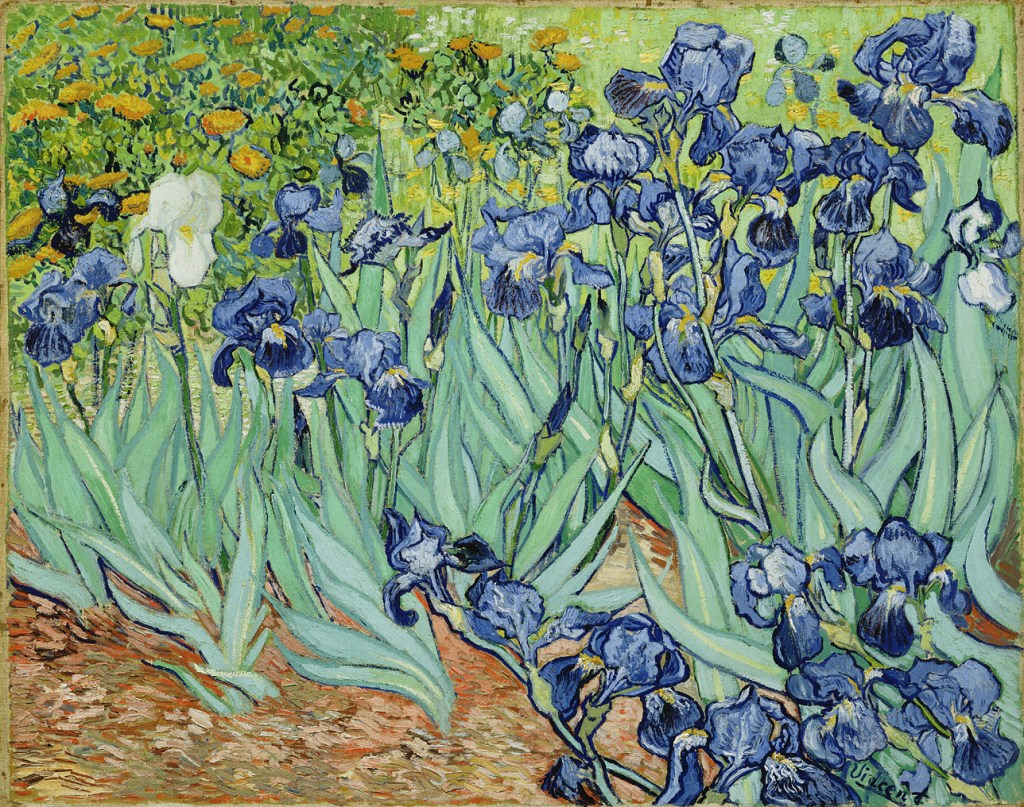
Irises, 1889, by Vincent van Gogh