Alan Summers’ nightfall

nightfall the key turns into a blackbird

Alan Summers (England, UK)

Publication credit:

First published: Blithe Spirit 31.4 (November 2021)

Article: 

The Unseen Go-Between in Haiku by Alan Summers
Haiku Society of America Haiku Spotlight (January 2022)

Award Credit

Runner up: Museum of Haiku Literature
Blithe Spirit vol. 32 no. 1 (February 2022)

Commentary

I appreciate the mystery (yugen) in this haiku and the possible interpretations. I initially felt a kind of fantasy-surrealism in this monoku. “The key” could be to a door, and if so, a door to what? Is the key a door that leads inside a physical building or room? Is it a key to a door that leads outside a building? Or, is this a key to a psychological door in the poet’s mind or within someone else’s psyche? In one interpretation, I get the feeling the key is turning and opening a locked door in the poet’s house leading outside. I like how the door does not need to be said in the monoku for me to imagine it.

I think “nightfall” effectively sets the tone and a mysterious atmosphere. I also think the double meaning of “turns” adds more depth to the monoku. Did the key physically turn into a blackbird? Or, did the poet open the locked door and simply saw a blackbird at night? Is the poet dreaming or daydreaming? Is this a monoku about the poet reading a fantasy novel? Did the door release a blackbird from a confined physical and/or mental space? Perhaps a limited physical room could symbolize a confined, limited mind or mental concept. When I see the key turn, I feel a door opening and the blackbird is released and disappears into the night. In that sense, perhaps the spirit of the blackbird is a key that opens the door to the Great Mystery/unseen dimensions of life and simultaneously opens the poet’s mind to a different way of seeing. 

If taken literally, I see the key transforming into a blackbird could symbolize how something that appears to be a concrete image (in this case, the key and the blackbird) is actually full of depth and mystery. It’s interesting how a single key can unlock possibilities and also lock a door and protect us from danger. I also get a sense that the blackbird is being honored and respected in this monoku, especially in relation to the night and the Great Mystery. I appreciate how this interpretation resonates with Indigenous spirituality. There are many Indigenous myths and legends about various birds. I also appreciate how this monoku expresses the beauty and importance of having an open mind. The poem encourages us to have the courage to see the world from different perspectives versus staying in our comfort zone and familiar ways of seeing and labeling. An intriguing and powerful monoku. 

 — Jacob Salzer

Nightfall is a shift in the day which brings mysteries with it. Symbolically, it unfolds a different world that manifests our true state of mind and heart. A time when we rarely see things through the lens of others and try to unfold our own stories. A time when we can fully concentrate on what matters the most in our lives. A time when certain realities are revealed to us through introspection or pondering.

Nightfall in this one-line haiku shows the vastness and significance of time, which motivates us to pause and imagine the scene that may look more inspirational and persuasive in this particular poem. The shift in the poem is the ‘key’ which reveals the mystery or unfolds the story; it can be the cognitive process that productively grasps the whole situation and gives flashbacks; it can be the meditative state of mind that unwinds the day’s fatigue by opening the doors of imagination or mysticism and brings some peace; it can be the solution to a problem when a person finds a creative solution and is able to find a way through critical thinking; or, it can be simply daydreaming when a person seeks solace in imagination and manifests their imagination in the most creative and surprising way, which looks magical in the end.

A blackbird symbolizes mystery, death, and magic but it is also significantly considered a sign of spiritualism or transformation. In this poem, nightfall transforms a person’s life where they can turn the key into something that looks more blissful and peaceful.

Overall, the poet challenges our senses to imagine and capture the vivid image of this poem and lets our creative faculties run wild and find how nightfall can spellbound us to see what we want to see or to see beyond seeing.

Hifsa Ashraf

The blackbird in England can be seen year-round. However, their mating season stretches from March up until July. So, perhaps this is a spring haiku. This relates well to the key possibly turning into a blackbird, as spring is a time of transformation. 

There is no kireji or cutting word in this monoku, which is common in English-language haiku that run as one line. There is a clear grammatical break after “nightfall,” though. 

However, you could say the haiku could be read as one flowing phrase, with “nightfall” being a verb that acts upon “the key.” Then, “turns” would be the second part of the haiku. 

“nightfall” also goes well with transformation as many things change during the night. Because of the darkness, things can be perceived differently. A person might imagine a key turning into a blackbird. A person might also imagine turning a key and going into an apartment or house and seeing a blackbird in the darkness. In this respect, the haiku might be speaking about human perception and its possible manipulation or trickery. I feel that the night, the key, and the blackbird are ultimately the same. 

This haiku is succinct with no word out of place. Also, the lovely soft sounds of the letter L contrasting with the sharp tick of the letter T make this haiku musical and layered.

A haiku that begs to be read over and over, it presents an abstract idea in a concrete sense.

Nicholas Klacsanzky

Copyright: © Arte Ivanna

Adrian Bouter’s lakeside mist

lakeside mist
takes the shape of a heron
morning news                 

Adrian Bouter (the Netherlands)
(previously published in Wales Haiku Journal, spring 2022)

Commentary:

The heron is frequently used in haiku for its features, colour, style, and voice in association with people’s realities. The heron can symbolize stability, knowledge, wisdom, and tact, which can be observed in its natural habitat which is usually a lake. Lakeside views are scenic and vivid, and give an overall perspective that is often mesmerizing and mysterious.

Being a nature observer, the poet shows the comparison between lakeside mist with what’s going on with their life, where new and creative perspectives help to filter and understand information such as news. It’s quite meditative, where a person gets relief through living close to nature by not trying to overthink about their situation. It’s obvious to me that the lakeside mist is more symbolic in this situation, where it acts as a canvas where a person paints their feelings—or circumstances are not clear to them.

The shape of a heron shows the delicacy of the situation, which might demonstrate how a person seeks solace in escapism through imagination, assuming the situation is in their control. This also shows how creatively we can solve our problems by merely seeing different but interesting perspectives. Morning news may vary from person to person. In this situation, it looks more like unpleasant or mundane morning news that the poet was not expecting. 

Hifsa Ashraf

I appreciate the mystery (yugen) in this haiku. The lakeside mist evaporating and revealing the heron could mean the news is revealing things that were once hidden from view. On the other hand, I could also see the morning news is the mist evaporating. What is revealed is something as ancient as Mother Earth and the heron. 

I’ve noticed every time I see a heron, he/she is alone. It seems they spend much of their time in solitude looking for fish. I equated this with the poet who also spends much of their time alone with Nature in solitude. 

It seems the morning news on TV or in a newspaper is often filled with negative events. I wonder if this haiku is expressing the poet’s struggle to find a resolution to all the noise of the morning news. This haiku for me shows how Mother Earth and the heron provide peace and solace. The morning news seems to be telling the story of human civilization while Mother Earth tells Her stories without words or thoughts. However, I also like how morning news could be the news of something personal going on in the poet’s life. In that interpretation, it could be good news.

The evaporating mist is a beautiful image that depicts impermanence. I get the stark reminder that our lives and the morning news are, ultimately, as transient as lakeside mist. However, the most beautiful part about this haiku (for me) is the peace and solitude found in both the poet and the heron. I think this is a haiku that encourages us to find peace in the chaos—to discover the calm eye of the storm.

Regardless of our interpretations, this haiku uses sharp images, yet also gives space for us to experience the moment. A strong haiku with meditative, philosophical, and psychological undertones.

 —Jacob D. Salzer

Upon research, herons are quite common in the Netherlands and are often sighted in Amsterdam. It is hard to tell which seasonal reference or kigo this haiku provides, but I would place this perhaps in spring. I can imagine a spring mist on a lake and herons being ubiquitous in this season. This lends power to the phrase “takes the shape of a heron” as spring is a time of new things coming and forming.

There is strictly no kireji or cutting word in this haiku, but the line break in the second line does it enough justice. There is an apparent syntactical break from line two to line three.

The association between morning news and the lakeside mist taking the shape of a heron is intriguing, creating a strong sense of toriawase, or layered juxtaposition. The poet has done well not to make the association too far or too close in connection, which is the essence of the art of haiku.

The length of the lines or pacing of the haiku is standard for English-language haiku, where the first line is short, the second line is longer, and the third line is short. This format emulates the traditional rhythm of Japanese haiku.

In terms of sound, my attention gets pulled toward the “i” and “o” sounds. The sharpness of the “i” contrasts well with the softness of the “o.”

Finally, this haiku follows the principles of brevity and simplicity in language. The feeling or mood of the haiku is easily accessible due to its language and flow. A wonderful haiku overall.

Nicholas Klacsanzky

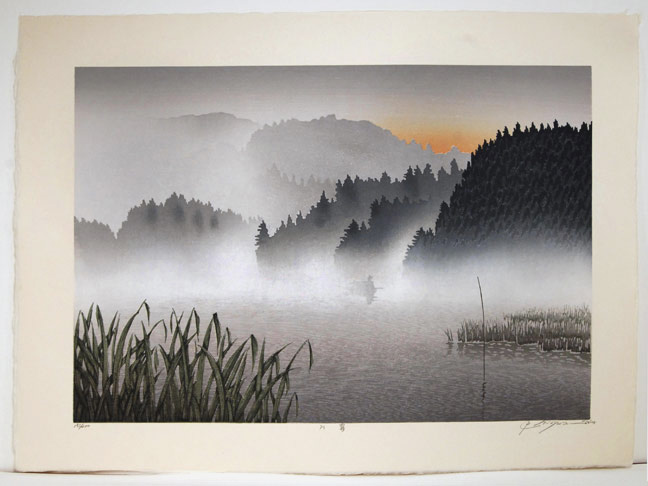
Mist Over the Lake by Shufu Miyamoto

R.C. Thomas’ silver lining

silver lining—
what the storm takes
from the magpie’s fable

R.C. Thomas (UK)
(Joint First Place, Sharpening the Green Pencil Haiku Contest, 2022) 

Commentary:

Magpies in various fables symbolize being prudent, wise, and cunning. A magpie in a fable, no matter who wrote it, is interesting and has a central place in the story. The bird itself is known for its self-centered nature that it uses to protect itself from threats. This haiku has cleverly placed the nature of a magpie by referring to a fable that centers on it. I may consider the fable as an allusion to empower the rest of this haiku. Irrespective of the discussion about the magpie being considered a good or a bad omen based on natural history, old literature has used this bird significantly in stories, poems, anecdotes, and fables, which shows how frequently it is connected with the daily lives of many people as a social bird.

Silver lining” is symbolically used to represent how easily we can get lessons from the birds around us, perhaps. The magpie, being a prudent and cunning bird, knows how to get something beneficial out of a difficult time, which is no less than a storm. I see a problem-solving aspect here where the poet tries to justify the nature of a magpie by giving it a central position and trying to convince us to see how things work when we use our minds actively and wisely no matter how hard the situation is. It also gives us a sense of realization that we as people are provided with many examples in our surroundings that can help us learn something positive. Just like in old times, people used to write fables inspired by nature and the creatures in their surroundings.

Now coming to the imagery of this haiku, I see it as black and white where the silver lining (light colour) blends with storm clouds (dark colour), and both are linked with the colours of the magpie. This can show how deeply our thoughts are linked with the shades of life and how they can reshape our approach to life.

Hifsa Ashraf

The personification of the storm in this haiku is interesting. I feel the storm is animated and full of Spirit. 
It seems the main message in this haiku is that words have power and have been affecting both humans and non-humans over thousands of years. It seems it is not only the words themselves but the energy, principles, and intentions behind the words that have significance and power. Along these lines, there are many interesting Indigenous myths and stories involving various birds, floods and storms born out of a deep reverence and respect for the Earth. I suspect there are fables about birds and storms in every culture. 

In regards to the storm in this haiku, in the book Black Elk Speaks, the Indigenous Medicine Man named Black Elk talks about his experience being in a colonized city for the first time. He says: “I was surprised at the big houses and so many people, and there were bright lights at night, so that you could not see the stars, and some of these lights, I heard, were made with the power of thunder” (Neihardt, page 135). In the notes, it says: “The Lakota word for electricity is wakhágli ‘lightning,’ hence “the power of thunder” (Neihardt, page 323). In other words, Black Elk had only seen electricity before in the form of lightning and he called storms and lightning Thunder Beings as a form of spiritual energy to be respected with reverence. 

In another interpretation, the storm in this haiku could possibly be a mental storm, perhaps caused and/or partly influenced by the fable itself. Along these lines, I think about the mistranslations and misinterpretations in some fables, and how words can be misused and abused. Unfortunately, as one example, some of the fables and metaphors found in certain religious texts are severely mistranslated and include stories of violence and dominance with a heavy emphasis on sin, fear, punishment and “my way or the highway” thinking. Furthermore, Divine Power is expressed in certain religious texts using only male “He” and “His” pronouns, consequently degrading the beauty and power of women. 

This is a consequence we all pay the price for and has clearly done a great deal of harm. In my view, if both men and women embrace the spirit of sensitivity and compassion within themselves, then we have a chance to make significant progress. 

Despite the negative consequences of certain fables, the silver lining in this haiku tells me the poet sees the bigger picture, and that the fable itself likely includes very challenging circumstances we can learn from. In short, depending on the fable, I see a potential mix of both negative and positive outcomes. Reading the fable itself could also perhaps inspire us to (pun intended) brainstorm better ones. If we look at the definitions of fable, we have: 

1) a short tale to teach a moral lesson, often with animals or inanimate objects as characters; apologue

2) a story not founded on fact

3) a story about supernatural or extraordinary persons or incidents; legend: the fables of gods and heroes.

4) legends or myths collectively: the heroes of a Greek fable

5) an untruth; falsehood: this boast of a cure is a medical fable

6) the plot of an epic, a dramatic poem, or a play

7) idle talk
Source: Fable Definition & Meaning | Dictionary.com

These definitions give us a better idea of what a fable is. In short, I see the word fable as a psychological portal into the human psyche.

The good news is, if the mind is conditioned, it can also be unconditioned. There are, indeed, many ways of seeing the world and many different ways of life. Even if someone has a specific philosophy or spiritual path, my sincere hope is they are also open-minded to other respectful, meaningful philosophies. 
I also strongly feel Mother Earth has many gifts we can all learn from. One of the greatest lessons I’ve learned from Mother Earth is the power of silence. It seems there is great wisdom in being quiet in Nature. This reminds me of a quote by Bashō: “Follow Nature and return to Nature.” Along these lines, when I read “magpie’s fable,” I initially heard stories of the bird’s life through his or her songs vs. human-made fables about the magpie. 

As a final interpretation, if taken literally, I can see light-hearted humor in this haiku as the storm has no ears to hear our human-made stories, nor does the magpie have English words to form the fable. The storm continues, and it will eventually pass, with or without humans and our stories.


Regardless of our interpretation(s), this haiku explores the deep psychological space between the human mind and Mother Earth. I think it also reminds us to be careful with our words and to be mindful of their effects and possible interpretations. An interesting and important haiku. 

 — Jacob D. Salzer

Hifsa and Jacob have explored this haiku in great depth. I’ll briefly comment on the kigo, kireji, toriawase, pacing, and sound of this poem.

The kigo, or seasonal reference, of this haiku could be between August and October since magpies are most active during this time. This makes this an autumnal haiku. The storm adds to this assumption.

The kireji, or “cutting word,” in this haiku is shown as the em dash in the first line. It successfully separates the two parts of the haiku while also giving us time to pause to imagine a silver lining.

The toriawase, or juxtaposition, is the association between the natural and fictional world. The wisdom and ingenuity of the magpie in fables are compared to a silver lining during a storm. A wonderful thought.

In terms of pacing, the length of the lines is a bit different than the standard in English-language haiku because the third line is long while it is usually short. However, the poet wrote the haiku organically and well-framed, because if the first line was placed as the third line, it would not be read as well. Also, the word “takes” is a fine place to cut the line to create suspense.

Finally, looking at the sound of the haiku, the many “i”s and “l”s create a combination of sharp and soft notes. This relates well to the rumble of a storm and the lesson of a fable.

A unique and fresh haiku with significant overtones.

Nicholas Klacsanzky

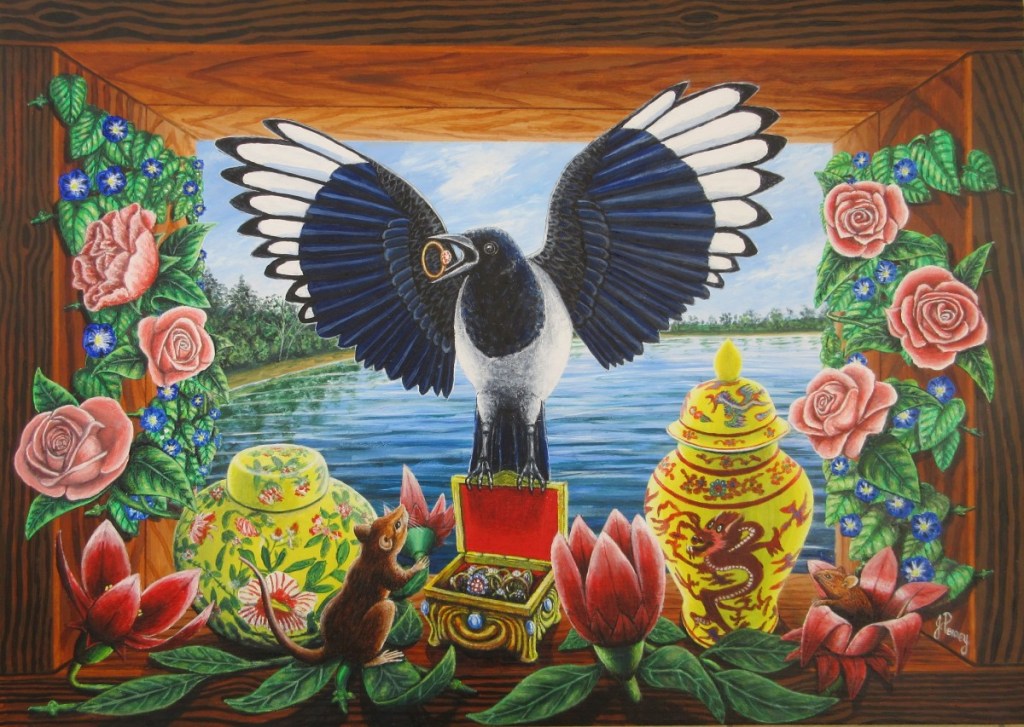
“Fantasy Magpie Fable.” Acrylic on deep wooden support by John Penney.