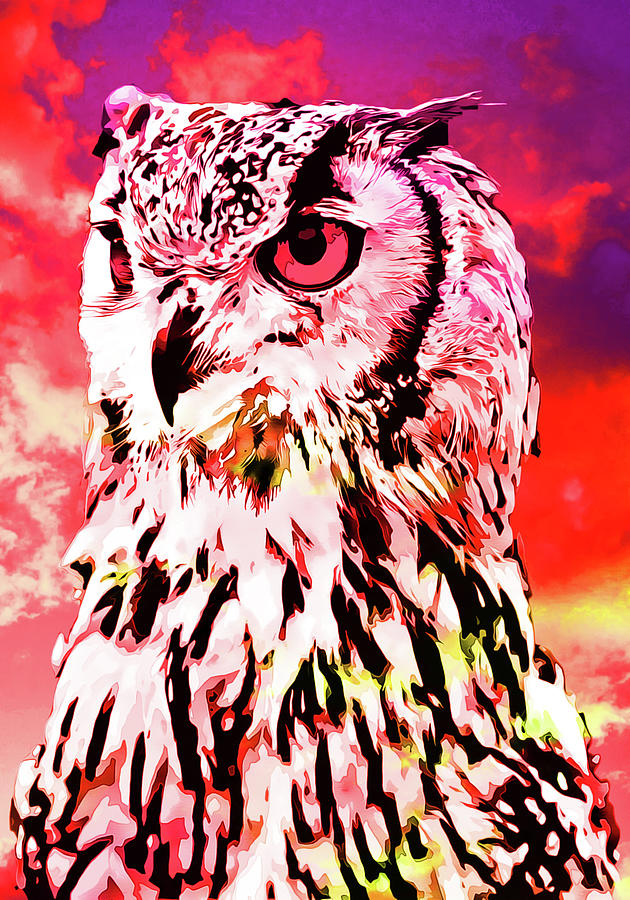
caught
between two worlds
an owl at sunset
— Luke Levi (USA)
(previously published in Fireflies’ Light, issue 25)
Commentary
I immediately connect with this haiku, partly because I am drawn towards Indigenous spirituality and appreciate how they acknowledge everything has a Spirit in the Great Mystery of life. I also connect with this haiku because I have seen owls in person that have inspired writing a few haiku about owls and their dreams. When I read “caught between two worlds,” I imagine twilight or what some people call the “golden hour” between day and night. It has been said that twilight can inspire mystical or spiritual experiences.
At the same time, I appreciate how the poet left the first two lines open for interpretation. When I read “caught between two worlds,” my first interpretation was the gap between the material/seen world and the Spiritual/unseen world that actually may not be seen as separate at all. The Buddhist saying: Form is Emptiness and Emptiness is Form comes to mind. Even atoms are mostly “empty” space. Therefore, it seems material forms are not as concrete as they appear to be. The two worlds could also be between a lifetime on Mother Earth and a spiritual afterlife after physical death. As the sun sets into the mysteries of night, this could be a symbol for our last breath into the afterlife. The two worlds could also be between the waking-dream state that many call “reality” and the world of sleep, dreams, and the subconscious. Possible states of consciousness between these two worlds are the hypnopompic (the state right before entering the “waking” world) or the hypnagogic state (the state right before falling asleep). Regardless of our interpretation(s), I think this haiku has a universal appeal and significance.
In more down-to-earth terms, I think “caught between two worlds” could easily apply to a wide range of relationships between two people with very different backgrounds and/or worldviews. In a broader sense, the two worlds could even be two cultures, two perspectives, or two sides of a war, etc. It seems the word “caught” holds inherent tension. It’s interesting to observe worlds within worlds here on Mother Earth: from microscopic/quantum to macro/cosmic perspectives and everything in between.
In Indigenous cultures, there are myths and legends about owls. Owls are excellent observers who are very quiet. It’s been said they mostly live their lives in solitude. In this perspective, one interpretation is the poet might be deciding whether or not to be (or possibly remain) single vs. be in a relationship. The word “caught” could imply uncertainty.
In short, I feel this haiku expresses animistic/Indigenous spirituality, different perspectives, and the depth of relationships and solitude. I also feel this haiku is also a portal into the world of dreams and the subconscious. It seems to carry contemplative power and encourages introspection. I think it also has the power to open our hearts and minds to what is possible in this lifetime. Perhaps it can encourage us to try our best to resolve conflicts. Ultimately, it seems in the gap between two worlds, we can silence the mind and experience peace. A powerful haiku.
— Jacob D. Salzer (USA)
The poem starts with the simple word ‘caught’ that resonates a lot and pauses our thoughts to think for a while before moving on to the next lines. The two worlds can be interpreted as: changing seasons, day and night, present and past, life and death, or time and space. Whatever it is, there is a transition where something got stuck, and it is experiencing some sort of unknown circumstances. Being inclined to spiritualism, I can see the two worlds as materialism (outer self) and selflessness (inner self). It’s more like yin-yang where one world reflects the other, or where one world overshadows the other one, causing chaos, confusion, or bewilderment. I also see ‘caught’ as a threshold level where a person initially tries to adjust to what is not visible or known to them.
The third line reveals some specifications of two worlds where ‘owl’ and ‘sunset’ may project time and space. An owl can symbolize wealth, prosperity, a good omen, wisdom, or fortune but in certain other cultures, it is a sign of bad omen. Keeping both aspects in mind, an owl as a nocturnal bird personifies our life as a combination of both good and bad, where a person struggles by exploring their inner and outer worlds—passing through ups and downs but with choices. It depends on where a person’s locus of control is. The sunset gives a clear demarcation of two worlds where the light enters into darkness and opens the new horizon, which may be subtle or sophisticated for a person if their senses are intact with reality.
— Hifsa Ashraf (Pakistan)
If I were to say what the kigo or seasonal reference is for this haiku, I would say winter. Owls are commonly a kigo for winter in the haiku tradition, but they may be different in various locales. Winter is often seen as a magical time, with gleaming snow and the cold that brings about a whole new landscape. This relates well to the supernatural symbolism of the owl.
In terms of how the two parts of haiku operate, we have the cut in the second line with the line break. It’s not a direct juxtaposition, but rather an association between the sunset and two worlds, plus the owl itself and two worlds. The sunset is a transition from one time to the next, which could be said to be another world. The owl, as we have discussed, has mystical qualities that can be seen as a bridge between two worlds or dimensions by many cultures.
This haiku might contain yugen or as described by Zeami Motokiyo: “To watch the sun sink behind a flower clad hill. To wander on in a huge forest without thought of return. To stand upon the shore and gaze after a boat that disappears behind distant islands. To contemplate the flight of wild geese seen and lost among the clouds.” There is a sense of natural awe and mystery in this haiku, plus a possible nod to nothingness as espoused by Buddhism. The nothingness in this haiku is the owl not being a part of any world, where its identity is gone. The nothingness in Buddhism is not physical but rather the emptiness of identity.
Two letters stand out to me when I read this haiku out loud: “t” and “o.” The letter “t” is great at creating an atmosphere of starkness and the letter “o” is excellent at slowing down the pace and making a piece more contemplative.
The format follows the common short-line-short lines sequence of English-language haiku that try to match the 5-7-5 sound units in Japanese judiciously. Most haiku by masters are between 6-9 words, and this one fits in nicely with eight. This ensures brevity and the effectiveness of expression.
The feeling behind this poem is deep, philosophical, and introspective. We need more haiku about owls in English, and this is a fine addition.
— Nicholas Klacsanzky (USA)


 Haiku Commentary