Ueshima Onitsura’s Icicles

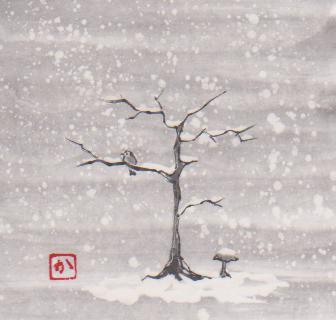
why
are some icicles long
some short?

– Ueshima Onitsura (1660-1738) (Japan)

I want to mention a few things about Onitsura before I look at his haiku. He was a Japanese haiku poet of the Edo period, famous in the Osaka region for his haiku poetry. Belonging to the Danrin school of Japanese poetry, Onitsura is credited (along with other Edo-era poets) of helping to define and exemplify Bashō’s style of poetry.

Born to a family of brewers in Itami (present-day Hyōgo Prefecture), Onitsura showed exceptional talent in poetry at the age of eight. At the age of 25, Onitsura moved to Osaka, where he begun his professional career in haiku and other forms of poetry.

Although he never became as influential and famous as Basho, Onitsura has a strong place in the history of haiku. In R.H. Blyth’s words, a prominent translator of haiku:

“Onitsura composed the first real haiku. They show his genius; they show pure nature; they best express his unintellectualized experience; they are ‘a sort of thought in sense.’ His verses are simple and easy, melodious, and poetical. Contemporary with Basho, he was independent of him, and the chief difference between the two men was in their power of making disciples. … The poetry of Onitsura has something in common with that of Robert Frost.”

With that being said, let’s dive into one of Onitsura’s haiku, which I greatly admire.

At first, it looks extremely simple. It seems almost like a question a child would ask. However, it is a deep question that reflects Onitsura’s Zen practice (in his old age, he stopped writing haiku to practice only Zen).

There is no answer to the question. Icicles simply grow the length they are through random processes. There is no fate, no engineering. They form spontaneously. The length of the icicles is not important in this haiku, only the act itself of forming an icicle, which has nothing to think about it.

Whether long or short, an icicle is an icicle. Part of the wabi-sabi philosophy of Japan is to accept things at they are, and seeing beauty in seeming imperfection. In this sense, no matter how long or short, each icicle is perfect in its own way.

Essentially, Onitsura is asking readers to ponder why things are the way they are. The easiest answer: they are because they are.

Here are some more haiku by Onitsura for your reading pleasure:

skeletons
all prettily made up –
cherry blossom viewing

there is no place
to throw the used bath water
insect cries!

this cool breeze –
the empty sky fills
with the sound of pines

though I have no lover
I too rejoice:
the change of clothes

my soul
dives in and out of the water
with the cormorant

Thank you for reading and taking the time to learn more about haiku.

– Nicholas Klacsanzky (Ukraine)

Christina Sng’s Conversation

winter evening
grandma dozes off
mid-conversation

© Christina Sng (Singapore)

Kokako 25, September 2016

What stroke me the most about this haiku was the ambiguity of the last two lines.  The act of dozing off could mean simply that her grandma was sleeping or that she had passed away.

It might not be so unclear though, as winter evenings can be harsh and lonely, and Christina sets an appropriate mood for death.

However, there is also an air of comedy as well. If she wrote, “grandma closes her eyes/mid-conversation” it would be much more obvious as to the poet’s intentions.

In haiku, though, ambiguity is a strength. Part of the reason why masters of haiku are read throughout centuries is because their haiku was not straightforward. Reading a haiku over several years, and maybe a lifetime, can yield discoveries of new layers of meaning and/or implication.

If one reads this haiku out loud, the second line seems light in mood, whereas the third line seems more serious. Plus, “winter evening” is a serious seasonal reference or kigo. So, I don’t want to pin down this haiku, but I am leaning more on the serious than the comical.

Though seasonal references are not required in haiku, they do add a lot of historical and philosophical information. With “winter evening” Christina adds our collective memories of winter evenings. They are often stark, lonely, harsh, but also a time for families to come together. In fact, each season is a duality. Winter is harsh, but brings us together for holidays and to escape the cold. Spring is the time of blossoms, but sometimes winter’s harshness remains, which is shown in what does not blossom. Summer is a fun time and full of energy, but the sun sometimes causes famines and natural disasters. Autumn is when the natural world is dying all around us, but in such a beautiful form that sometimes we forget about the suffering nature is enduring.

Just like winter being double-sided, so is this haiku. You can feel sadness, comedy, or maybe an indescribable mixture of both. This haiku shows us the spontaneity of life, and possibly death. Though we try to control our lives and manage our surroundings somewhat, we are far from being rulers over our lives.

Looking at it sonically, the “i” sound in the first line makes the winter even starker. The “o” sound carried through the last two lines show the lull and continuation that is insinuated. I think Christina made a smart choice not to use punctuation or kireji (cutting word) in the first line, as she already used a hyphen in the third line, and using a dash or ellipses may have looked awkward.

Technically, sonically, and atmospherically, this is a poignant haiku that begs to be read over and over again.

– Nicholas Klacsanzky (Ukraine)


Saigyō Hōshi’s Wind

how can we quell
the burning thoughts
that inflame the body?
only by encountering
the cooling wind

– Saigyō Hōshi (Japan)

Tr. Stephen Addiss

Before I dive into the tanka itself, I want to supply some information about this renowned Japanese writer.

Saigyō Hōshi (西行 法師, 1118 – 1190) was a famous Japanese poet of the late Heian and early Kamakura period. Born Satō Norikiyo (佐藤 義清) in Kyoto to a noble family, he lived during the traumatic transition of power between the old court nobles and the new samurai warriors. After the start of the Age of Mappō (1052), Buddhism was considered to be in decline and no longer as effective a means of salvation. These cultural shifts during his lifetime led to a sense of melancholy in his poetry. As a youth, he worked as a guard to retired Emperor Toba, but in 1140 at the age of 22, for reasons now unknown, he quit worldly life to become a monk, taking the religious name En’i (円位). He later took the pen name, “Saigyō” meaning Western Journey, a reference to Amida Buddha and the Western paradise. He lived alone for long periods in his life in Saga, Mt. Koya, Mt. Yoshino, Ise, and many other places, but he is more known for the many long, poetic journeys he took to Northern Honshū that would later inspire Matsuo Bashō in his Narrow Road to the Interior. Some main collections of Saigyō’s work are in the Sankashū, Shin Kokin Wakashū, and Shika Wakashū. He died in Hirokawa Temple in Kawachi Province (present-day Osaka Prefecture) at the age of 72.

In Saigyō’s time, the Man’yōshū was no longer a significant influence on waka poetry, compared to the Kokin Wakashū. Where the Kokin Wakashū was concerned with subjective experience, word play, flow, and elegant diction (neither colloquial nor pseudo-Chinese), the Shin Kokin Wakashū (formed with poetry written by Saigyō and others writing in the same style) was less subjective, had fewer verbs and more nouns, was not as interested in word play, allowed for repetition, had breaks in the flow, was slightly more colloquial, and more somber and melancholic. Due to the turbulent times, Saigyō focuses not just on mono no aware (sorrow from change) but also on sabi (loneliness) and kanashi (sadness).

To me, Saigyō is a great self-realized poet who showed his depth of spirituality through symbolism. This tanka is no exception. The idea that thoughts can inflame the body is quite a Zen idea, I would say. The Zen state is being aware without thoughts. The burning might be real or metaphorical. If we indulge in thoughts, we set our reality ablaze instead of seeing it in its natural serenity. Speaking on a physical level, thoughts are reactions to stimuli, and these reactions can even heat up our liver and cause our body to heat up.

However, the last two lines can also be taken literally or figuratively. Saigyō was a wanderer and hermit who survived harsh conditions. He may have been giving credit to nature to exposing him to his true self by settling his thoughts through cool wind. But this also could be a reference to the wind that Bashō said called him to poetry. This wind, felt on the palms and above the head when one is a self-realized person, has been described in many spiritual practices and traditions, including Zen. It is interesting he says “cooling wind” instead of “freezing wind or “cold wind,” as “cooling wind” points more to a soothing experience, and possibly to the experience of wind being emitted from the hands and above the head from enlightenment. To some readers, feeling a cool breeze coming out of one’s hands and head may seem far-fetched, but this experience has been recorded by Christian, Islamic, Hindu, Buddhist, and many other traditions in the past and currently.

Personally, I believe Saigyō is talking directly about his experience as a self-realized person, and tells readers that they need to feel their eternal spirit to fully dispel their thoughts in order to know reality. Unless and until we experience this, reality will always be clouded by what we think of it.

– Nicholas Klacsanzky (Ukraine)

Christina Sng’s Walk

walking home
from the hospital
a lone daffodil

Bottle Rockets #35, August 2016

© Christina Sng (Singapore)

I appreciate how this haiku allows for different interpretations for
the reader. Is the feeling of solitude one of joy and resolution
because the person is no longer confined within the walls of a
hospital? Or is it one of loneliness because a person is walking home
alone with no one to greet them at the door? There is room and space
left for interpretation, and emotions are generated from pure
observation.

I also enjoy the last line “a lone daffodil.” It brings rich
possibilities of where this daffodil is: perhaps growing from a crack
in the sidewalk or growing within a garden patch surrounded by
different types of flowers. I get a feeling of strength that this
daffodil is thriving, alone, no matter what environment is conjured up
within the readers’ imagination. An excellent haiku.

Jacob Salzer (USA)

Tzetzka Ilieva’s Starry Night

starry night…
the school custodian carries the flag
on his shoulders

© Tzetzka Ilieva (Bulgaria)

Acorn #28, Spring 2012

The feeling behind this haiku is multi-faceted: earthy, humbling, epic, and melancholic. There is also a possible allusion to the painting “The Starry Night”  by Vincent van Gogh in the first line that adds another dimension to it. Maybe that dimension is a hint at the toils the school custodian has gone through, as Gogh painted “The Starry Night” while in personal torment.

The last line carries a lot of weight, no pun intended. “Shoulders” references at least two things at once: his actual shoulders, and his metaphorical shoulders. It is already a grand image to have the national flag bolstered on one’s shoulders, but to think of the symbolic implications is even grander. School custodians are typically thought of as low-level people in a society, but with him carrying the flag, an instantly poetic and contemplative scene arises in the reader’s mind. It could happen that all of us, even school custodians, carry one’s country forward. It may be that each citizen of a country is valuable, despite our feelings of being minuscule compared to the reaching influence of politicians, figureheads, and celebrities.

The first line, besides making a possible allusion to van Gogh’s painting, is making a physical reference to the stars on the flag. I presume this flag is the American flag, though other flags have stars on them. The stars on the flag are also complimented by the night sky filled with stars. This sense of fullness, stars top and bottom, displays a classical haiku aesthetic of completeness and oneness. The ellipsis (…) reiterates this sense.

The use of “the” in this haiku shows the gravity and respect this subject deserves. If it was “a school custodian” or “a flag” it would not have as much weight to it. Usually in haiku, we try to be selective about the articles we use to show a mood and which place readers should place their attention primarily. But in this haiku, both the school custodian and the flag are given equal respect, which goes along well with the context of the haiku.

On a sonic level, the “s” sound works well in “starry,” “school,” “carries,” “his,” and “shoulders.” For me, this sound makes the haiku even more reverential in mood.

About the action itself: we don’t know exactly why the school custodian is carrying the flag, and possibly outside. Many reasons could arise: he had to take it down to put it in a box during summer season, he had to bring a flag to an event in the school, he had to replace a flag in a classroom, the school is closing down and he is moving the flag outside into a packaging location, and many more possibilities. But what I do know is that seeing this haiku in my mind’s eye, with the school custodian walking down a hall, the flag on his shoulders, I can’t help but feel something indescribable.

– Nicholas Klacsanzky (Ukraine)

Robert D. Wilson’s Painting

not now, crow …
the wind’s painting
canyon walls

© Robert D. Wilson (Philippines)
Under the Basho 2016

Often, the power of a haiku (or a hokku) is driven by the strength of its third line. Playing against expectations, the poem leads us one way only to change directions and surprise us in the end with an unforeseen insight. As readers, we are shocked into an “aha” moment and given a fresh new way of looking at the world.

Robert D. Wilson, in his superb hokku “not now, crow …”, bucks this approach. Instead, he hits us with a powerful first line, imposing upon the reader an array of implicit questions. Why not now? Why a crow? What is the relationship between the narrator and the crow? Are they companions? Adversaries? And what, exactly, is it that needs to be left until later? These questions, triggered by three short words, work to create a wide space into which the reader can step.

Within this space, Wilson places an image of the wind “painting canyon walls.” While the wind does not literally paint, it does so metaphorically through erosion. Over time, the wind will alter the shape and look of a canyon wall through its steady pressure. The wind is one of nature’s creative forces, an agent of change in the world.

Yet just as the wind is an agent of change, so too is a crow. As scavengers and eaters of carrion, crows are widely associated with death. The narrator is fully aware that the world is a changing place, and what the crow represents within it. Reflecting back to the opening of the poem, we realize this hokku is a contemplation of mortality. Against a backdrop where “the wind’s painting canyon walls”, the narrator begs off the crow, tells it “not now”, and remains unready to face that final change of death.

– Dave Read (Canada)

Momolu Freeman’s Guitar

summer breeze painting my old guitar

16-1

Words and art © Momolu Freeman (USA)

I believe Freeman made the right decision to make this a one liner. When you have too few words, it is often better to make a haiku one line instead of two or three.

For example:

painting
my old guitar
summer breeze

or:

summer breeze
painting
my old guitar

or:

summer breeze
painting my old guitar

… seems to have less impact on the reader and does not look as appealing on the page.

The one line version also encourages readers to see the double meaning easier. It can be read as “summer breeze/painting my old guitar” or without a stop as “summer evening painting my old guitar.” The first one is a contrast/comparison, and the second one is implying the summer breeze is painting the old guitar, either by splashing paint unto the guitar with its force, or by staining the guitar with whatever is in the surroundings. It could also be metaphorical, as the wind could be painting the guitar in an unseen way, painting it with its currents and unseen shapes.

“Summer,” the seasonal reference or kigo, is that of romance, relaxation, joy, but also the burning sun which crumbles crops. This being paired with painting an old guitar is poignant. Indeed, in a summer breeze, we can feel something of memories and the renewal of those memories. Like painting an old guitar, a summer breeze brings many memories back of joy, but also maybe of sadness or reminiscence.

No season is black and white, especially in haiku. Though seasons have themes, each season has counterpoints we can be aware of.

The “r” sound in the haiku gives the effect of wind rustling through trees and maybe the guitar itself. The “i” sound in “painting” and “guitar” seems to give greater emphasis and maybe a sense of the toil in the process of painting a guitar.

The art gives an indication of the seriousness of the topic as well. The guitar appears to have been given African attributes, and points to African-American tradition in the blues and other music based on the guitar. Though America is a young country in relative terms, the ancient African heritage brought to America by way of slavery has had a profound impact on music, from blues, jazz, rock, funk, soul, disco, house, and much more.

This haiku might be less of pointing towards a personal experience, and more of a collective experience, how Africans are reclaiming their heritage and finding it through the strains and strands of history.

– Nicholas Klacsanzky (Ukraine)

Lucia Fontana’s Barley Expanse

barley expanse . . .
like incense smoke
the poppy waves

The Mainichi, 17th August, 2016

© Lucia Fontana (Italy)

One of the things that drew me towards this haiku is that it has a simile. Usually in haiku, we try to stay away from metaphors, personification, simile, and other poetic devices that do not present subject matter in an objective sense.

However, it is also a tradition in haiku to use simile as a kind of a trick of the mind, or to bring attention to a deeper truth. Though it is used sparingly for effect, when it is done right, it works well. It is like when you are playing music in a certain mode and introduce a note not in the mode. It surprises the audience and can sometimes make a performance special. In any art, we cross boundaries to reveal new emotions or to express something needed to be expressed.

Though the first line is straightforward, especially with a classical kireji (or “cutting word” or punctuation in English), the following lines start with “like,” enacting a simile that has overtones of spirituality. Many people who write haiku have a Buddhist background, as Basho, the “godfather” of modern haiku (or hokku, as it was back then) was a Zen practitioner. Haiku is not a Zen art form, but Zen has greatly influenced haiku in its journey from being a part of a linked verse named renga and becoming its own poetic form that has grown more serious, philosophical, and powerful in showcasing people’s connection with nature, and vice versa.

With “incense smoke,” the reader is guided to see the poppy’s petals in their turning in the wind, like the curl of incense. This image is even more stark with colors in mind: barley being golden yellow and poppies usually being a luscious red. Red can be said to be a color of passion and devotion. In a sense, I think the writer is saying she sees something ethereal in the way the poppy’s petals wave. Poppy’s petals are light and feathery, and are layered on top of each other. I believe the comparison of these petals with incense smoke is apt, and their color can definitely bring about a feeling of something innocent, spiritual, and awe-inspiring.

Though the ellipsis seems to clearly cut the haiku into two portions, we can also read the haiku as: barley expanse . . . like incense smoke/the poppies wave. This gives a new sense to the haiku, suggesting the poppies are interacting with the barley field in a natural way, but there is an underlying spirituality to it as well.

However, both ways of reading the haiku brings about the sense of the magic of nature. As children, we feel the mystery and power behind nature on our explorations through forests, plains, deserts, and the like. As adults, we can lose this feeling of the magic of nature. I think the feeling behind this haiku is that the spirituality and mystery of nature should be seen in our eyes again.

It is interesting to note the use of the word “expanse” and “incense” which rhyme and both refer to spirituality. Also of importance is the connection between “smoke” and “poppy” with the “o” sound, which gives off a sense of something prolonged (the traveling of incense, for instance). The ellipsis, in addition, emphasizes the sense of continuation.

Lucia Fontana has written a unique haiku, using a simile, colors, and motion in a poignant and meaningful way. Hopefully more modern haiku poets will venture to use similes like this and put their attention to spiritual subjects more often.

– Nicholas Klacsanzky (Ukraine)

Maria Laura Valente’s First Snowflakes

road to home—
first snowflakes fall
on my memories

Italian original:

strada di casa
sui ricordi d’infanzia
la prima neve

© Maria Laura Valente (Italy)

(previously appeared in “My mandala – Haiku Anthology”, Cascina Macondo, 2015.; also appeared in “Inchiostri d’Autore”, Accademia Barbanera Edizioni, 2016; “La couleur d’un poème”, Milan, 9 July 2016 (1st prize))

I am not conversant in Italian, but I enjoy the sound of the English translation of this haiku. The “o” sound in “road,” “to,” “home,” “snowflakes,” “on,” and “memories” gives a sense of something drawn out, as in a journey home. Also, the alliteration of “first” and “fall” works well to give emphasis.

Though this haiku seems nostalgic, it mixes with the present moment with “first snowflakes.” I think this mixture gives a sense of introspection or a sense of an ever-changing life.

Though the first line indicates a road home and then a personal reference is made in the third line, the “road” could be the journey of the snowflakes as well. There is also a connection with memories of home and first snowflakes, in that memories of home are usually childhood memories. The first snowflakes one sees or the first snowflakes of the year can be a symbol of our childhood: beautiful but extremely transient.

Another side of this haiku is that the snowflakes is in a sense burying the memories of the poet by covering what she can see from the train window. All of her familiar sights are clothed in the ubiquitous form of snowflakes.

This blankness connects well to spiritual philosophies. At the end of our spiritual journey, as expounded by many spiritual teachings, we will be blank—simply a vessel for a higher power to work through us. It is an elimination of the ego and a passing into collective consciousness. I do not know if the author wanted to imply this meaning or reference it, but as a reader of spiritual books and follower of spiritual traditions, it seems this spiritual meaning could be within this haiku.

The snowflakes cannot talk, but in a sense, it seems nature is telling the author: forget the past, and be in the present. Is the author’s home still her real home? Where is our home in actuality? Home is often an abstract concept, though we may live in one place all of our lives.

Getting back to the technical side of the haiku, the use of a kireji, or cutting word (punctuation for English) works well to separate the two parts of the haiku. It is interesting that she did not use an ellipsis (…) to show the continuous motion of the journey. I believe she used an em dash to show the “isness” of the present moment being portrayed.

There is also a certain rhythm to having three words per line that lends itself to showing a journey, which is also reflected in the original Italian version.

There are several pathways of reading this haiku, but it can be said clearly that this haiku gives a sense of awe of the moment, especially in relation to our most poignant memories.

– Nicholas Klacsanzky (Ukraine)


Christina Sng’s Summer Rain


summer rain
finally I am all
cried out

©
Christina Sng (Singapore)
(previously published in hedgerow, issue #86, 2016)

I think this haiku is a fine example of Matsuo Basho’s karumi or “lightness.” Basho did not enjoy pretentiousness or elaboration. He told his disciples, “in my view, a good poem is one in which the form of the verse, and the joining of its two parts, seem light as a shallow river flowing over its sandy bed.”

Why is this important in haiku? Well, haiku now is about mostly everyday life and the small things that happen to us that are actually quite big in a subtle way. I believe Basho also wanted haiku to be like reality: simple at first sight, but with so much irony, contradiction, joy, and melancholy.

We start with a seasonal reference, or a kigo. When rain comes in summer, it is much needed and much appreciated, as people want some respite from the heat and plants want nourishment.

The second line has a spiritual overtone. It implies a oneness, or a reaching of potential. The use of enjambment is interesting, as in haiku, we rarely use enjambment. Enjambment is more of a western poetic device, but in haiku it can be used occasionally to imply more meaning.

The third line seems naturally a carry through of the second line, as “finally I am all cried out.” Yet, what if the author is saying instead that she has become “all,” and that “all” is cried out? It is quite imaginative, but one can see a pure nothingness from “all” being cried out.

It is also intriguing to note that haiku are usually written in the present tense, yet we have the past tense “cried.” Well, writing in the present tense is only a guideline, as some experiences just seem to have be written in past tense:

in the shade of a willow tree
i paused for what i thought
would be just a moment

– Saigyo

a whole field of
rice seedlings planted—I part
from the willow
– Basho

and many more.

But let’s get back to the interpretations. Another way to look at the last two lines is that even though she has finally cried herself out, the summer rain is still there or comes after she has finished crying. This presents an aesthetic of continuity, which is a classic haiku theme.

Another way to see the lines is that the author is talking to the summer rain, and telling that she has cried herself out. It is not easy to know how to read the lines exactly without the punctuation, but that is one of the benefits of leaving out punctuation. In haiku, you can imply much more, usually, by having less or no punctuation.

The late Jane Reichhold noted that if a haiku feels like it needs punctuation, it probably is not phrased properly. While there are definite exceptions to this principle, it is a good thing to keep in mind while writing haiku and trying to form your lines.

Yet another take at the lines is that the summer rain is speaking “finally I am all cried out.” The personification is not explicit, but it is there with enough imagination and stretching of the mind.

To close, I would like to pay attention to the sound of the haiku. The “i” in “rain,” “finally,””I,” and “cried” seem to lend to the intensity of the haiku’s tone. The “r” in “rain” and “cried” bring more power to the juxtaposition.

Christina has written a multi-faceted and memorable haiku. It is an example we can remember when we want to write in a light way, use enjambment, or use the past tense.

– Nicholas Klacsanzky (Ukraine)