children’s laughter
the iridescent sheen
of a soap bubble
— Jay Friedenberg (USA)
There is a mixture of emotions that can be found in this haiku. You have children’s laughter and brightness, which are associated with happiness and positivity. However, the mention of a soap bubble supplies an added perspective. The ethereal nature of a soap bubble lends to thoughts of sadness and the limits innocence’s longevity.
This relates to the Japanese aesthetic of “fūryū” which can be described as transitory beauty. Bath time for children is usually playful and memorable. But as an adult, when we see our children enjoying this moment, we may view it with a more introspective eye. We might take note of the transitory nature of childhood innocence and become nostalgic for simpler times.
The word “iridescent” is also important in this haiku. It refers to degrees of luminescence from different angles, and this might point to the fact that the poet is seeing this particular moment from a new view.
There is no kigo, or seasonal reference, mentioned in this haiku, but I would place it in spring. The laughter and joy mixed with melancholic introspection seem appropriate with this season.
Getting more into the technical aspects of this haiku, I think the poet did right by not adding punctuation as a “cutting word” or kireji in the first line. It would have made the first line too long, in my opinion. The length of the lines is standard for English-language haiku, which does its best to follow the go-shichi-go rhythm of Japanese haiku. Also, there is a plenitude of “l”s, “i”s, and “s”s in this poem. Not only does it make it musical, but it adds to the happy but stark nature of this haiku.
Friedenberg, through this poem, has given readers a chance to reflect on their childhood years and to cherish the joy they might have lost. Possibly, this haiku might prompt readers to integrate some of their innocent nature back into their lives. Sometimes we need reminders that life doesn’t always have to be serious. It can be fun and silly, and we can derive happiness from the smallest of things.
— Nicholas Klacsanzky (USA)
This beautiful and colorful haiku took me back to my childhood. I started reminiscing about this time of joy and happiness. I can relate to the deep and subtle feelings embedded in the imagery of this haiku that echo back, which creates a soothing impact on the reader’s memory.
In terms of the senses, I can divide this haiku into three parts:
– Line 1 is about hearing children’s laughter
– Line 2 is about seeing the iridescent sheen
– Line 3 could be about touching the soap bubble
Children’s laughter—the sound of a carefree life that starts from our childhood when there is little-to-no sense of responsibility or worldly possessions. The sound of children’s laughter is quite soothing as it has a great impact on the psyche of not only children but also the people who surround them. I take it as laughter therapy that we rarely experience these days but still want to be a part of. Our inner child misses these moments and sometimes, we seek solace in reminiscing about those happy moments that still strike our eardrums softly and make us smile.
The iridescent sheen depicts rainbow colors, the colors of life, and happiness, which connects to laughter. This shows the ‘wholeness’ of life where various colors impact our ‘aura’ and make it beautiful and positive. The sheen is the glow that subtly and miraculously brings light to life, especially in the form of elation and utmost joy. The iridescent sheen also presents hope and positivity in life which helps us to focus on small moments of happiness and the blessings we miss or ignore.
A soap bubble here shows how short our childhood bliss lasts. It also indicates the delicacy and subtlety of moments that we enjoy with our loved ones that unfortunately has a short duration.
Looking at the haiku at a more granular level, as Nicholas said, there are no ellipses in the first line. This makes this poem more open for interpretation and more flexible for enjoying the positive energy that the poet beautifully weaved into it.
To me, this haiku is about gathering our childhood memories related to hearing, seeing, and touching. I loved the way the poet magnified the micro-elements of innocence and positivity, which turned it into a life lesson.
— Hifsa Ashraf (Pakistan)

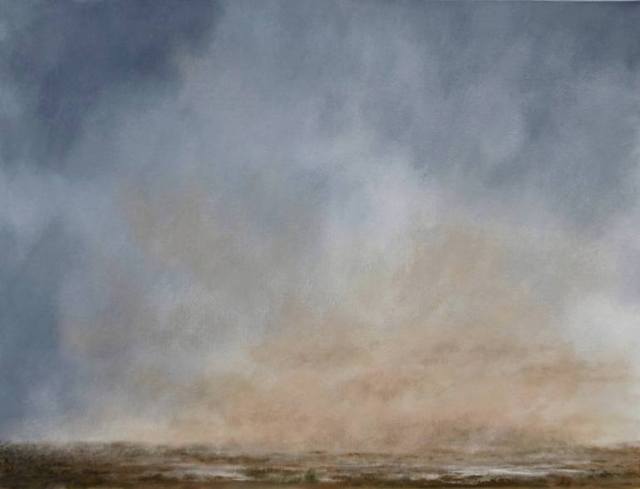
— Painting by Vandy Massey
 Haiku Commentary