
THE INTRUDER
You stole her computer, her jewelry, and her credit cards, and bought things from companies around the world.
Yes, they cleaned up the shattered glass you left behind. And they have a new alarm system now, with a fence that nobody can climb.
You too are bound by the laws of karma. I just hope the seeds of karma will soon be destroyed before they grow into a vast, criminal tree.
morning mist . . .
the prisoner’s breath lingers
above barbed-wire
– Jacob Salzer (USA)
(previously published Contemporary Haibun Online, January 2020)
This haibun (prose and haiku) starts with the worldly possessions of a person whom he loves. The computer, jewelry, and credit cards all show the signs of luxuries that a person possesses. The word ‘stole’ means that a person has either taken away all these luxuries or made her deprived of worldly comfort.
Having only shattered glass left behind indicates the mark of a broken relationship where there is nothing left. So, when someone enjoys worldly possessions by destroying others, their own life becomes more barren and destroyed as the analogy of seeds and trees in this haibun beautifully explains.
The morning mist reflects the confusion and chaos where there is no clear picture of what is right and what is wrong, and what is beyond the thick layer of mist that becomes a barrier. The prisoner’s breath could signify the efforts of an enslaved person who is so lost in worldly possessions and mundane life that they forget the consequences and put their life at stake. The barbed wire is another way of making a person conscious of their deeds whilst committing criminal activities.
Overall, the morning mist is like a ‘pleasure’, the prisoner’s breath is like their ego, and the barbed wire is their superego. The overall imagery of this haibun revolves around seeking pleasure by wrongdoings and eventually being caught up in the web of karma, where things that come around, go around. The pleasure principle takes a person to the verge of destruction where they lose their values, principles, and ethics, which destroys everything just to gain worldly wealth and temporary comfort. But when they get caught, they find themselves merely a sign of destruction.
The title of this haibun is quite intriguing as ‘intruder’ is any foreign or outer attraction that takes our focus away from the self, and we get lost into the luxuries of life until we achieve nothing.
– Hifsa Ashraf (Pakistan)
I like how this haibun is laid out into short paragraphs that are no longer than two sentences each. It makes the content easily digestible and stark.
It is interesting how Salzer creates a narrative with the wrongdoing being demonstrated in the prose and the result of that action in the haiku. A lot of times, haibun make a leap of subjects and do not necessarily create a plot. Both methods are viable and in the case of this haibun, it creates pathos.
The morning mist is free and travels where it wills. But with the prisoner, even their breath “lingers above the barbed-wire.” So, this could signify that the criminal in this story is locked away within and without.
With an eye of sound, it is intriguing to note that each paragraph of the prose begins with the letter “y.” Also, in the haiku, we have the alliteration of “m” and a strong string of “r” sounds. The letter “r” is hard and brings about the roughness of life in prison to the reader’s mind.
The meter of the haiku is also punchy and seems to reflect the violence of the criminal’s situation. Take the second line for example: the Prisoner’s Breath Lingers.
I feel that overall, Salzer conveyed a sense of remorse for both of the parties: the victim and the thief. An essential principle of haiku is to covey compassion, and this haibun is a fine example of this idea.
– Nicholas Klacsanzky (USA)

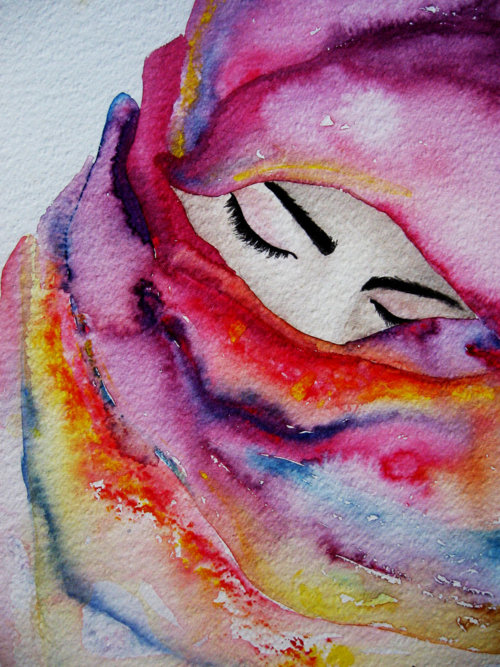
– Painting by Ria Hills

 Haiku Commentary